
O&D Is a Conditioning Program With a Leak
THE THEORY
Lumon's O&D department is not a manufacturing operation but a physical-conditioning curriculum, and its most portable artifacts, the pictogram cards, are already moving through an active internal smuggling channel financed by an unknown Lumon insider. Milchick's interrogation of Dylan and Petey's prior possession of breakroom footage confirm that security is tracking a recurring, institutionally understood breach pattern. Dylan did not initiate a crisis. He walked into the middle of one already in progress.
How This Theory Works
O&D's output is not a product line. It is a cover story with no articulable customer and no shared functional logic across its known artifacts. Burt cannot name who uses the hatchets or watering cans, offering only a speculation that the executive wing upstairs might be the recipient, a non-answer structurally identical to MDR's epistemic situation and therefore legible as a Lumon template rather than a department-specific explanation. Hatchets, watering cans, and pictogram cards share no manufacturing category, serve no named recipient, and generate no description that survives light pressure. When a department cannot say what it makes or who uses it, the visible output is not the real output. The incoherence is the argument.
The pictogram cards are the element that pulls O&D out of the administrative frame entirely. Viewers parsing the imagery have identified what appears to be a chokehold among the pictograms, a physical restraint technique with no relationship to craft production, artisanal assembly, or executive office supply. If the cards document what they appear to document, then at least one department on the severed floor is training workers in something bodily. That reframes every other O&D artifact retroactively. Hatchets cease to be decorative and become consistent with a curriculum that runs from grip exercises to restraint technique. The cards are not art. They are a syllabus, and the syllabus is the most legible and portable piece of the conditioning program, which is precisely why it matters that they were already on an open table in a room MDR employees could enter.
Felicia's suppression reflex is the behavioral confirmation of what the cards suggest structurally. When Elizabeth begins to observe that the hatchets were not aggressive, Felicia shuts her down immediately. Elizabeth was not disclosing something she knew. She was approaching an inference that someone had been trained to intercept. The specific contour of the suppression matters: Felicia does not stop Elizabeth from mentioning hatchets. She stops her from characterizing their nature. That is a more sophisticated boundary than simple product-line secrecy. It means the information Lumon is protecting is not what O&D makes but what O&D's output implies about what O&D does. A department conditioned to police inferences about its own tools is a department whose tools mean something its workers are not permitted to articulate.
The theft itself reshapes when placed against Milchick's interrogation framing. When Milchick asks Dylan whether someone paid him to smuggle the pictogram card out, he is not testing a hypothesis. He is checking Dylan against a known mechanism. That phrasing implies prior incidents, institutional memory of a payment structure, and an active internal search for whoever at Lumon is financing the outflow. Petey's prior possession of breakroom footage confirms the pattern has history. Two severed employees, two separate incidents, two categories of restricted material moving outward, points toward a breach channel Lumon is trying to close rather than isolated acts of individual defiance. Cobel pursues Reghabi as the external node. Milchick hunts for the internal coordinator. Both investigations are closing on the same channel from opposite ends.
But the most consequential detail is the one the show leaves unresolved: the pictogram cards were already sitting on an open table in a space MDR could access before Dylan arrived. Dylan did not breach a sealed container. He walked into a room where operationally sensitive material had already been moved across departmental lines Lumon publicly enforces. Someone upstream of Dylan had already made that transfer, which means the internal coordinator Milchick is hunting was already operational. The severance protocol, the mechanism Lumon built to keep its workers epistemically blind, is precisely the architecture an inside operator working at the outie level would need. The institution's workers cannot carry knowledge across the boundary. The institution's own design is the exploit. Dylan did not open anything. He walked through a door that was already ajar, and Milchick's question confirms that security knew the door existed long before Dylan stepped through it.
Is this theory convincing?
Key Evidence
Burt Cannot Explain O&D Output
When MDR asks what O&D makes, Burt can only speculate that the items might supply the executive wing upstairs, offering no definitive purpose for the hatchets or watering cans.
Felicia Silences Elizabeth's Slip
When Elizabeth says 'the hatchets weren't aggressive,' Felicia immediately shushes her, suggesting O&D workers have been conditioned to avoid discussing the nature of their output.
Dylan Pockets Pictogram Card
Dylan quietly slips one of the pictogram cards into his pocket before Milchick arrives, implying the card's content was unusual or significant enough to warrant concealment.
No Shared Function Across Items
The known O&D outputs, hatchets, watering cans, and pictogram cards, share no obvious product category or functional relationship, undermining the idea that O&D is a coherent manufacturing operation.
Lumon Conceals Purpose From Workers
Burt tells Mark that a lot is unknown to O&D as well but that the work is important, replicating the same epistemically sealed logic that keeps MDR from understanding its own refinement task.
Other Theories for S1E06
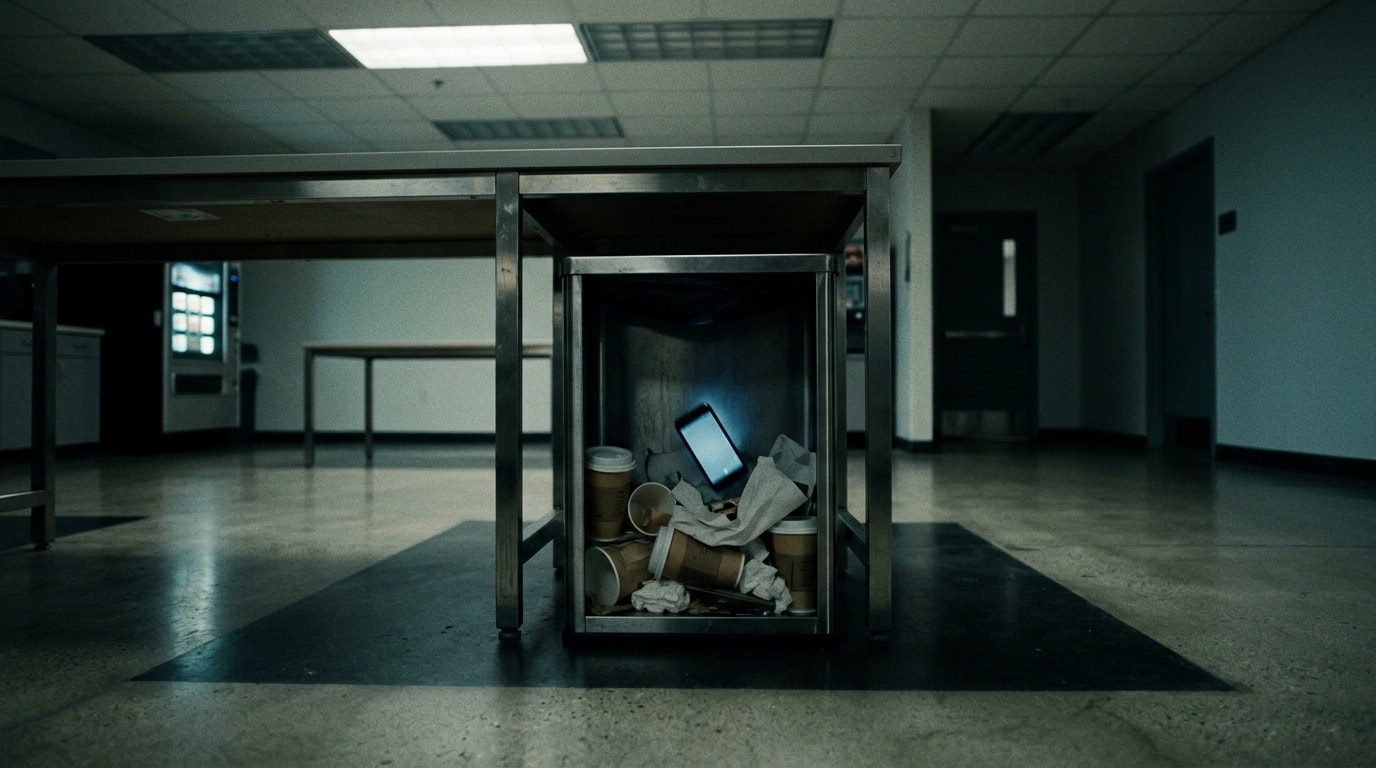
Mark Buries the Evidence to Bury Himself
Mark's outie is as much an obstacle to his own liberation as Lumon is, and the phone disposal proves it: he reviews the missed calls, understands what he is suppressing, and destroys the evidence anyway.
Cobel Serves Kier Before Lumon
Harmony Cobel's obedience to Lumon is conditional on her private judgment that the company remains aligned with Kier's true teachings, making her a theological agent using corporate power rather than a corporate loyalist who happens to be devout.

Mark's Disposal Signals Deliberate Evidence Burial
Mark's disposal of Petey's phone is not evidence destruction but a performance of it: the battery separation, the review of missed calls, and the return to his own curb all indicate someone staging closure while unconsciously ensuring the connection remains traceable.

Lumon Preempts Coordination It Cannot Survive
Lumon's control over its severed employees is not primarily maintained through surveillance and punishment but through designed attention fragmentation: every person with dangerous knowledge is simultaneously obligated to a local, pressing problem that prevents them from pooling that knowledge with anyone else.
Irving's Devotion Accidentally Drives Resistance
Irving's Kier-worship is not a cover for resistance but its accidental engine and its automatic suppressor: he breaches institutional isolation through doctrinal logic and then recants through the same logic, leaving Lumon's control intact.
Kier's Philosophy Condemns Lumon's Own Secrecy
Lumon's leadership did not fail to implement Kier's philosophy of 'illumination beyond all.
Dylan's Son Makes Him Lumon's Leverage
Dylan's innie is now structurally the most dangerous member of MDR, not the most compliant, because Lumon's documented leverage over him and his own radicalization were created by the same witnessed moment.

The Arteta Family Is Lumon's Proof of Concept: Capture Looks Like Friendship
Lumon's relationship with the Arteta family operates simultaneously at the macro level of Angelo's legislative advocacy and the micro level of Gabby's deliberate erasure of Devon, and both registers serve the same institutional function.