Irving's Devotion Accidentally Drives Resistance
THE THEORY
Irving's Kier-worship is not a cover for resistance but its accidental engine and its automatic suppressor: he breaches institutional isolation through doctrinal logic and then recants through the same logic, leaving Lumon's control intact. The show has not confirmed whether Irving's selective reading of Kier's doctrine reflects unconscious desire or genuine interpretive belief, but the distinction may not matter. Either way, his interior life has been shaped into a system that generates transgression and then punishes itself for it, requiring no external enforcement.
How This Theory Works
Irving's Kier-worship is the mechanism by which MDR breaches its isolation, and the same belief system that drives him toward collective inquiry will cause him to condemn that inquiry afterward. He does not frame the visit to O&D as resistance. He frames it as obedience. That distinction matters because it means Lumon's own mythology contains the seed of the interdepartmental contact Lumon is actively suppressing.
What the show has not confirmed is the more damaging possibility: that Irving is not a true believer who stumbled into subversion, but a man whose devotion has curdled into something he cannot name, and who uses doctrinal language precisely because it is the only grammar available to him for desires Lumon has not authorized. He reads company doctrine for permissions and gaps, as when he identifies that the handbook says nothing about lip-to-lip contact. If he has applied the same interpretive pressure to departmental structure, then the phrase 'as Kier intended' is not deference. It is a loophole he has identified and is using while remaining insulated from recognizing it as defiance. The Kier framework does not radicalize him. It launders him.
The sharpest evidence for this is the apology. After the team is caught, Irving calls himself a bad example as senior refiner, absorbing Cobel's punishment as confirmation that he was wrong. But the visit was his idea, and he justified it on doctrinal grounds. The apology is not humility. It is the self-correcting loop closing. The ideology that produced the transgression is now producing the recantation, which means Irving is not a resistance figure whose cover is piety. He is a figure whose interior life Lumon has colonized so thoroughly that the colony generates its own antibodies. The resistance he accidentally enables will be dismantled not by Lumon's enforcers but by Irving himself, in full sincerity, because sincerity is the trap.
Is this theory convincing?
Key Evidence
Irving's 'Kier Intended' Justification
Irving tells Dylan, Helly, and Mark he wants to return to O&D immediately with all of them, explicitly justifying the move by saying he wants to unite the departments as Kier intended.
Doctrine as Permission, Not Rebellion
Irving frames the interdepartmental visit as a doctrinal obligation rather than an act of defiance, suggesting his Kier-worship provides a framework within which collective action becomes ideologically sanctioned.
Irving's Senior Refiner Apology
After the team is caught in the hallway, Irving apologizes and says he has been setting a bad example as senior refiner, framing his own doctrinal initiative as a personal failure.
Handbook's Gap on Physical Contact
Irving notes to Burt that the handbook says nothing about lip-to-lip contact, demonstrating a pattern of reading company doctrine for gaps and permissions rather than simply following its surface prohibitions.
Activist Shift From Strict Rule-Follower
Irving, previously known for strict handbook adherence, takes on a leadership role to push for interdepartmental unity, suggesting his devotion to Kier has evolved into a more action-oriented posture.
MDR's Hallway Privileges Revoked
Cobel revokes MDR's hallway privileges as direct punishment for the O&D visit, confirming that Lumon views Irving's doctrinally-framed initiative as a genuine threat to institutional control.
Other Theories for S1E06
Mark Buries the Evidence to Bury Himself
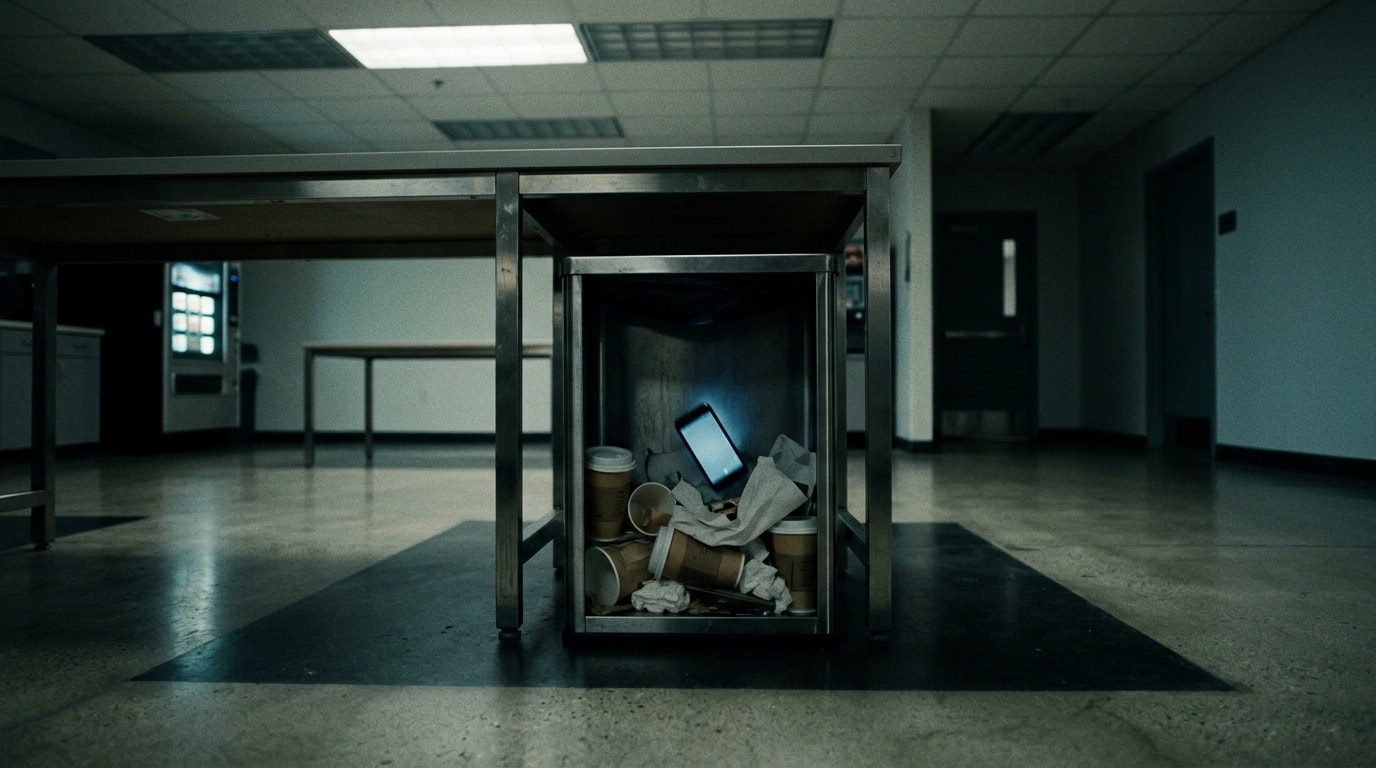
Mark's outie is as much an obstacle to his own liberation as Lumon is, and the phone disposal proves it: he reviews the missed calls, understands what he is suppressing, and destroys the evidence anyway.
Cobel Serves Kier Before Lumon
Harmony Cobel's obedience to Lumon is conditional on her private judgment that the company remains aligned with Kier's true teachings, making her a theological agent using corporate power rather than a corporate loyalist who happens to be devout.

Mark's Disposal Signals Deliberate Evidence Burial
Mark's disposal of Petey's phone is not evidence destruction but a performance of it: the battery separation, the review of missed calls, and the return to his own curb all indicate someone staging closure while unconsciously ensuring the connection remains traceable.

Lumon Preempts Coordination It Cannot Survive
Lumon's control over its severed employees is not primarily maintained through surveillance and punishment but through designed attention fragmentation: every person with dangerous knowledge is simultaneously obligated to a local, pressing problem that prevents them from pooling that knowledge with anyone else.
Kier's Philosophy Condemns Lumon's Own Secrecy
Lumon's leadership did not fail to implement Kier's philosophy of 'illumination beyond all.
Dylan's Son Makes Him Lumon's Leverage
Dylan's innie is now structurally the most dangerous member of MDR, not the most compliant, because Lumon's documented leverage over him and his own radicalization were created by the same witnessed moment.

The Arteta Family Is Lumon's Proof of Concept: Capture Looks Like Friendship
Lumon's relationship with the Arteta family operates simultaneously at the macro level of Angelo's legislative advocacy and the micro level of Gabby's deliberate erasure of Devon, and both registers serve the same institutional function.
O&D Is a Conditioning Program With a Leak
Lumon's O&D department is not a manufacturing operation but a physical-conditioning curriculum, and its most portable artifacts, the pictogram cards, are already moving through an active internal smuggling channel financed by an unknown Lumon insider.