
Mark's Disposal Signals Deliberate Evidence Burial
THE THEORY
Mark's disposal of Petey's phone is not evidence destruction but a performance of it: the battery separation, the review of missed calls, and the return to his own curb all indicate someone staging closure while unconsciously ensuring the connection remains traceable. The deliberateness of the act points not to a man protecting himself from Lumon but to a man who cannot fully commit to severing his last link to what Petey was trying to tell him. Mark disposes of the phone at his own address because some part of him is not finished with it.
How This Theory Works
Mark is not trying to escape detection. He is trying to preserve the appearance of having tried to escape detection. The battery separation, the review of missed calls before discarding, the reversal back to his own curb rather than a distant location: none of this is the behavior of someone who genuinely wants evidence destroyed. It is the behavior of someone staging destruction while leaving the object recoverable.
The sharpest unspoken truth the theory approaches but does not commit to is this: Mark already knows, at some level, that he does not want Petey's information gone. He stored the phone in his basement rather than discarding it immediately after Petey's death. He reviews the missed calls before disposal, which means he is not avoiding the information, he is memorizing it one final time. The battery separation is technically degrading but functionally symbolic. It is a ritual of closure performed by someone who has not closed anything. The disposal is directed inward, not outward. Mark is not protecting himself from Lumon. He is performing protection for himself, because he cannot yet admit he wants to keep the connection open.
The address confirms this. A person genuinely burying evidence does not use their own residential trash can after backing up to it in deliberation. They drive somewhere else. Mark does not. The phone is placed where it will be collected by services tied to his name, at a location permanently associated with him. Whatever cover this disposal is meant to provide, Mark has ensured it provides none. He has not buried the evidence. He has filed it.
Is this theory convincing?
Key Evidence
Battery and Phone Discarded Separately
Mark disassembles the phone and throws the battery and the phone body into the trash as separate objects, a deliberate action that goes beyond simply discarding the device.
Mark Reviews Missed Calls First
Before disposing of the phone, Mark retrieves it from his basement and looks at the missed calls on the screen, indicating he is aware of the communication history and choosing to destroy it rather than act on it.
Car Reversal Before Disposal
Mark drives partway down the street, then backs up to his own trash can to throw the phone away, suggesting a moment of deliberation about the act he is committing rather than an impulsive discard.
Phone Hidden in Basement Prior
Mark had stored Petey's phone in his basement rather than discarding it immediately after Petey's death, indicating he held onto it consciously before deciding to destroy the evidence.
Disposal at His Own Address
Despite the apparent intent to cover his tracks, Mark disposes of the phone in his own residential trash can rather than at a neutral or distant location, suggesting the disposal is incomplete or performative.
Other Theories for S1E06
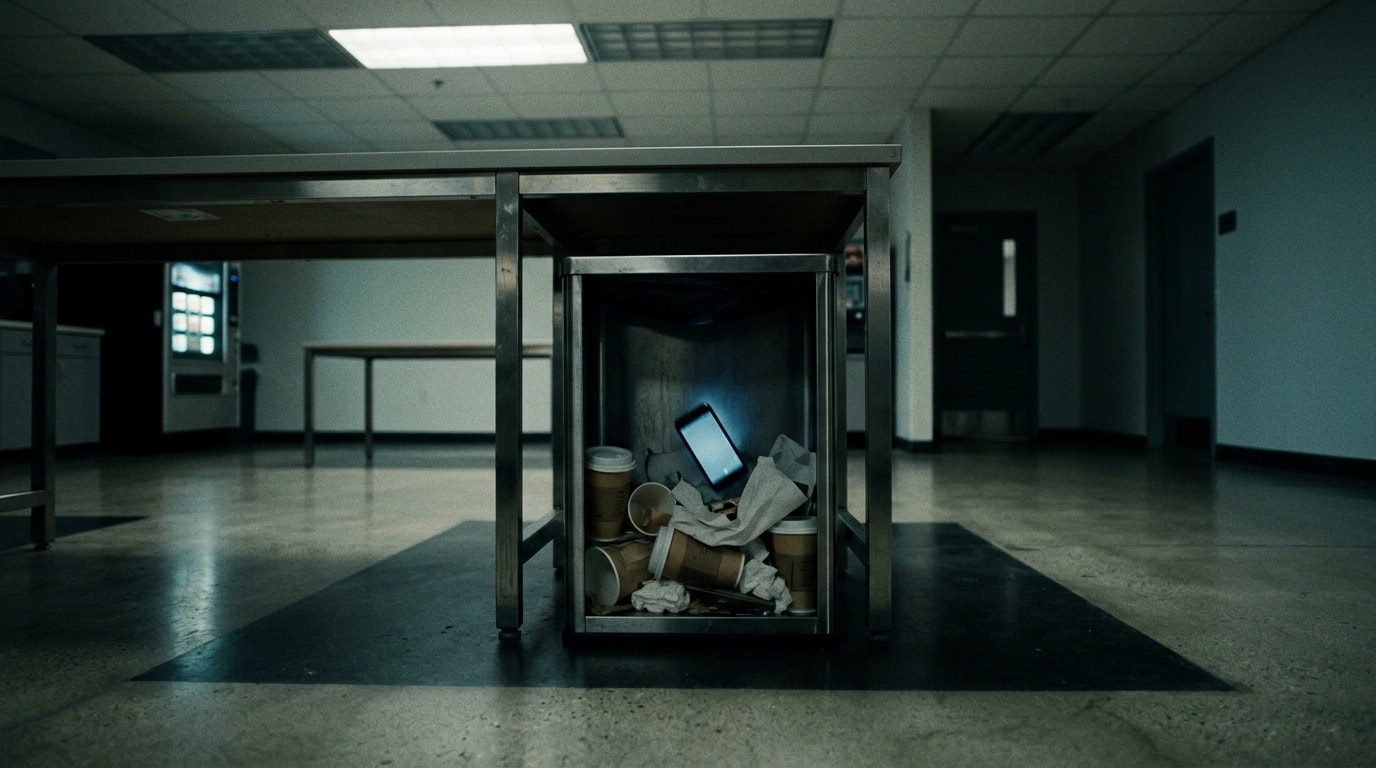
Mark Buries the Evidence to Bury Himself
Mark's outie is as much an obstacle to his own liberation as Lumon is, and the phone disposal proves it: he reviews the missed calls, understands what he is suppressing, and destroys the evidence anyway.
Cobel Serves Kier Before Lumon
Harmony Cobel's obedience to Lumon is conditional on her private judgment that the company remains aligned with Kier's true teachings, making her a theological agent using corporate power rather than a corporate loyalist who happens to be devout.

Lumon Preempts Coordination It Cannot Survive
Lumon's control over its severed employees is not primarily maintained through surveillance and punishment but through designed attention fragmentation: every person with dangerous knowledge is simultaneously obligated to a local, pressing problem that prevents them from pooling that knowledge with anyone else.
Kier's Philosophy Condemns Lumon's Own Secrecy
Lumon's leadership did not fail to implement Kier's philosophy of 'illumination beyond all.
Irving's Devotion Accidentally Drives Resistance
Irving's Kier-worship is not a cover for resistance but its accidental engine and its automatic suppressor: he breaches institutional isolation through doctrinal logic and then recants through the same logic, leaving Lumon's control intact.
Dylan's Son Makes Him Lumon's Leverage
Dylan's innie is now structurally the most dangerous member of MDR, not the most compliant, because Lumon's documented leverage over him and his own radicalization were created by the same witnessed moment.

The Arteta Family Is Lumon's Proof of Concept: Capture Looks Like Friendship
Lumon's relationship with the Arteta family operates simultaneously at the macro level of Angelo's legislative advocacy and the micro level of Gabby's deliberate erasure of Devon, and both registers serve the same institutional function.

O&D Is a Conditioning Program With a Leak
Lumon's O&D department is not a manufacturing operation but a physical-conditioning curriculum, and its most portable artifacts, the pictogram cards, are already moving through an active internal smuggling channel financed by an unknown Lumon insider.