
Lumon Preempts Coordination It Cannot Survive
THE THEORY
Lumon's control over its severed employees is not primarily maintained through surveillance and punishment but through designed attention fragmentation: every person with dangerous knowledge is simultaneously obligated to a local, pressing problem that prevents them from pooling that knowledge with anyone else. Mark Scout's two-front defiance is inadvertently stress-testing this architecture, and Lumon's responses are confirming the design with each move it makes against him.
How This Theory Works
The sharpest way to read Lumon's institutional structure is not as a punishment apparatus but as a coordination-prevention machine. The Cobel-Devon overlap makes this visible. Devon is already searching, already circling Lumon's operations from outside the building through articles linking Angelo Arteta to the severance legalization fight. At the exact moment her search gains traction, Cobel materializes inside her home as a lactation consultant, without Devon's knowledge or consent. The precision of that placement is not monitoring after the fact. It is preemptive redirection, already inside Devon's search before Devon knows she is being watched. Lumon does not need to catch people after they find something dangerous. It needs to ensure the search never reaches the moment of combination, when one person's partial knowledge meets another's and the gap closes.
Dylan's undetected theft of the pictogram card completes the other half of the mechanism. Nobody catches him. Cobel does not intercept the card. What this reveals is that Lumon's architecture does not require real-time detection of every private act, because real-time detection is not the point. Dylan now has a private project that exists entirely outside anyone else's awareness, including Cobel's. Cobel is managing Devon. Graner is running a parallel pursuit of Reghabi. The MDR team is being escorted back to their floor. Each search is isolated from every other search. The company's power does not come from omniscience. It comes from guaranteeing that no one, at any level, ever accumulates enough simultaneous bandwidth to see the full picture. Dylan's stolen card is not an escape from this system. It is the system working exactly as designed, giving him a private stake that keeps his attention local and bounded.
Mark's innie is, knowingly or not, attacking the specific vulnerability this architecture is designed to protect. When he demands that Cobel explain what his actual job is, he is refusing the foundational contract of the severance arrangement, which depends on innies accepting that meaningful answers are not theirs to seek. Cobel's response is immediate and instructive: she deploys the Break Room rather than answering. This is not a counter-argument. It is a confession that no sanctioned answer could survive scrutiny. MDR now has direct, witnessed evidence that the institution's only tool for an innie who stops complying is force. No explanation follows the punishment. No persuasion is attempted alongside it. The Break Room, used here as escalation rather than correction, reveals that Lumon has nothing left once compliance is refused. Mark has handed his team a rhetorical template that requires no restricted information to replicate, only the willingness to turn Lumon's own declared principle of illumination beyond all against its operational secrecy.
The O&D walk sharpens this into a collective threat. When Mark leads his entire team down a revoked hallway, he converts a private grievance into a public test of enforcement. Lumon intercepts the group, but passing that test costs the institution something it cannot recover through the Break Room: MDR now knows what enforcement looks like, and they watched it happen together. In the O&D storeroom, Mark articulates the organizing logic explicitly. Multiple departments, each operating in ignorance of the others, may collectively understand more than any one of them does alone. This is not a guess or an intuition. It is a structural observation about Lumon's information architecture. Elizabeth's mention of hatchets, quickly suppressed by Felicia, confirms that O&D is already producing output whose purpose neither department can account for, and that self-censorship under pressure is already normalized. Burt's agreement to pursue unsanctioned goat department contact signals that O&D has arrived at the same suspicion MDR carries: the departments' outputs interlock in ways Lumon has specifically designed them not to see.
The near-instantaneous failure of the Burt plan is where the theory's sharpest finding emerges, and where both fronts converge. Milchick arrives to dissolve the interdepartmental contact almost immediately after Burt proposes it. Cobel removes Mark from the floor before the episode closes. The speed is the evidence. If Lumon's monitoring is thorough enough to neutralize a plan at the moment of its formation, before a single unsanctioned communication reaches the goat department, then the innies are not simply being kept ignorant of their work's purpose. The act of deciding to find out is itself being intercepted. This is a qualitatively different form of control than the informational blackout the innies already understood themselves to be operating under. They knew they were kept in the dark. What the Burt plan's failure reveals is that the moment they reached for a light switch, someone was already watching the hand. Mark has now measured the architecture he is fighting, and the measurement was accomplished through the act of being stopped.
Cobel's escalating response makes full sense only when read against the Petey precedent she is already tracking. Petey reintegrated, asked real questions, was hunted, and died. Mark is now replicating the early behavioral signature Lumon already has on file as the precursor to that outcome. The Break Room, in this context, stops functioning as a disciplinary instrument and starts functioning as a delay, not time to correct Mark, but time to decide how long the institution can afford to let him continue before making the same decision it made about Petey. What Cobel is managing is not the O&D walk or the Burt alliance in isolation. It is the combination: an innie who has taught his team how to ask the question Lumon cannot answer, operating inside a surveillance architecture whose totality the innies are now, through the failure of the Burt plan, beginning to measure from the outside in.
Is this theory convincing?
Key Evidence
Mark Demands Job Explanation From Cobel
Mark directly asks Cobel what his actual job is during their confrontation, refusing to accept her authority without explanation, a direct challenge to the informational hierarchy Lumon depends on.
MDR Walks Hallway After Revocation
Despite being told hallway privileges are revoked, Mark leads his entire team to O&D, transforming a passive grievance into an act of deliberate institutional disobedience.
Break Room As Escalation Signal
Cobel's immediate use of the Break Room in response to Mark's defiance reveals that Lumon has no persuasive answer for an innie who refuses compliance, defaulting instead to punishment.
Mark Defends Ms. Casey Directly
Mark tells Cobel that if anyone should face the Break Room, it should be him rather than Ms. Casey, explicitly volunteering himself for punishment and demonstrating a willingness to absorb institutional cost.
Outie Confidence On Date With Alexa
Mark's outie displays increased openness and social ease during his date with Alexa, naming Gemma directly and holding emotional weight without deflection, suggesting a psychological posture consistent with his innie's growing assertiveness.
Mark Challenges Lumon's Core Philosophy
In O&D, Mark asks why Lumon's stated principle of illumination beyond all does not extend to its own employees, turning the company's foundational rhetoric against its operational secrecy.
Other Theories for S1E06
Mark Buries the Evidence to Bury Himself
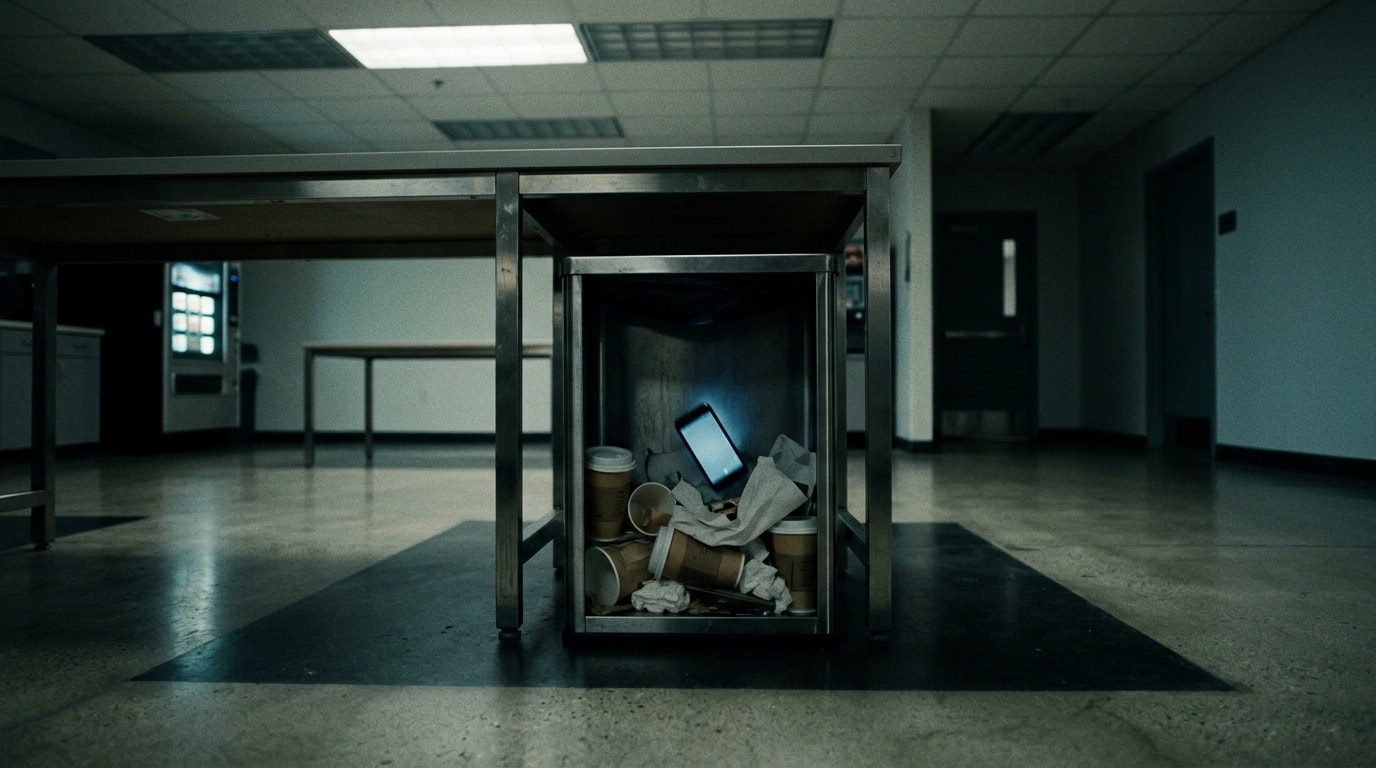
Mark's outie is as much an obstacle to his own liberation as Lumon is, and the phone disposal proves it: he reviews the missed calls, understands what he is suppressing, and destroys the evidence anyway.
Cobel Serves Kier Before Lumon
Harmony Cobel's obedience to Lumon is conditional on her private judgment that the company remains aligned with Kier's true teachings, making her a theological agent using corporate power rather than a corporate loyalist who happens to be devout.

Mark's Disposal Signals Deliberate Evidence Burial
Mark's disposal of Petey's phone is not evidence destruction but a performance of it: the battery separation, the review of missed calls, and the return to his own curb all indicate someone staging closure while unconsciously ensuring the connection remains traceable.
Irving's Devotion Accidentally Drives Resistance
Irving's Kier-worship is not a cover for resistance but its accidental engine and its automatic suppressor: he breaches institutional isolation through doctrinal logic and then recants through the same logic, leaving Lumon's control intact.
Kier's Philosophy Condemns Lumon's Own Secrecy
Lumon's leadership did not fail to implement Kier's philosophy of 'illumination beyond all.
Dylan's Son Makes Him Lumon's Leverage
Dylan's innie is now structurally the most dangerous member of MDR, not the most compliant, because Lumon's documented leverage over him and his own radicalization were created by the same witnessed moment.

The Arteta Family Is Lumon's Proof of Concept: Capture Looks Like Friendship
Lumon's relationship with the Arteta family operates simultaneously at the macro level of Angelo's legislative advocacy and the micro level of Gabby's deliberate erasure of Devon, and both registers serve the same institutional function.
O&D Is a Conditioning Program With a Leak
Lumon's O&D department is not a manufacturing operation but a physical-conditioning curriculum, and its most portable artifacts, the pictogram cards, are already moving through an active internal smuggling channel financed by an unknown Lumon insider.