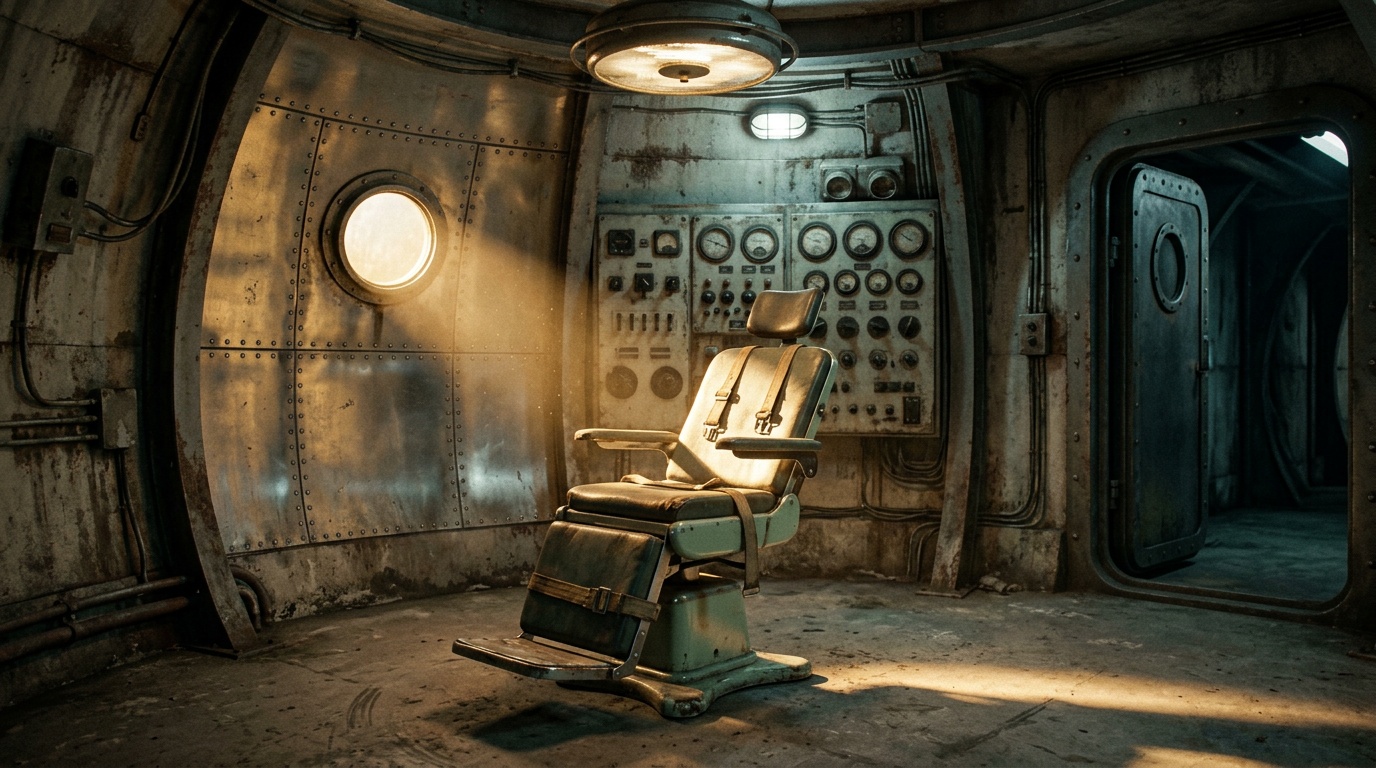
Vault 33 Was Never a Shelter — It Was a Laboratory With a Cover Story
THE THEORY
House's 2077 black-box experiment was not abandoned when Bill's brain failed under amplified signal — it was institutionalized. The vault system, specifically Vault 33, provided Hank MacLean with a decades-stable civilian cover from which to solve the exact signal-tolerance failure House documented before the bombs fell. The people inside that vault were never survivors to be protected; they were the most convenient captive research population the program had ever produced.
How This Theory Works
The 'market research' framing House uses when he injects the black box into Bill's neck is not irony or deflection — it is institutional language, the kind that requires prior approval, project nomenclature, and a chain of reporting. House does not discover what the device does during this scene. He confirms it. Bill picks up the bat, beats two men to death on instruction, and House's reaction to that outcome reads as validation rather than surprise. The experiment was already structured. What the field test needed was a failure mode, and Bill's resistance provided one.
The critical diagnostic moment is what House does the instant Bill begins to resist. He does not withdraw the device or accept the result as a ceiling. He increases the signal. That is not improvisation — it is a correction drawn from an established protocol, applied immediately and with precision. The failure that follows, Bill's skull detonating under the amplified output, is not the experiment going wrong. It is the experiment identifying its remaining problem: a fatal signal-tolerance threshold that the technology had not yet learned to respect. House retrieves the black box from the aftermath. The device survives the test. His closing line — 'the world may end, but technology will continue to advance' — is not philosophical resignation. It is a project status update delivered to no one, because no one else needs to hear it yet.
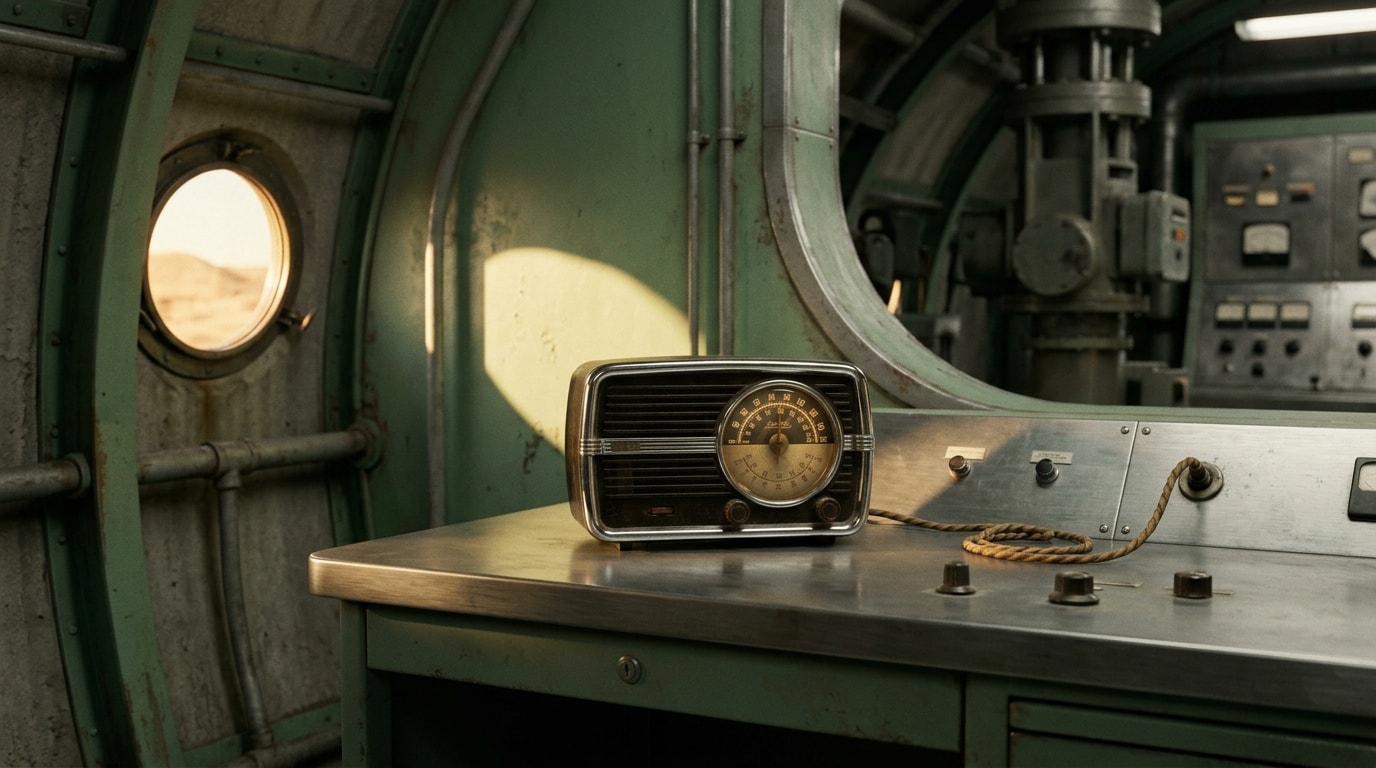
Hank MacLean is where the project update gets delivered. Hank's recorded message from the Vault-Tec research facility is the most precise piece of evidence connecting the pre-War experiment to its post-War continuation. He identifies himself by full name, states that nobody involved technically knows he is present, and describes his function as integrating the technology. That language — the formality, the operational invisibility, the upward report to an unnamed superior — is not the behavior of a rogue overseer or an improvising survivor. It is the behavior of an embedded asset executing a deniable field mandate. The secrecy is structural, not incidental. His changed appearance on the surface signals the shift from administrative cover to active laboratory mode. Vault 24's test subject, a wastelander who died from the same category of fatal brain failure that killed Bill, confirms what phase of the program Hank is currently running: he is closing the gap between House's 2077 prototype and a version of the device that does not destroy its subject.
Vault 33's function within this architecture becomes coherent once Hank's mission is accepted as real. A long-term covert research mandate requires a cover identity stable enough to last decades, immune to the social volatility of the surface, and plausible enough that the people inside it never question whether they are the point of the operation or merely its context. Vault 33 provided all of that. Lucy and Norm MacLean did not grow up in a shelter. They grew up inside an asset's legend — a constructed domestic reality whose function was to keep Hank administratively legible, emotionally anchored, and operationally invisible for as long as the work required. The residents of Vault 33 were not incidental to the program. Their proximity to Hank was always the reason they were there.
New Vegas and the vault system are parallel completion tracks for the same pre-War program, not separate projects. The Securitron surveillance network, the casino economy that channels every resident's behavior through systems House controls entirely, the architecture that makes compliance the path of least resistance for anyone inside it — none of this required House to perfect skull-mounted behavioral override unless the goal was never purely observational. Bill's death in 2077 solved the signal-tolerance problem by identifying it. Hank's work at Vault 24 is solving it by iterating past it. What House built in New Vegas is the deployment environment that a functional version of the device will require: a dense, surveilled, economically captive population that never consented to be a test environment and has no institutional mechanism for discovering that it is one. The black box was the prototype. The vault was the incubator. New Vegas is where the experiment scales.
Is this theory convincing?
Key Evidence
Forcible Injection Framed as Research
House forcibly injects the black box onto Bill's neck against his will while calling it 'good old-fashioned market research,' revealing that the experiment was designed under institutional cover language rather than acknowledged as a weapon.
Bill Kills on Command
After the injection, Bill picks up the baseball bat placed in his hands and beats two of his friends to death on House's instruction, demonstrating that the device achieved full behavioral override of a resisting subject.
House Notices Resistance Immediately
House observes Bill beginning to resist the black box's effect and responds by increasing its signal power rather than withdrawing, indicating he recognized the resistance as a known failure mode with a known correction.
Device Retrieved After Subject Dies
After Bill's head explodes from the amplified signal, House retrieves the black box from the remains, treating the device as a continuing asset rather than discarding it with the failed subject.
Technology Survives All Ending
House concludes the experiment by stating 'the world may end, but technology will continue to advance,' framing the black box's development as a project that supersedes any civilizational collapse.
Pre-War House Controls Post-War City
The Ghoul tells Lucy that New Vegas survived because of one man, Robert House, establishing a direct line from the pre-War experimenter to the post-War technological sovereign of the Mojave.
Other Theories for S2E01
Cooper Knew Before the Bombs Fell
Cooper Howard knew the bombs were coming, said nothing to save anyone but his daughter, and failed even at that.
Cooper's Khan Vendetta Spans Two Centuries
Cooper Howard has spent two centuries in deliberate, recurring conflict with the Great Khans, not as an incidental consequence of wasteland survival but as a sustained vendetta he has chosen to maintain across multiple generations of tribal leadership.

Moldaver Sent Cooper to Kill House
Moldaver tasked Cooper Howard with assassinating Robert House, not merely spying on him, using his wife's cold-fusion deal as cover to place him inside House's orbit before the bombs fell.
House's Double Hides the Real Power
The bar scene does not reveal a security precaution House adopted under pressure.
Hank MacLean Reports In to Vault-Tec Command
Hank MacLean has been executing a coordinated Vault-Tec assignment, not fleeing one, and his radio check-in at a secret facility places him inside a chain of command that survived the war and is now pointing him toward Robert House's territory.
Vault-Tec Wired Americans to Become Communists
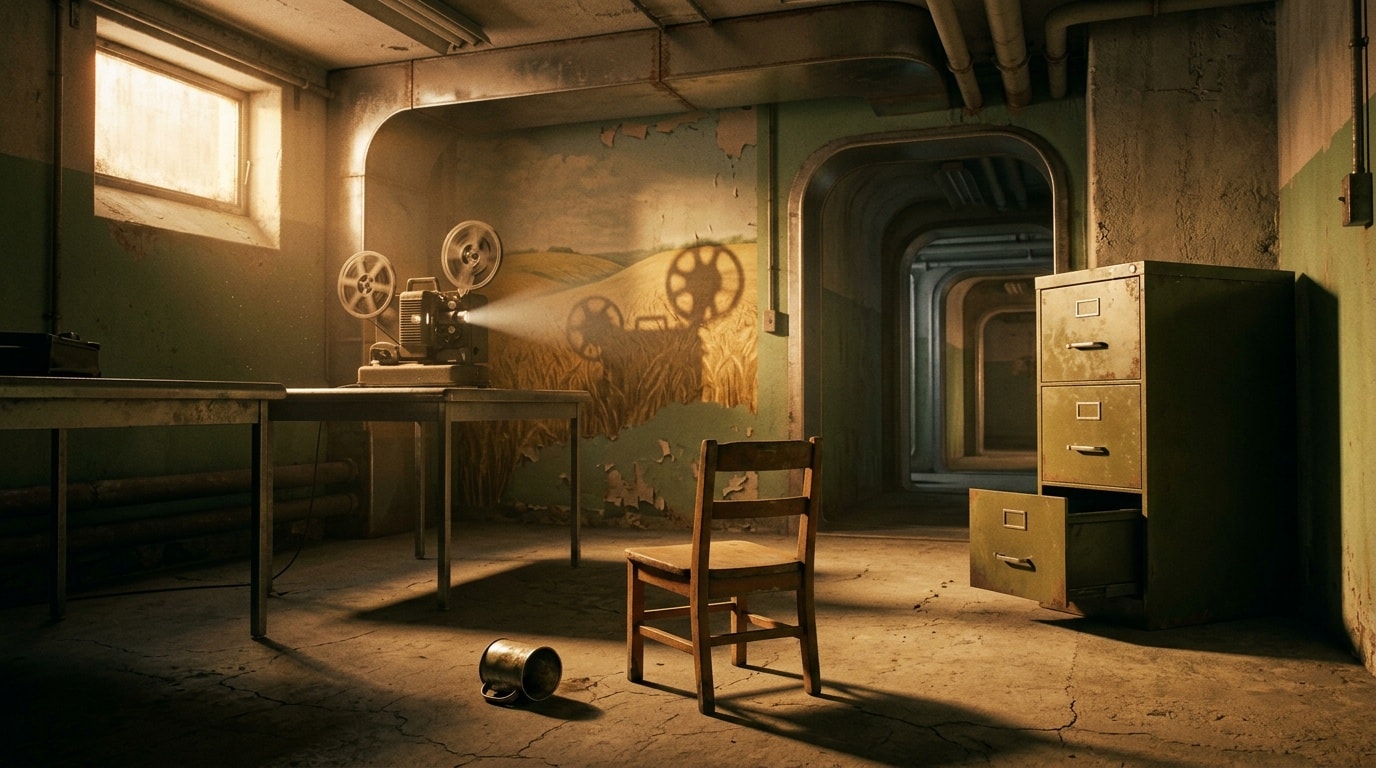
Vault-Tec used at least one vault to manufacture ideological enemies, not study them, implanting residents with neural control devices and forcing communist indoctrination as a deployable political asset rather than a behavioral science project.