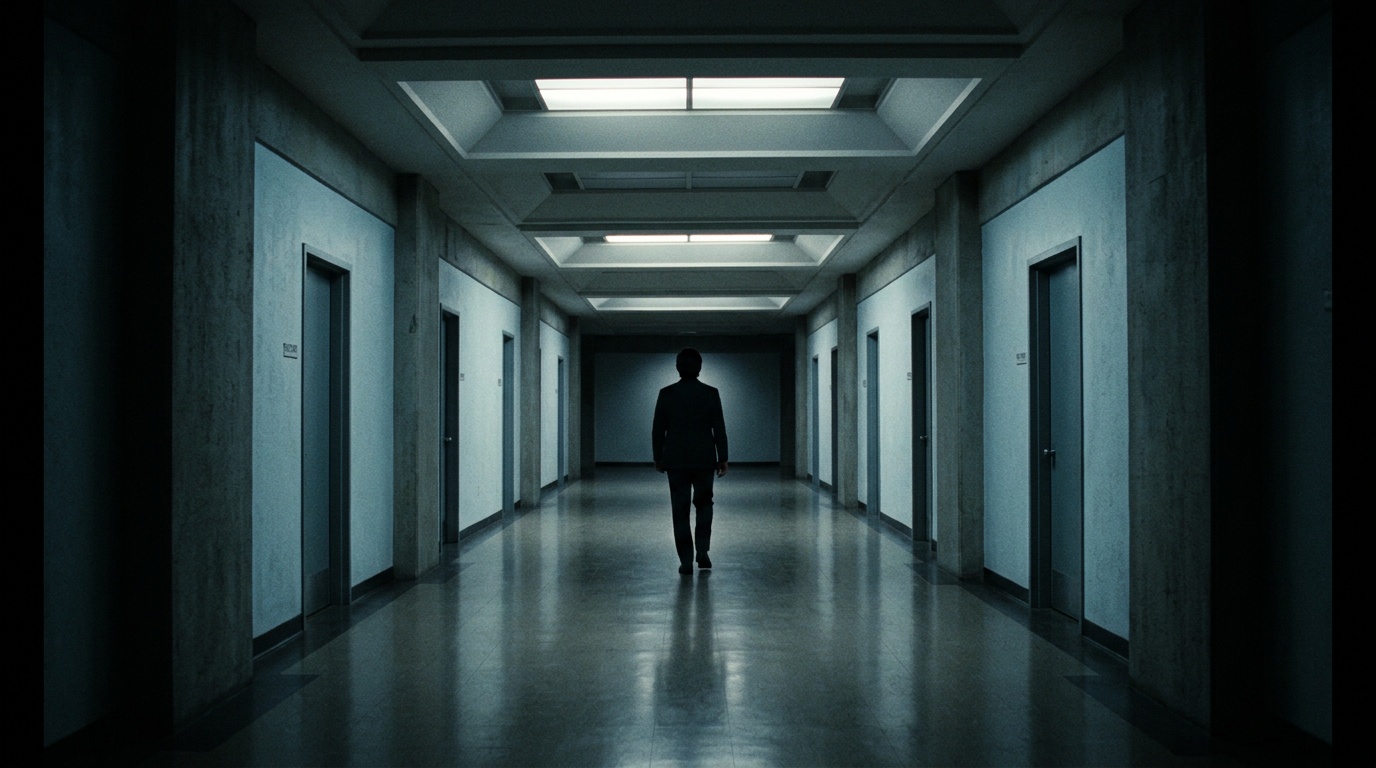
Lumon Uses Retreats to Expose Innies to Woe
THE THEORY
Woe is a literal entity Lumon has operational access to, and the outdoor retreat is a deliberate exposure mechanism designed to identify which innies can receive a visitation. The ban on the Fourth Appendix from the severed floor is not reverence but containment: it is the interpretive key that allows innies to name what they encounter. Irving, having heard the text read aloud and then walked alone into the dark, is now the first innie to hold both the experience and the framework simultaneously.
How This Theory Works
Woe is not a projection Irving's psychology manufactures under cold and isolation. She is a real entity Lumon has access to, and the outdoor retreat is the mechanism of exposure. What Irving experiences is not dream logic reaching for comfort. His innie knows one architecture: MDR. A mind seeking safety would produce that floor as refuge. Instead the floor appears surrounded by bare winter branches, and at a workstation inside it sits a figure conducting herself as a Lumon employee, typing, occupying the space as though assigned to it. The invaded familiarity is the argument. The intrusion does not originate from within Irving's psychology. It arrives from outside and chooses the one territory his severed self recognizes.
The structural parallel between Irving's experience and Kier's account is the sharpest piece of evidence the show offers. Kier commits a moral transgression, the death of his twin brother Dieter, then walks to the waterfall where Woe appears and tells him the fault is his. Irving commits a moral transgression of his own: he accuses Mark of desire, tells Helly her cruelty about Burt was unwarranted, alienates the group, and walks alone into the dark. He loses his torch. He falls asleep in the cold. He wakes at a workstation with a figure at another station nearby. The sequence is not coincidence and the show does not offer a mundane explanation for it. The Four Tempers are not allegory Kier employed to process grief. They are forces that respond to transgression by appearing, and the parallel structure of the two encounters confirms they are functioning literally within the narrative.
Milchick's campfire reading is not pastoral atmosphere. It is deliberate staging. The Fourth Appendix is described as so sacred it is forbidden on the severed floor, yet Milchick reads it aloud in the wilderness at night, immediately before the group disperses into darkness. That sequencing is a controlled operation. Lumon designed the retreat, controlled the isolation, chose the reading material, and set the conditions. Irving sleeping alone in the snow is not an accident the company failed to prevent. It is the outcome the retreat was constructed to produce. The question the outdoor setting answers is not which innies bond best with coworkers, but which innies receive the vision when the conditions are arranged correctly.
The most important and least obvious claim this theory presses concerns the specific function of the ban. The Fourth Appendix is not forbidden on the severed floor because it is too sacred for ordinary eyes. It is forbidden because it gives innies the framework to recognize what is already happening to them. The document describes the Tempers as literal forces that appear in response to moral failure. An innie who has experienced a visitation and then reads the Fourth Appendix can name what she encountered. An innie who has read the Fourth Appendix and then experiences a visitation can recognize it in the moment. Lumon's suppression apparatus is not reverence. It is containment of the interpretive key. The wilderness retreat dissolved that barrier for Irving specifically, by giving him the text first and then walking him directly into the exposure conditions. He is now the one innie who holds both the experience and the framework simultaneously, which makes him the figure Lumon's suppression architecture is most urgently designed to contain.
This reframes what Lumon is actually selecting for when it refines its innies. Refinement numbers and efficiency metrics measure compliance and labor output. The outdoor retreat measures something the standard apparatus cannot: a specific relationship to supernatural exposure. Irving's outie paints Lumon corridors without knowing why. His innie dreams of those corridors invaded by an entity from Lumon's founding text, during a retreat Lumon orchestrated, in conditions Lumon created. The company is sorting for employees who can receive a visitation without breaking, without remembering enough to act on it, and without access to the interpretive key that would let them name it. Whether Irving, having now crossed all three of those thresholds, can be contained by the standard tools is the question the show has not yet answered. It is also the more unsettling one, because Kier's claim to have tamed the Tempers in Scissor Cave may be the founding lie the entire suppression apparatus exists to protect.
Is this theory convincing?
Key Evidence
Irving's Forest Workstation Vision
Irving falls asleep alone in the snow after losing his torch, then wakes to find himself at a computer workstation that resembles the MDR setup, with a figure working at another station nearby.
Woe Appears to Kier at Waterfall
Milchick reads from the Fourth Appendix that after Kier caused Dieter's death, he walked to the waterfall where he 'first encountered Woe,' who told him Dieter's fate was his doing, framing Woe as a literal judgmental presence.
Irving's Transgression Precedes Vision
Irving accuses Mark of making love to Helly with his eyes while his wife rots, then tells Helly her cruelty about Burt was unwarranted, alienates the entire group, and walks alone into the dark immediately before his visitation experience.
Fourth Appendix Banned From Severed Floor
Milchick describes the Fourth Appendix as having such sanctity that it is forbidden on the severed floor, suggesting it contains content Lumon actively suppresses from innies, which raises the question of why Lumon chose to expose it here.
Tempers Tamed in Scissor Cave Origin
The Fourth Appendix locates Scissor Cave as the place where Kier tamed the Four Tempers for the first time, and the retreat leads the innies to this same location, suggesting the geography of the Tempers is being revisited with purpose.
Other Theories for S2E04
Helena Eagan Has Been Helly All Along
The person the MDR team has accepted as innie Helly throughout Season 2 is actually Helena Eagan, her outie, running an extended impersonation on the severed floor -- feeding information to Lumon management and using the retreat to surveil how far the group will go in defiance.
Grief Cannot Be Severed From the Body
The severance chip blocks information, but grief is not stored as information.

Kier Killed Dieter and Buried the Evidence
Kier Eagan murdered his twin brother Dieter and authored the Fourth Appendix as the sole surviving account, engineering a grotesque punitive myth that redirected culpability onto the victim.
Dieter Is Kier's Repressed Self, Not His Brother
Dieter Eagan was Kier's psychological projection, not his brother, a constructed figure through whom Kier could externalize and ritually destroy the desiring, undisciplined parts of himself that threatened his commercial identity.
Lumon's Retreat Is a Ritual Conviction System
The wilderness retreat in 'Woe's Hollow' is not a team-building exercise but a closed theological system designed to make innie defiance impossible to experience as morally neutral.

Irving's Outdoor Past Was Never Erased
Irving's innie is not protecting a secret he was told about but one that has crossed the severance barrier without his knowledge, surfacing as instinctive defensiveness rather than retrievable memory.
Helena Slept With Mark for Reasons She Cannot Name
Helena Eagan did not sleep with Mark to secure her cover.
Lumon's Small Lies Are the Big Control
Lumon's severance procedure does not just erase memory; it surgically removes the social and epistemic infrastructure through which employees could challenge any claim the company makes.