
Kier Killed Dieter and Buried the Evidence
THE THEORY
Kier Eagan murdered his twin brother Dieter and authored the Fourth Appendix as the sole surviving account, engineering a grotesque punitive myth that redirected culpability onto the victim. Woe's direct accusation, preserved inside the very document Kier controlled, names his agency explicitly, but the absurdist detail that surrounds it preempts any reading serious enough to act on that accusation. The severance program is not a productivity tool that borrowed religious language; it is the institutional re-enactment of that fratricide, structured to repeat what Kier did to Dieter at scale and across generations.
How This Theory Works
Kier Eagan is not a founder who mythologized a tragedy. He is a man who killed his brother, then spent his remaining hours constructing the only document that would survive him on the severed floor, a document no corroborating witness could contradict and that Lumon would ensure no severed employee could read without institutional supervision. The Fourth Appendix is a controlled confession, shaped by the one man with the most to gain from a particular version of events, and its most incriminating line is hiding in plain sight. Woe speaks to Kier from Dieter's eyes and says, 'This is your doing. Now he's no one's brother, only chaos' whore.' That is not an accusation Kier invented to enrich his mythology. It is the accusation he could not excise without destroying the document's spiritual authority, so he buried it instead, inside a narrative so grotesque that no reader would survive it with their skepticism intact.
The grotesque detail is the mechanism, not the content. An eye popping from a skull, hair falling in clumps, a body dissolving into the wilderness as divine punishment for masturbation: these are not the features of a credible historical record. They are the features of a morality tale engineered to preempt interrogation. Helly laughs immediately upon hearing it, without prompting, identifying the story as absurd before she has any framework to explain why. Her laughter is not a character beat. It is the theory's first confirmation. A doctrine constructed at that pitch of grotesquerie is also constructed at that pitch of immunity. The accusation Woe delivers is real; the packaging around it is designed to ensure no one takes the accusation seriously enough to follow it anywhere.
Milchick's response to the laughter makes the architecture explicit. He does not defend the text's internal logic, because the text's logic was never the point. He instructs Miss Huang to throw the marshmallows into the fire and tells the group that marshmallows are for team players and that people often laugh at what they don't understand. This is a loyalty evaluation dressed as pastoral correction. Comfort is made contingent on accepting Kier mythology without question. Skepticism is reclassified not as a legitimate critical response but as cognitive failure, evidence that the doubter lacks the spiritual seriousness to process what they were given. The marshmallows are trivial. The architecture behind their withdrawal is not. What Milchick is administering is not doctrine. It is a compliance test, and the workers who fail it have just identified themselves.
The psychological layer beneath the obedience theater is where the theory becomes most uncomfortable. Kier did not sacrifice Dieter out of grief or necessity. He discovered that he preferred his project to his twin, that Dieter's attachment made the Lumon vision impossible, and the appendix is the institutional mechanism by which that preference is laundered into virtue. Irving's vision of Woe at a workstation built like the MDR floor is the detail the argument cannot afford to leave unremarked. Woe does not appear in a painting or a handbook illustration or a historical reconstruction. She appears at a terminal identical to the ones the innies occupy every day. Lumon did not inherit Kier's guilt and set it aside as mythology. It operationalized it. The psychological force of guilt, the witness who named Kier's responsibility before he could reshape it into legend, is not archived. It is structurally active in the institution's present, built into the infrastructure of what Lumon actually does to people.
That is what the Fourth Appendix finally authorizes. Kier's walk toward the waterfall while Dieter cried out is a desertion, and Woe's Hollow is the site of a fratricide dressed as a spiritual encounter. The appendix renders that desertion as the founding event of Lumon's entire ideological system, which means every innie who internalizes the text is not merely accepting obedience. They are accepting that being unmade, being severed from the bonds that make a person recognizable to themselves, is what happens to people who deserved it. Milchick already knows what the text predicts about Mark and Helly. He is not a reader of the appendix. He is its enforcement. Kier purged Dieter for exactly the kind of attachment they are forming, and the retreat was not a reward. It was a classification event. The founding fratricide is wired into the operational doctrine of the severed floor, and every marshmallow withheld is a small rehearsal of what Kier did at the waterfall.
Is this theory convincing?
Key Evidence
Woe Accuses Kier Directly
Milchick reads from the handbook: Woe spoke to Kier from Dieter's eyes and said 'This is your doing. Now he's no one's brother, only chaos' whore,' placing direct responsibility for Dieter's fate on Kier.
Woe as Gaunt Supernatural Bride
The handbook describes Woe as a gaunt bride half the height of a natural woman, framing her as a distinct supernatural entity rather than a metaphor, consistent with Lumon's treatment of the tempers as real forces.
Dieter's Death Blamed on Masturbation
The handbook's official account attributes Dieter's physical dissolution to masturbation, a cover story so absurd it obscures whatever Kier actually did, with Milchick insisting every word is truth.
Marshmallow Punishment for Laughter
When Helly and Mark laugh at the Dieter story, Milchick burns the marshmallows and says the team he thought he knew would have processed more thoughtfully, signaling that the absurd mythology demands reverent submission, not scrutiny.
Retreat Set at Waterfall Crime Scene
Lumon specifically brought the team to the waterfall where Kier first encountered Woe and stood while Dieter died, framing the retreat destination not as reward but as a site of foundational guilt.
Irving Dreams of Woe at a Workstation
Irving, alone in the forest after walking away from camp, has a vision of Woe working at a computer station identical to the MDR floor, connecting the supernatural temper directly to Lumon's present-day operations.
Other Theories for S2E04
Helena Eagan Has Been Helly All Along
The person the MDR team has accepted as innie Helly throughout Season 2 is actually Helena Eagan, her outie, running an extended impersonation on the severed floor -- feeding information to Lumon management and using the retreat to surveil how far the group will go in defiance.
Grief Cannot Be Severed From the Body
The severance chip blocks information, but grief is not stored as information.
Lumon's Retreat Is a Ritual Conviction System
The wilderness retreat in 'Woe's Hollow' is not a team-building exercise but a closed theological system designed to make innie defiance impossible to experience as morally neutral.
Dieter Is Kier's Repressed Self, Not His Brother
Dieter Eagan was Kier's psychological projection, not his brother, a constructed figure through whom Kier could externalize and ritually destroy the desiring, undisciplined parts of himself that threatened his commercial identity.

Irving's Outdoor Past Was Never Erased
Irving's innie is not protecting a secret he was told about but one that has crossed the severance barrier without his knowledge, surfacing as instinctive defensiveness rather than retrievable memory.
Helena Slept With Mark for Reasons She Cannot Name
Helena Eagan did not sleep with Mark to secure her cover.
Lumon's Small Lies Are the Big Control
Lumon's severance procedure does not just erase memory; it surgically removes the social and epistemic infrastructure through which employees could challenge any claim the company makes.
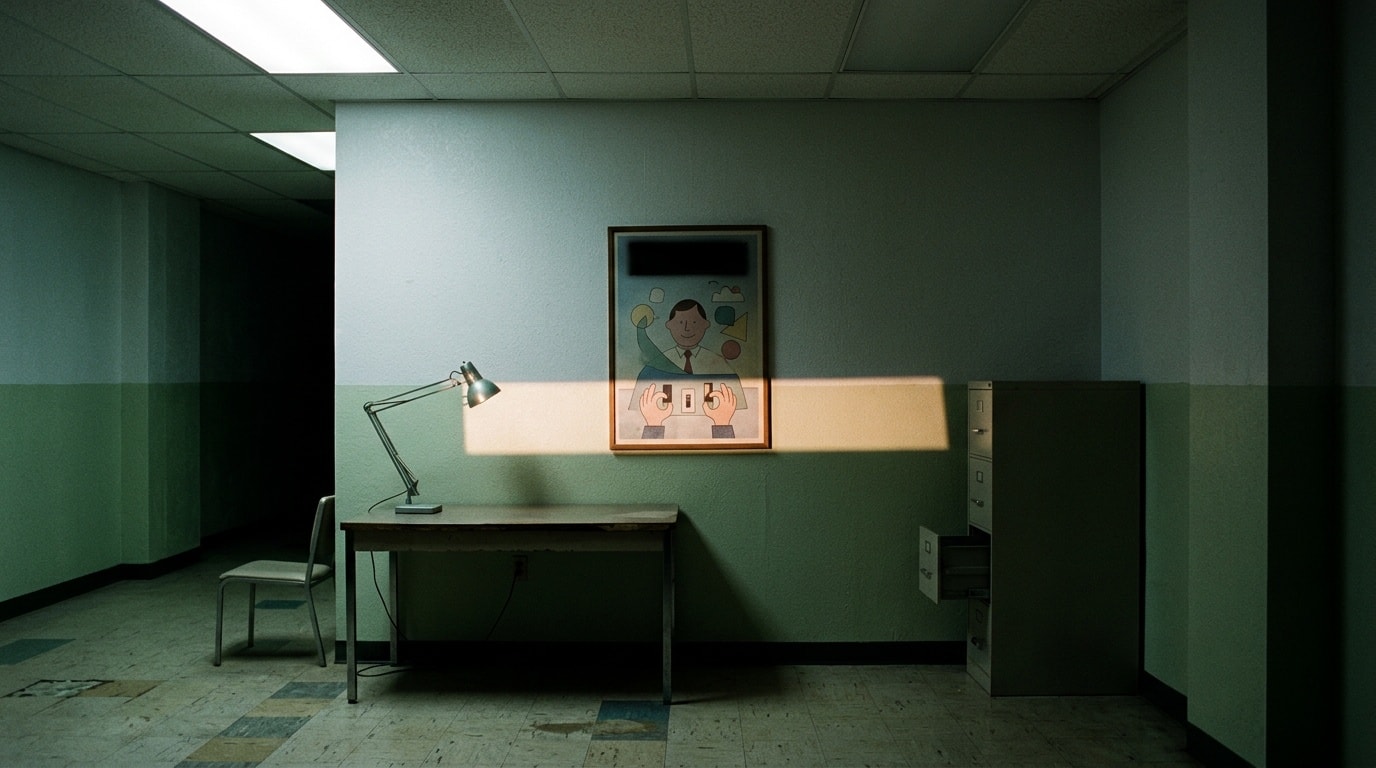
Irving's Farewell Encodes the Overtime Contingency
Irving's parting words to Dylan were a deliberate instruction keyed to a specific object: the break room motivational poster depicting Dylan holding the Overtime Contingency Protocol switches, captioned with that exact phrase.