Lumon's Retreat Is a Ritual Conviction System
THE THEORY
The wilderness retreat in 'Woe's Hollow' is not a team-building exercise but a closed theological system designed to make innie defiance impossible to experience as morally neutral. Costuming pre-assigns the innies as sinners and their handlers as righteous agents before a single doctrinal word is spoken, while doppelganger figures fill the conscience-void that severance created by substituting a controlled prosthetic for the self-witnessing faculty the innie no longer possesses. Together, the two mechanisms ensure that resistance is not merely punished after the fact but theologically pre-absorbed into Lumon's founding myth before it can be consciously named.
How This Theory Works
Severance does not merely divide a person. It amputates the faculty that makes conscience possible. Conscience requires a self that can observe itself from outside, the part of a person that watches, judges, and redirects. The innie, cut off from the outie who performs precisely that witnessing function, is left with no mechanism for moral reckoning. Lumon engineered this gap, and the retreat at Woe's Hollow exists to fill it with something Lumon can fully control. The two instruments of that control are the costume and the double, and they operate in sequence: the costume assigns moral identity before action occurs, and the double scripts whatever action follows into a pre-existing narrative of temptation and fall.
The costuming delivers its verdict silently and in advance. The MDR employees wear black throughout the outdoor retreat while Milchick and Miss Huang wear white, in cuts and styles otherwise nearly identical. This is not incidental wardrobe. The fourth appendix, retrieved during the retreat and explicitly forbidden on the severed floor, frames Woe's Hollow as the site of Kier's contest against human weakness, with the four tempers mapped onto four struggling figures. Within that framework, black does not connote neutrality. It carries the weight of the untamed, the rebellious, the spiritually unresolved. White signals those already aligned with Lumon's doctrinal authority. Lumon dressed the innies as sinners before they arrived, then walked them through a landscape designed to confirm the designation. Milchick's response to the campfire laughter is the sharpest confirmation that this framing is operationally live. When Helly and Mark laugh at the Dieter story, Milchick does not address them as employees breaking a protocol. He tells them the team he thought he knew would have processed more thoughtfully, then has Miss Huang throw the marshmallows into the fire as a spiritual sanction rather than a disciplinary one. The black outfits on the laughing innies and the white on the man withdrawing grace are the visual grammar of a congregation that has disappointed its priest.
The doppelganger figures are where the system deepens from costuming into something more invasive. Each figure looks like a specific team member and appears at the moment that member faces directional uncertainty on the path. This level of specificity is not improvised. It requires that Lumon already held a detailed psychological and physical model of each innie before the retreat began, assembled through the continuous observation that Lumon's architecture makes invisible. The retreat is not the moment of data collection. It is the confirmation run, the controlled diagnostic condition in which Lumon deploys what it already extracted and observes how each innie responds to a confrontation with their own image. Irving's accusation of Mark, Helly's surfaced shame about her outie self: these eruptions are the behaviors of people being provoked by a confrontation they cannot name. The doppelgangers elicit. They do not guide.
Milchick's statement at the waterfall is the load-bearing line that reveals the full architecture. He does not describe the doppelganger figures as safety personnel, environmental guides, or team-building props. He says Kier's twin was always with him, so Lumon provided each of them with the same. That sentence performs a precise transfer of theological logic. The twin relationship is a template, the Kier-Dieter bond is the prototype, and the doppelgangers are its corporate reproduction. The innie cannot reach the outie without collapsing the severance that makes the innie useful to Lumon. So Lumon builds a simulacrum of each innie standing outside the innie, raising an arm to indicate the correct direction, never speaking, never waiting to be consulted. This is conscience behavior, not companionship behavior. The figures direct and recede. But Dieter in Lumon theology is not merely a companion. He is the figure whose suffering Kier caused and then fled, the one Woe holds Kier accountable for. If Lumon has mapped the Kier-Dieter structure onto the innie-outie relationship, each doppelganger representing Dieter positions each innie as Kier: the dominant self whose choices the other self pays for entirely. The retreat does not allude to this myth loosely. Four doubles arrive simultaneously at the waterfall, one for each innie, at the mythological terminus of the founding story. That is choreography, not coincidence. The myth was not applied to the retreat after the fact. The myth was the blueprint.
The two systems interlock to close every available exit from the conviction they jointly impose. The costume marks defiance as transgression before it happens, assigning sinfulness as a pre-condition of the innie's identity on the retreat. The doppelganger then encodes whatever the innie does as a re-enactment of Kier's temptation narrative, absorbing even the impulse to resist into the founding story's structure. What Lumon achieves through their combination is confession without conscious consent. The innies walk Kier's path dressed as his four tempers, meet their Dieters at each waypoint, and arrive at the waterfall having symbolically accepted that their existence costs another self everything. Whether they consciously register that conclusion is precisely the question the show refuses to answer, and the refusal is the point. Lumon may not need the innies to understand what they just confessed to. The walk alone may be sufficient to install it.
Is this theory convincing?
Key Evidence
Milchick's Twin Justification at Waterfall
Milchick appears at the waterfall and explicitly states that because Kier's twin was always with him, Lumon provided each innie with the same, directly linking the doppelgängers to the Kier-Dieter twin mythology.
Four Figures Direct the Group
Throughout the retreat, figures resembling each of the four MDR members appear on cliffs and in the terrain, silently directing the group along Kier's path, matching Milchick's claim that the doubles function as companions in the same way Dieter accompanied Kier.
Fourth Appendix Twin Narrative
The fourth appendix, forbidden on the severed floor and retrieved during the retreat, tells of Kier and Dieter's journey together toward Woe's Hollow, establishing the twin bond as the founding myth the doppelganger exercise is designed to re-enact.
Retreat Designed Around Woe's Hollow Path
The entire retreat route retraces Kier and Dieter's journey step by step, with the doppelgängers appearing at each waypoint, suggesting the experience was engineered to map the innies onto the brothers' roles rather than simply exposing them to nature.
Other Theories for S2E04
Helena Eagan Has Been Helly All Along
The person the MDR team has accepted as innie Helly throughout Season 2 is actually Helena Eagan, her outie, running an extended impersonation on the severed floor -- feeding information to Lumon management and using the retreat to surveil how far the group will go in defiance.
Grief Cannot Be Severed From the Body
The severance chip blocks information, but grief is not stored as information.

Kier Killed Dieter and Buried the Evidence
Kier Eagan murdered his twin brother Dieter and authored the Fourth Appendix as the sole surviving account, engineering a grotesque punitive myth that redirected culpability onto the victim.
Dieter Is Kier's Repressed Self, Not His Brother
Dieter Eagan was Kier's psychological projection, not his brother, a constructed figure through whom Kier could externalize and ritually destroy the desiring, undisciplined parts of himself that threatened his commercial identity.

Irving's Outdoor Past Was Never Erased
Irving's innie is not protecting a secret he was told about but one that has crossed the severance barrier without his knowledge, surfacing as instinctive defensiveness rather than retrievable memory.
Helena Slept With Mark for Reasons She Cannot Name
Helena Eagan did not sleep with Mark to secure her cover.
Lumon's Small Lies Are the Big Control
Lumon's severance procedure does not just erase memory; it surgically removes the social and epistemic infrastructure through which employees could challenge any claim the company makes.
Irving's Farewell Encodes the Overtime Contingency
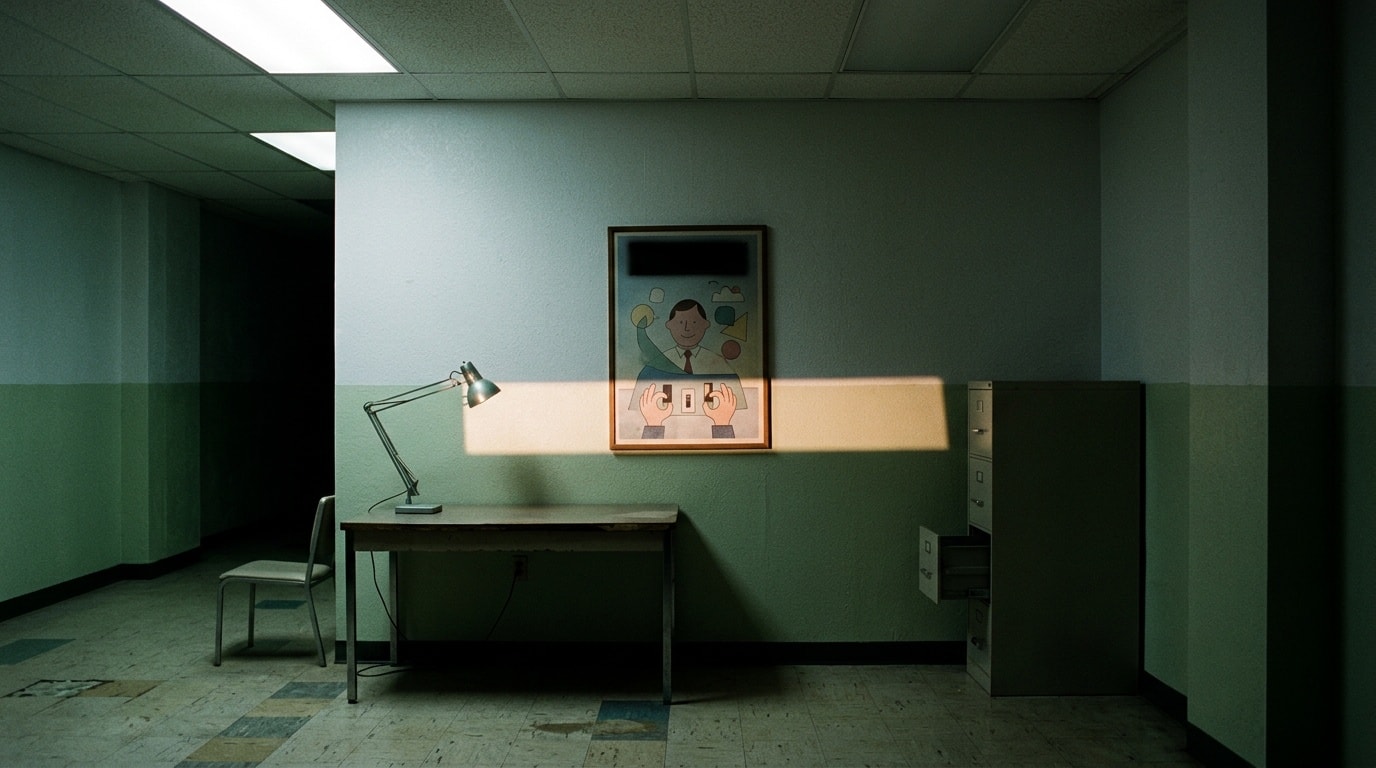
Irving's parting words to Dylan were a deliberate instruction keyed to a specific object: the break room motivational poster depicting Dylan holding the Overtime Contingency Protocol switches, captioned with that exact phrase.