The Woman Playing Helly Is Helena
THE THEORY
Helena Eagan has replaced her own innie on the severed floor, not as an assigned operative but as an act of motivated possession -- a need to control the version of herself that defected. The behavioral breaks are specific: she cannot replicate Helly R.'s physical ease with Mark because she knows the history without having lived it, and her warmth toward Irving is not Helly's register but Helena's idea of what a compliant innie should offer. Every move the MDR team makes in her presence is known to Lumon in real time, through the most intimate possible channel.
How This Theory Works
Helena Eagan is not performing her innie's role because she was ordered to. She is doing it because she wants to, and that distinction is the theory's sharpest edge. The behavioral failures -- the hallway hesitation with Mark, the mechanical warmth toward Irving -- are not the errors of a careless impersonator. They are the errors of someone who believes she understands her innie well enough to pass, and who is wrong. Helena has watched Helly R. from the outside through reintegration logs, behavioral reports, and outie surveillance. She knows the broad strokes. She does not know the texture. What she cannot simulate is embodied memory: the specific weight of having grabbed Mark, the specific irritation that made Helly R. sharp with Irving rather than soft. Helena's substitution is not cold espionage. It is something more unsettling -- an act of possession, driven by a need to control the version of herself that escaped her.
The Irving interaction is where that psychology surfaces most clearly. Helly R. was not a nurturer. She was antagonistic, rage-driven, and constitutionally hostile to Lumon's sentimental register. When this version of Helly offers Irving a steadying gesture, she is not approximating Helly -- she is approximating what Helena thinks a good innie would do. The warmth is not Helly's. It is Helena's idea of the role. That is a different kind of failure, and it points inward: Helena does not just want to surveil the MDR team. She wants to correct Helly R., to replace the version of herself that became a problem with one that behaves.
This reframes every scene she inhabits. She carries full outie knowledge while performing ignorance, which means the cognitive load of each interaction is asymmetric in ways her castmates cannot detect. Her awkwardness around Mark is not emotional distance -- it is the strain of managing information she cannot act on, about a relationship she has studied but not lived. The goat room search, presented as Mark and Helly working in parallel toward the same goal, is plausibly the opposite: a Lumon loyalist positioned inside the resistance's most trusted relationship, where no courier is needed because the surveillance is the person.
Is this theory convincing?
Key Evidence
Hallway Hesitation With Mark
When Mark and the person presenting as Helly share a charged moment in the hallway, she becomes awkward and hesitant rather than assertive, directly contradicting Helly R.'s established pattern of being the one who physically initiated their relationship.
Performed Warmth Toward Irving
This version of Helly offers Irving a warm, nurturing gesture when he expresses uncertainty about returning to O&D, a mode of support inconsistent with Helly R.'s established antagonistic and rage-driven personality.
Robotic Demeanor Across Interactions
Observers note an insincere, almost mechanical quality to her emotional responses across multiple interactions this episode, as though she is executing approximations of Helly's behavior rather than inhabiting it.
Unfamiliarity With Established Intimacy
Where original Helly grabbed Mark and kissed him without hesitation, the current version cannot navigate their physical proximity with anything resembling that prior ease, suggesting the memory of that intimacy may be absent or simulated.
Other Theories for S2E03
Lumon's Compliance Machine Built a Rival Husband
Lumon's family visitation protocol is a behavioral governance instrument, not a welfare accommodation, designed to convert emotional susceptibility into metered compliance.
Irving's Dreams Are a Map to the Exports Hall
Irving's outie has been painting a specific hallway that corresponds to a real location on the severed floor: the exports hall in Optics and Design.
Lumon's Loyalty Protocol Destroys What It Was Built to Preserve
Lumon's recanonized Kier paintings are a standardized loyalty protocol that instrumentalizes identity as recursive capture — transforming an employee's own self-image into the mechanism of their containment.
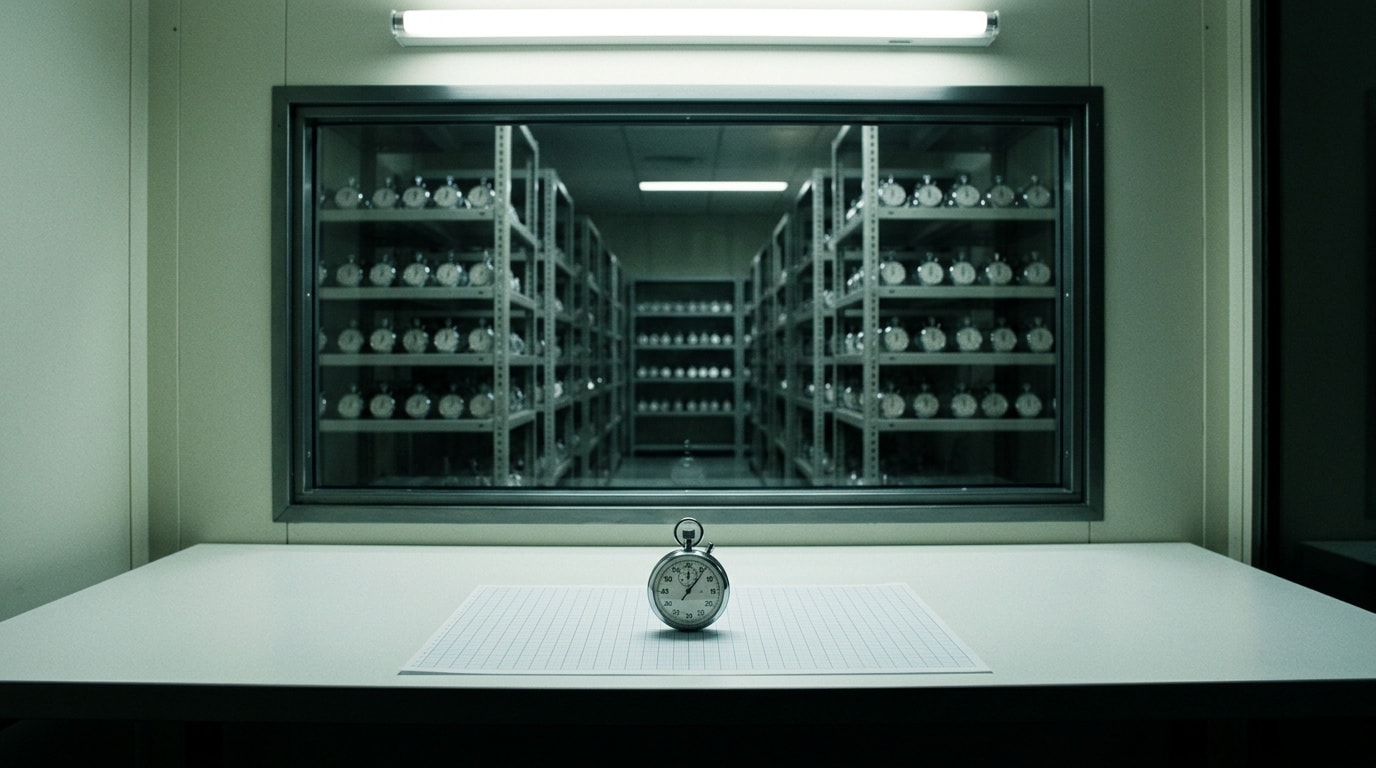
Mark Is Mapping the Severance Switch Itself
Mark's outie is conducting a structured timing experiment on the severance transition itself, using a stopwatch and silent manual count to measure the switch as a quantifiable interval Lumon has never disclosed.
Lorne Knows Ms. Casey Was Not Released
Lorne does not believe Ms.
Lumon Weaponizes Language to Control Innies
Lumon has built a cross-departmental linguistic register that delivers Kier-based ideological conditioning below the threshold of conscious recognition, embedding doctrine not in what employees are told to think but in the grammatical structures through which they are permitted to report thinking it.
Reintegration This Early Changes Everything
Mark pursuing reintegration in episode 3 is a structural signal that the season's central conflict is something the show has not yet named, because no serialized drama spends its finale card this early without believing something worse is waiting.
Mark's Guilt Is Sabotaging His Innie Romance
Mark did not retain knowledge of Gemma by accident.