
Lumon Weaponizes Language to Control Innies
THE THEORY
Lumon has built a cross-departmental linguistic register that delivers Kier-based ideological conditioning below the threshold of conscious recognition, embedding doctrine not in what employees are told to think but in the grammatical structures through which they are permitted to report thinking it. The evidence is the pattern itself: Lorne's archaic phrasing in a physically isolated department, Natalie's past-tense emotional modeling, and the consistent anachronism across unconnected floors all point to a shared institutional source rather than individual idiosyncrasy. If the severance procedure removes prior context and the prescribed language fills that void, the two mechanisms function as a single system built to eliminate the linguistic tools dissent would require.
How This Theory Works
Lumon has engineered a linguistic register that functions as the primary delivery mechanism for ideological control, operating below the level of content, at the level of grammar and syntax, precisely because that level is harder to consciously resist or identify. The claim is not that some employees speak oddly. It is that the speech patterns are consistent enough across departments, and matched closely enough to Kier handbook rhetoric, to indicate employees are absorbing a prescribed linguistic style from a shared, institution-wide source rather than developing individual idiosyncrasies.
Lorne's refusal of the missing persons sketch provides the sharpest test case. She calls Wellness a 'frippery,' an archaic construction that belongs to a different century of English usage. Lorne works in Mammalians Nurturable, a department so physically remote from MDR that Mark and Helly had to crawl through a tunnel to reach it. She has no obvious mechanism for adopting MDR's vocabulary or Milchick's management style. Yet her phrasing matches the register found throughout Lumon's handbook materials and in other deeply embedded employees across unconnected departments. The cross-departmental consistency is what the theory requires, and Lorne delivers it. Coincidence becomes statistically untenable as an explanation the more departments the pattern holds across.
Natalie's exchange with Milchick adds a second data point that operates at an even finer level of precision. When she tells him the board wants him to know she 'received this gift and appreciated it,' the past tense is doing specific work. She is not describing a feeling. She is modeling a sanctioned emotional response in the completed past tense, bracketing it as finished and therefore correct, while leaving Milchick with the implicit instruction to arrive at the same predetermined conclusion on his own. Lumon is not just shaping what employees think. It is shaping the grammatical structure through which they are permitted to narrate their own compliance back to the institution. That is not onboarding language. That is a system designed to make employees report their conditioning in the same terms the institution used to produce it, which forecloses the linguistic tools they would need to describe resistance.
The institutional consequence of this pattern is the one the theory has been approaching without landing on directly: if linguistic conditioning is operating cross-departmentally and below the threshold of conscious recognition, then the severed floor was not designed to protect innies from the complexity of outie life. It was designed to produce a workforce that cannot formulate dissent, because the language available to them was pre-shaped to make Kier's authority feel like the only grammar in which experience can be expressed. The severance procedure and the linguistic environment function as a single system. The procedure removes prior context; the language fills the resulting void with Lumon's own.
Is this theory convincing?
Key Evidence
Lorne's 'Fripperies' Dismissal
Lorne, working in the entirely separate Mammalians Nurturable department, dismisses Wellness as something they 'don't abide such fripperies as,' using an archaic construction that mirrors the Kier handbook's rhetorical register rather than any recognizable contemporary speech pattern.
Cross-Department Linguistic Consistency
Multiple unconnected employees across different Lumon departments use anachronistic or whimsical phrasing that matches the Kier ideological register, suggesting a shared source of linguistic conditioning rather than individual idiosyncrasy.
Natalie's Past-Tense Emotional Modeling
Natalie tells Milchick that she 'received this gift and appreciated it' using a completed past tense rather than a present-tense expression of feeling, framing sanctioned emotional response as a finished, correct act for Milchick to replicate.
Handbook Rhetoric Mirrored in Speech
The archaic phrasing used by Lorne and other embedded Lumon employees closely parallels the formal, quasi-religious language of Kier's documented teachings, suggesting employees absorb doctrine at the level of vocabulary and syntax.
Other Theories for S2E03

Lumon's Compliance Machine Built a Rival Husband
Lumon's family visitation protocol is a behavioral governance instrument, not a welfare accommodation, designed to convert emotional susceptibility into metered compliance.
Irving's Dreams Are a Map to the Exports Hall
Irving's outie has been painting a specific hallway that corresponds to a real location on the severed floor: the exports hall in Optics and Design.

Lumon's Loyalty Protocol Destroys What It Was Built to Preserve
Lumon's recanonized Kier paintings are a standardized loyalty protocol that instrumentalizes identity as recursive capture — transforming an employee's own self-image into the mechanism of their containment.
Mark Is Mapping the Severance Switch Itself
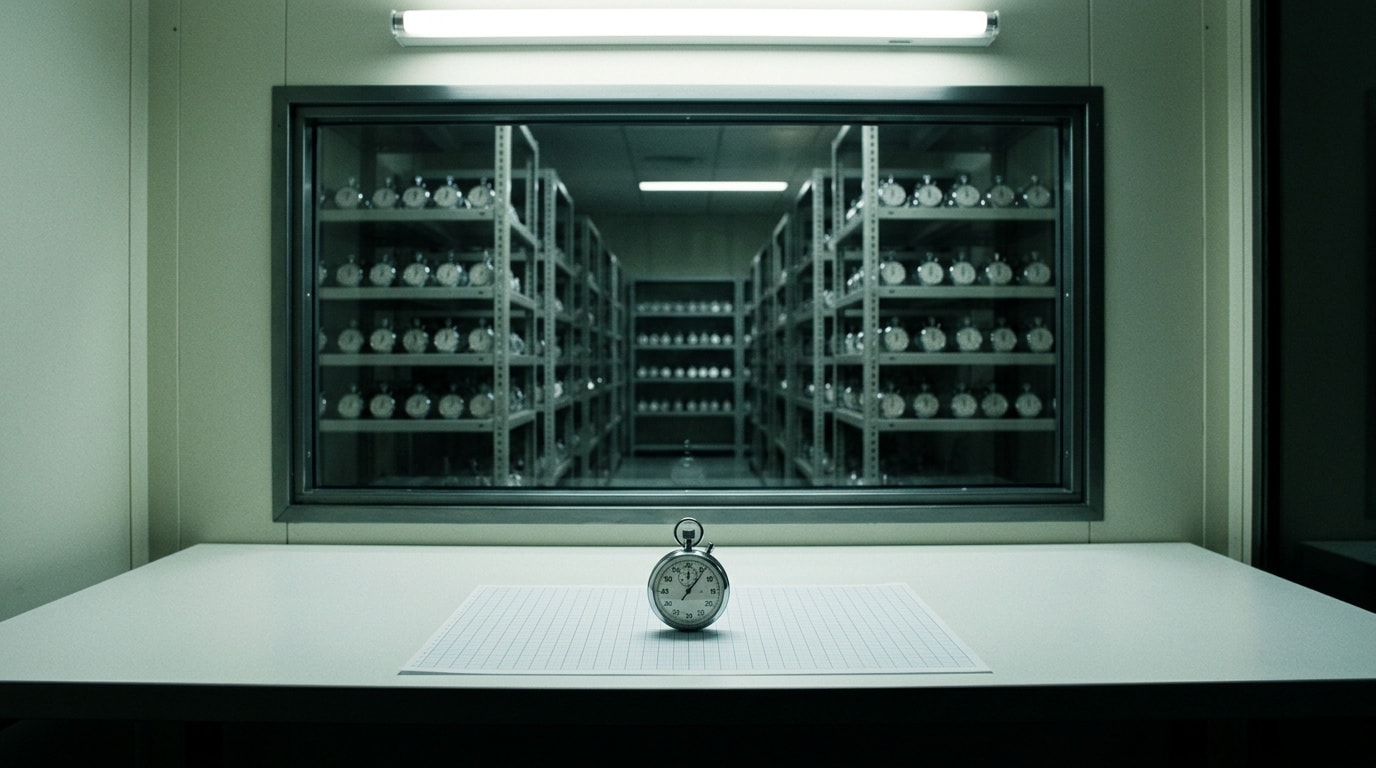
Mark's outie is conducting a structured timing experiment on the severance transition itself, using a stopwatch and silent manual count to measure the switch as a quantifiable interval Lumon has never disclosed.

Lorne Knows Ms. Casey Was Not Released
Lorne does not believe Ms.

Reintegration This Early Changes Everything
Mark pursuing reintegration in episode 3 is a structural signal that the season's central conflict is something the show has not yet named, because no serialized drama spends its finale card this early without believing something worse is waiting.

Cobel Fled Because She Knew the Trap
Cobel reversed in the parking lot not from intuition but from recognition: the board's invitation carried the structural signature of a containment maneuver she had personally used against others, and she identified herself as the target before she reached the entrance.

Mark's Guilt Is Sabotaging His Innie Romance
Mark did not retain knowledge of Gemma by accident.