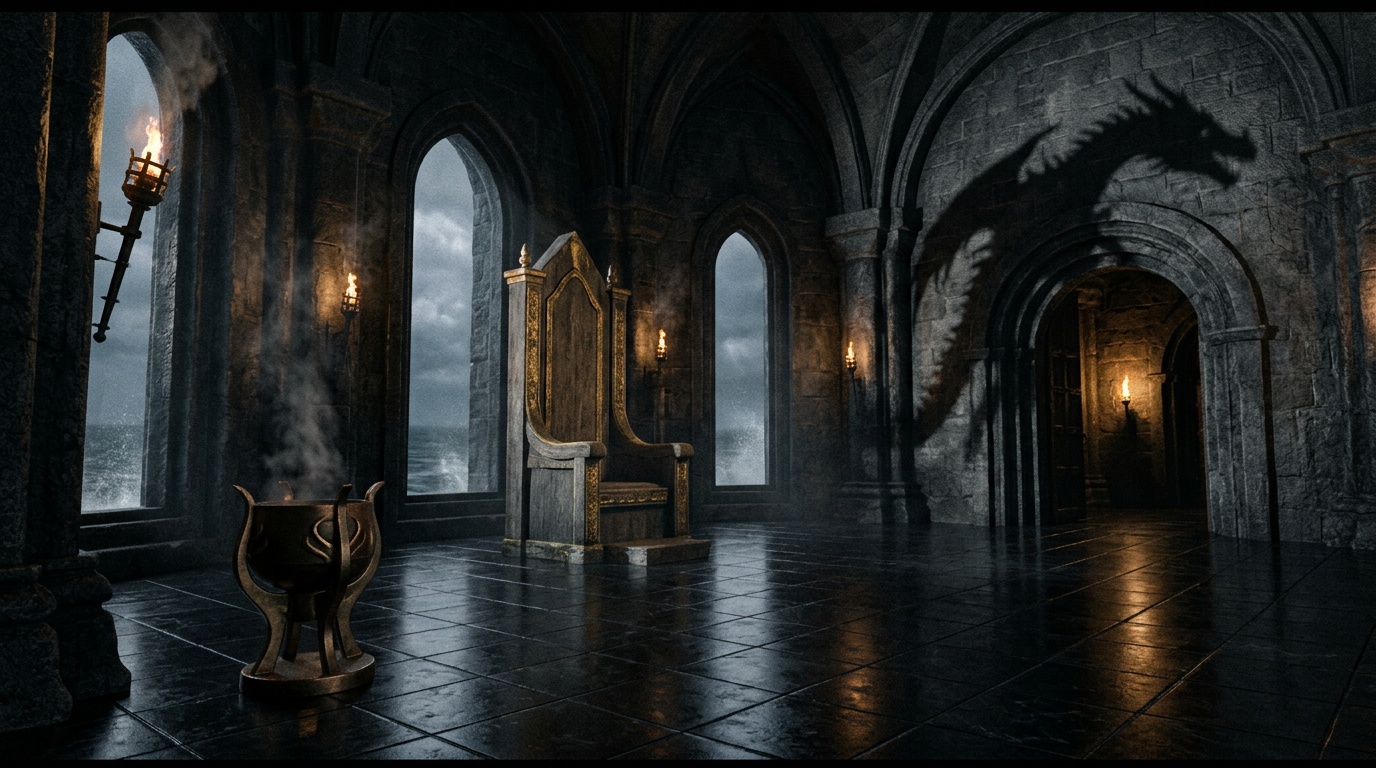
Daemon Builds Loyalty Through Dragon Threat
THE THEORY
Daemon is not managing Rhaenyra's Kingsguard on her behalf. He is constructing a loyalty structure at Dragonstone in which the knights' obligation to Rhaenyra is mediated entirely by his own coercive authority, leaving him as the effective sovereign of that relationship. The oaths sworn at Dragonmont were sworn, in every functional sense, to Daemon.
How This Theory Works
Daemon did not extract loyalty oaths from Lorent Marbrand and Steffon Darklyn on Rhaenyra's behalf. He extracted them on his own terms, using Caraxes as a weapon of personal authority, in a way that makes the loyalty owed to Rhaenyra contingent on Daemon's willingness to enforce it. The show confirmed the oath-taking. It has not confirmed who the knights now truly serve.
The mechanism matters. Daemon did not bring the knights before Rhaenyra and have her receive their oaths. He took them to the Dragonmont, positioned Caraxes overhead, and compelled the oaths himself. The dragon is his, not hers. The threat is his. The moment of submission was staged by Daemon and witnessed only by Daemon's authority. Knights who swear under duress to a man with a dragon above them have sworn to that man first.
The pattern is consistent: Daemon acts first, frames it as service to Rhaenyra, and accumulates leverage before she can assert control. He disregarded her direct command that nothing be done without her leave, sent ravens anyway, then took the Kingsguard to the Dragonmont. The loyalty oaths, extracted at dragonpoint without her presence, follow the same logic. If those knights ever calculate where the real power at Dragonstone sits, the answer Daemon has already arranged is Caraxes. What this theory presses toward is the possibility that Daemon does not experience himself as subordinate to Rhaenyra at all. His deference is strategic performance. The oath-taking was not insubordination he failed to suppress. It was a demonstration of the hierarchy he intends to establish, conducted openly, because he no longer considers her authority a serious constraint on his own.
Is this theory convincing?
Key Evidence
Caraxes Positioned During Oath-Taking
Daemon brought the two Kingsguard knights to the slopes of Dragonmont and had Caraxes loom over them during the loyalty oath, making the dragon an explicit physical threat rather than a ceremonial backdrop.
Oaths Sworn to Daemon's Arrangement
The knights swore loyalty to Rhaenyra as queen and Jace as heir, but the oaths were compelled and witnessed by Daemon alone, without Rhaenyra present to receive them.
Daemon Defies Rhaenyra's Direct Command
Rhaenyra commanded that nothing be done without her leave; Daemon disregarded this order, sent ravens, and took the Kingsguard to the Dragonmont, demonstrating that he operates outside her authority.
Threat of Treason Named Explicitly
Daemon warned the knights of the price of treason during the oath-taking, framing loyalty as a survival calculation rather than an honor-based commitment.
Other Theories for S1E10
Rhaenyra Has Been Counting Casualties in Her Body Since Before the War Had a Name
Rhaenyra's restraint at the Black Council was never a strategic posture.
Vhagar Chose: Aemond Never Had Control
Vhagar killed Lucerys because she chose to, not because Aemond ordered it.
The Choking Scene Is Two Betrayals Landing at Once
When Daemon's hands close around Rhaenyra's throat, he is not reacting to a single provocation but to two simultaneous revelations: Rhaenyra has refused to be the conqueror he constructed her as, and she has inadvertently exposed that Viserys judged him, privately and permanently, as unfit to carry the dynasty's deepest inheritance.
Prophecy Drives Rhaenyra's War, Not Vengeance
Rhaenyra's strategic restraint is not caution or grief but prophetic obligation: Viserys entrusted her alone with Aegon the Conqueror's Song of Ice and Fire vision, making her the sole keeper of a mandate that reframes the Dance of Dragons as a war fought under constraint rather than for conquest.
Otto Harvests What Alicent Can No Longer Read
Otto Hightower deploys the Nymeria page not because he believes it can stop a war but because he has identified a specific cognitive pattern in Alicent: decades of learned submission have caused emotional memory to replace textual content, rendering her constitutionally unable to read political symbols correctly.
Rhaenys Is the Alliance's Ceiling: Corlys Sails on Her Collateral, Not Rhaenyra's Cause
Corlys Velaryon's fleet does not belong to Rhaenyra's war; it belongs to the version of Rhaenyra that Rhaenys staked her own credibility to describe.
Aemma's Death Drives Rhaenyra's Refusal
Rhaenyra's refusal of midwife assistance during her labor is a deliberate assertion of bodily sovereignty modeled on the specific violation done to Aemma, whose body was cut open without consent while Rhaenyra watched.
Syrax Screams Because Rhaenyra Does
The rider-dragon bond transmits physical suffering across distance without contact or command, and the labor sequence at Dragonstone is structured to prove it.