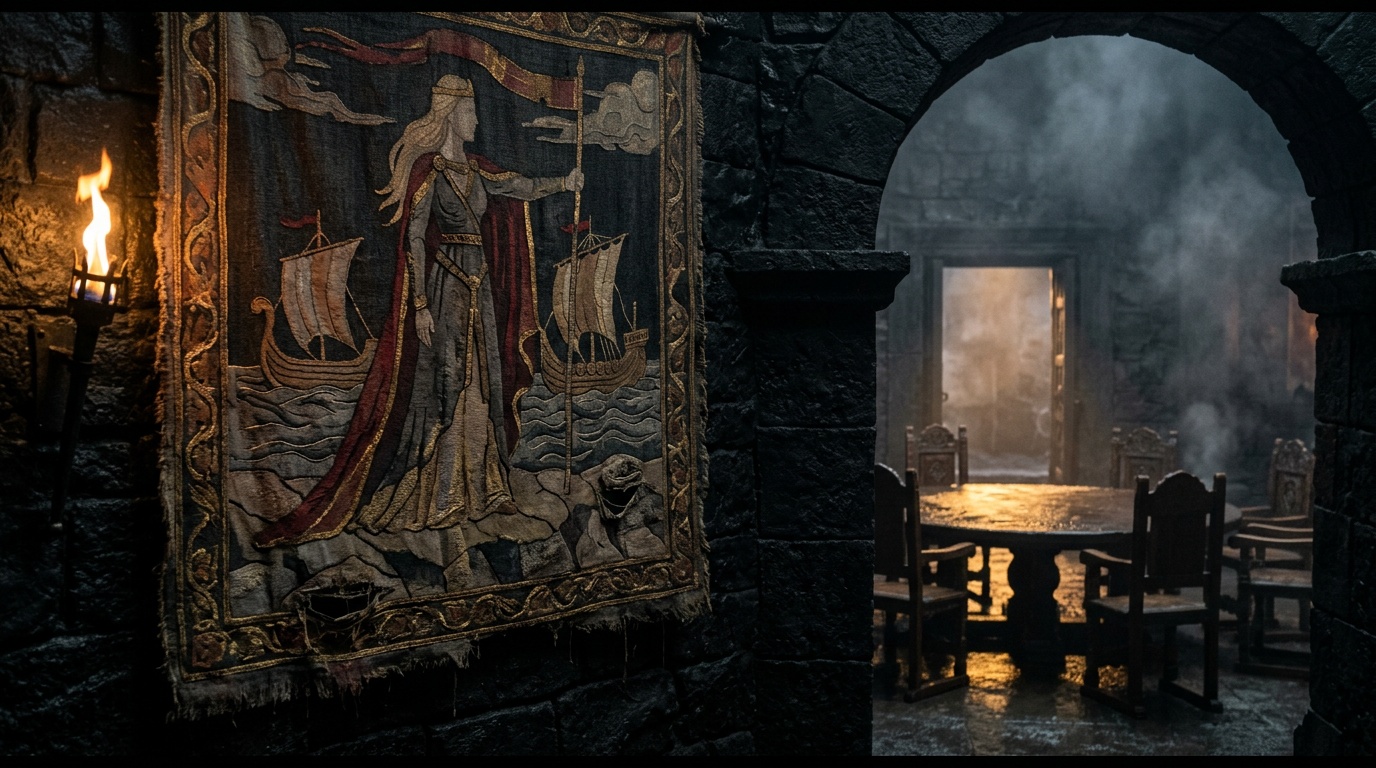
Otto Harvests What Alicent Can No Longer Read
THE THEORY
Otto Hightower deploys the Nymeria page not because he believes it can stop a war but because he has identified a specific cognitive pattern in Alicent: decades of learned submission have caused emotional memory to replace textual content, rendering her constitutionally unable to read political symbols correctly. He moves the page into the negotiation without Alicent present precisely to harvest its emotional charge while foreclosing any exchange that might restore her ability to read the room. This incapacity is not a one-time vulnerability Otto is exploiting but a renewable tactical resource he has observed across years, one that will cause Alicent to misread every future peace gesture she constructs.
How This Theory Works
The sharpest unspoken truth of the Dragonstone negotiation is not that Otto borrowed Alicent's grief without her consent. It is that Alicent's grief has become the only currency she possesses, and Otto understood this long before she did. His history of keeping Alicent structurally uninformed is not incidental to that understanding. A man who excluded her from the conspiracy that made her queen, who required her genuine ignorance to manufacture her moral authority, has spent years studying exactly what she can and cannot process about her own political situation. By the time he carries the Nymeria page to Dragonstone, he is not guessing at her epistemological limits. He has mapped them.
The storybook page is not a weapon Otto invented. It is a wound Alicent has been keeping open, and its usefulness to him depends entirely on a failure that has been accumulating in her for decades: the content of the Nymeria passage has become invisible to her. What she retained from those readings under the Godswood is not what the text says but how it felt to read it, and those two things are now in direct opposition. Westeros's literary tradition offered Alicent no shortage of passages about deference, the wisdom of standing down, the long peace that follows surrender. She chose the story of a queen who lashed ten thousand ships together and crossed an ocean rather than accept subjugation. That choice is not careless. It is diagnostic.
The epistemological gap the show is constructing between Alicent and Rhaenyra runs precisely here. Rhaenyra does not misread the Nymeria page. She reads it correctly. A warrior queen who refused to yield to a power claiming dominion over her is not a symbol of reconciliation; it is a mandate. Alicent sent Rhaenyra a mandate and experienced it as an olive branch because the framework through which she processes female defiance converts it, automatically, into female sentiment. This is not a failure of intelligence. It is the predictable output of a formation that taught Alicent to accommodate rather than to lead, to locate the emotional register of a text rather than its political argument. She learned how to yield gracefully, and that is the only vocabulary left to her. The memory of reading with Rhaenyra has not merely colored the text; it has replaced it.
Otto has observed this pattern across years and identified it as a renewable resource, not a wound he opened but one he has watched Alicent maintain, waiting for the right diplomatic moment to press it into service. That is the precise reason Alicent is absent from her own appeal. Her absence is not incidental to the negotiation's structure: it is its load-bearing element. Otto cannot afford to let Alicent deliver the page herself, because Alicent present would risk an actual reconciliation rather than a managed hesitation. He needs the emotional charge without the emotional risk. He needs Rhaenyra to feel Alicent's longing without giving Alicent the chance to mean it out loud in the same room where Rhaenyra might respond in kind. The gap between the artifact's owner and its carrier is not a tell about Otto's tactics. It is a tell about what Otto understands Alicent's incapacity to be worth, and what he is willing to extract from it without her knowledge. What made the coup's moral face persuasive was Alicent's genuine ignorance of it. What makes the page's emotional charge persuasive is Alicent's genuine inability to see past it. Otto has not changed instruments. He has found the same instrument again.
Rhaenyra's response addresses both layers of the manipulation with a single sequence. She strips Otto's Hand pin before any terms are discussed, not as theater but as epistemological correction, refusing to let the negotiation proceed from a posture that grants Green legitimacy on her ground. Then she returns the page. That return does not travel back to Otto. It routes past him entirely, back to the woman whose longing he borrowed without permission, back to Alicent specifically. The message is not a rejection of peace. It is a precise identification of the problem: I know this came from you, I know he used it, and I am returning it to you because you are the only person in this exchange I am still willing to address directly. Rhaenyra is not refusing to speak to Alicent. She is insisting that speaking to Alicent requires that Otto not be the medium.
What makes this theory structurally durable rather than merely applicable to one scene is the pattern it predicts forward. Alicent will keep reaching for gestures that mean one thing to her and the opposite to Rhaenyra, not out of carelessness, not out of bad faith, but because she has no other vocabulary for political imagination. Every peace offering she constructs will be cut from the same wood as the war, because the formation that shaped her cannot produce symbols that Rhaenyra reads as concession. Otto does not need to find a new instrument. He only needs to let Alicent keep reaching for the texts she can no longer actually read, and keep positioning himself as the one who carries them. He is not exploiting a single wound. He is relying on a cognitive pattern that will generate fresh misreadings indefinitely, and he has arranged the structure of her access to the negotiation to ensure that no direct exchange can interrupt it.
Is this theory convincing?
Key Evidence
Otto Presents the Childhood Storybook Page
During the bridge negotiation, Otto hands Rhaenyra a page she had torn from a storybook that she and Alicent read together as girls under the Godswood, inscribed with text about Nymeria's ships, using a relic of their shared past as a rhetorical appeal.
Rhaenyra Strips Otto's Hand Pin
Rhaenyra approaches Otto and removes the symbol of the Hand of the King from his cloak, a deliberate act of delegitimization that reframes the entire negotiation before she responds to the Greens' terms.
Page Returned as Message to Alicent
Rhaenyra returns the torn storybook page to Otto, a gesture that functions as a direct communication back to Alicent rather than simply a rejection of the peace offer, since the page's emotional meaning belongs to Alicent, not Otto.
Otto's Voice Frames the Appeal as Strategic
Otto presents the page in conjunction with the Greens' formal terms, positioning the emotional appeal as part of a negotiating sequence rather than a standalone act of goodwill, revealing its instrumental character.
Alicent Absent from Her Own Appeal
The storybook page is Alicent's artifact but is delivered entirely by Otto without her present, meaning Otto is channeling Alicent's emotional authority for his own diplomatic purpose rather than transmitting her genuine intent.
Other Theories for S1E10
Rhaenyra Has Been Counting Casualties in Her Body Since Before the War Had a Name
Rhaenyra's restraint at the Black Council was never a strategic posture.
Vhagar Chose: Aemond Never Had Control
Vhagar killed Lucerys because she chose to, not because Aemond ordered it.
The Choking Scene Is Two Betrayals Landing at Once
When Daemon's hands close around Rhaenyra's throat, he is not reacting to a single provocation but to two simultaneous revelations: Rhaenyra has refused to be the conqueror he constructed her as, and she has inadvertently exposed that Viserys judged him, privately and permanently, as unfit to carry the dynasty's deepest inheritance.
Daemon Builds Loyalty Through Dragon Threat
Daemon is not managing Rhaenyra's Kingsguard on her behalf.
Prophecy Drives Rhaenyra's War, Not Vengeance
Rhaenyra's strategic restraint is not caution or grief but prophetic obligation: Viserys entrusted her alone with Aegon the Conqueror's Song of Ice and Fire vision, making her the sole keeper of a mandate that reframes the Dance of Dragons as a war fought under constraint rather than for conquest.
Rhaenys Is the Alliance's Ceiling: Corlys Sails on Her Collateral, Not Rhaenyra's Cause
Corlys Velaryon's fleet does not belong to Rhaenyra's war; it belongs to the version of Rhaenyra that Rhaenys staked her own credibility to describe.
Aemma's Death Drives Rhaenyra's Refusal
Rhaenyra's refusal of midwife assistance during her labor is a deliberate assertion of bodily sovereignty modeled on the specific violation done to Aemma, whose body was cut open without consent while Rhaenyra watched.
Syrax Screams Because Rhaenyra Does
The rider-dragon bond transmits physical suffering across distance without contact or command, and the labor sequence at Dragonstone is structured to prove it.