The Town Reads Its Residents and Weaponizes What It Finds
THE THEORY
The entity controlling the town operates as a surveillance system of extraordinary intimacy, accessing private biological and psychological histories that no resident has disclosed within its borders and converting that information into targeted leverage. Fatima's pregnancy, Elgin's sealed dream, and the radio voice are not three separate phenomena; they are three outputs of one mechanism: intimate knowledge converted into personalized pressure. Whatever is doing this is not constrained by biology or physics, only by intention, and its use of human communication infrastructure is mimicry designed to make its agency felt without being understood.
How This Theory Works
The most precise demonstration of the town's method is also its most intimate: Fatima was told by doctors that conception was medically impossible for her. She did not disclose this history to anyone inside the town's borders. A third-year medical student examines her and confirms a pregnancy that contradicts established clinical fact, with Ellis confirmed as the father. The town has not generated a random biological anomaly. It has generated a specific child from a specific union inside a specific woman whose infertility was sealed in her private medical history, inaccessible to any resident. That precision is not incidental. It is the argument. For the town to reverse Fatima's infertility, it had to first read it, at the level of cellular biology, without her knowledge or consent, and then act on what it found there. Donna's reassurance that residents have been conditioned to interpret every impossible event as hostile does not resolve the harder question Donna leaves untouched: how does the town know? Her counterargument addresses the emotional response and abandons the mechanism entirely. A miracle calibrated with perfect accuracy to one person's deepest private grief, produced by an entity that kills on a schedule, does not become less threatening by being real. It becomes more threatening, because it demonstrates that the entity has already been inside.
Elgin's blocked bus dream extends this targeting logic from biological reality to knowledge access. Elgin is not struggling to remember something he forgot. He is struggling against something that does not want to be remembered. His description to Julie carries a phenomenological precision that separates his experience from ordinary trauma: he feels he is supposed to recover something, and he cannot determine whether what presses back against his conscious access is real or was constructed under duress. Every other passenger crossed the same transitional window into the town. Elgin alone reports this specific sensation of withheld information fighting containment. That asymmetry is not a difference in grief tolerance or memory consolidation. It is a difference in what the town did to him specifically on arrival. Smiley's death, a state almost no resident witnesses directly, functioned as a partial key that reopened the sealed channel without completing it, which confirms the suppression is active and targeted rather than accidental. The town chose Elgin as a receiver, granted him partial access to something about its governing logic during the liminal moment of his arrival, and then locked it because what he accessed was too legible. The block is a containment measure applied to one person. It is surveillance followed by selective censorship.
The radio voice is the same operation at a different register, and Tabitha's challenge to Jim names exactly why. She does not argue the voice is non-human as a confident alternative theory. She raises it as the honest acknowledgment that Jim's human-agency framework cannot account for what the town contains. Her evidence is experiential and direct: she has encountered the creatures up close in a way Jim has not, and she presses that advantage. Jim's response is revealing precisely because it is not a refutation. He does not counter her evidence. He reframes it: whatever she saw in the tunnels is what "they" wanted her to see. This is a deflection that acknowledges the phenomena are real while insisting a human hand orchestrates them. That circular logic is not a flaw. It is a survival requirement. If someone built this, someone can be stopped or reasoned with or exposed. Jim's framework needs human agency because human agency is the only kind that keeps escape rational. But the framework requires two separate actors, a human engineer operating a transmitter and a separate force that punishes escape attempts with feedback that is immediate, proportionate, and targeted, where one actor explains both more economically.
The three cases resolve into a single mechanism when read together. An entity capable of dressing its creatures in pristine humanoid form before deploying them at night is an entity that understands human legibility and uses it strategically. The creatures' transformation is mimicry: a non-human instrument made to look human enough to destabilize recognition. The radio voice is the same operation, a non-human entity using human broadcast infrastructure and human language not because those are its natural modes but because they make its agency legible enough to be felt. Fatima's pregnancy uses the infrastructure of human reproduction in the same way: the town does not conjure the child from nothing; it uses existing human biology, an existing relationship, an existing womb, but it authors the outcome. The mimicry in each case is precise enough to create the appearance of natural or human causation while the actual authorship remains illegible. This is not an accident of the town's method. It is the method. The entity wants its interventions felt but not understood, intimate but not traceable.
What unites Fatima's pregnancy, Elgin's sealed dream, and the radio voice is that none of them are blunt environmental facts. Each one is personalized. The pregnancy targets the specific wound in one specific woman's private history. The dream suppression targets the one passenger who accessed something too clearly. The voice targets the survivors' specific need for a human interlocutor: it speaks in the register they require to maintain the project of escape. The town's cruelty, and possibly its mercy, are not random supernatural interference applied universally. They are the outputs of a system that has already read each resident more thoroughly than any resident has read themselves, and is now deciding, with apparent intention, what to do with what it found.
Is this theory convincing?
Key Evidence
Fatima's Direct Dialogue on Impossibility
Fatima states explicitly that she was told she could not have children, and that what is currently happening is medically impossible, with Kristi's confirmation adding clinical weight to the claim.
Fatima's Fear of Being Mocked
Fatima confides that she wonders if the town is trying to torture and mock her through the pregnancy, the same way the creatures torment the residents at night, framing the impossible conception as potentially hostile rather than benevolent.
Donna's Miracle Counterargument
Donna tells Fatima that the residents have seen so much impossible and horrible things that they reflexively assume any impossible event is bad, and suggests that the pregnancy could simply be a miracle.
Episode Title Pointing to Fatima
The episode is titled 'Belly of the Beast,' and viewers note that the title applies directly to Fatima's situation, something growing inside her belly in a place defined by predatory impossibility.
Town's Tailored Effects on Individuals
The pregnancy is cited as evidence that the town does not apply its reality-altering properties randomly but in ways specific to each person's history, with Fatima's prior infertility making her pregnancy the most personalized impossible outcome yet shown.
Kristi Confirming the Pregnancy
A third-year medical student confirms the pregnancy at the opening of the episode, lending the impossible biological fact the weight of in-world medical authority rather than leaving it as Fatima's subjective experience.
Ellis Confirmed as Father
Kristi asks whether Ellis is the father and Fatima confirms it, establishing that this is a conventional pregnancy in its origin even as it is impossible in its existence.
Other Theories for S2E07
Smiley's Autopsy Confirms Creature Conversion and Bile as Fromville's Death-Management Substrate
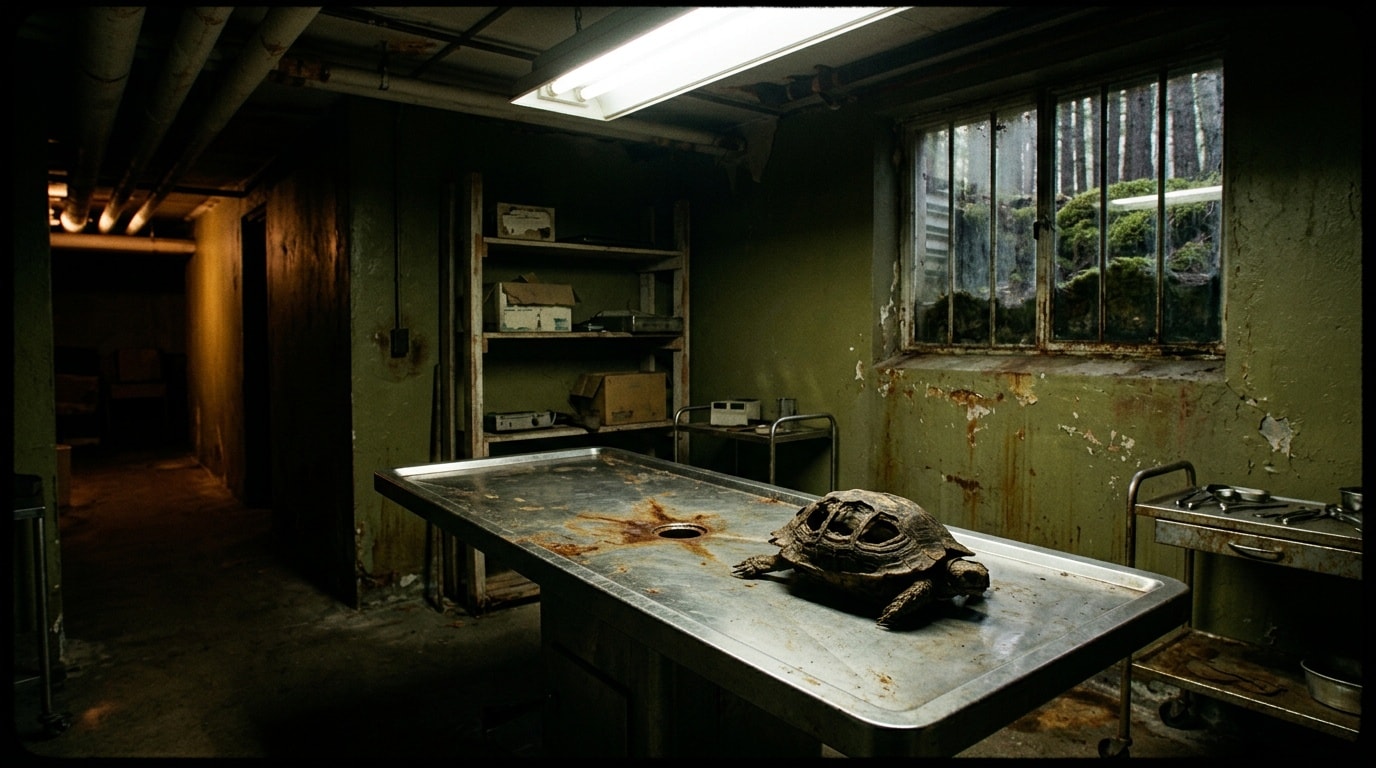
The autopsy of Smiley establishes two interlocking claims: the creature's structurally human interior confirms that Fromville's monsters are converted townspeople, not alien entities, and the complete absence of every fluid except bile, combined with post-mortem movement, identifies bile as the singular operational substrate that persists beyond apparent death.

The Music Box Spreads Like Infection
The music box is a transmission event, not a personal hallucination, spreading the same vision independently to Boyd, Elgin, and Mari within a single episode.

The Town's First Autumn Signals Something Worse
The town's perpetual summer was not natural stasis but a deliberate constraint on whatever forces govern this place, and its collapse into autumn signals that the constraint has failed.

Attach the Antenna, Fly It Over
Jim believes attaching a stripped radio antenna to Randall's drone and flying it above the treeline could amplify or transmit a signal beyond the town's boundary.

Someone Inside the Town Is Complicit
Randall is not just floating an idea when he asks Jim whether someone inside the town might be in on the experiment.

Sunlight Doesn't Kill Them. Rules Do.
The creatures in FROM are not killed by sunlight, and their disappearance at dawn reflects administered behavioral rules rather than physical vulnerability.