Cooper's Presence Physically Rewrote the Apocalypse
THE THEORY
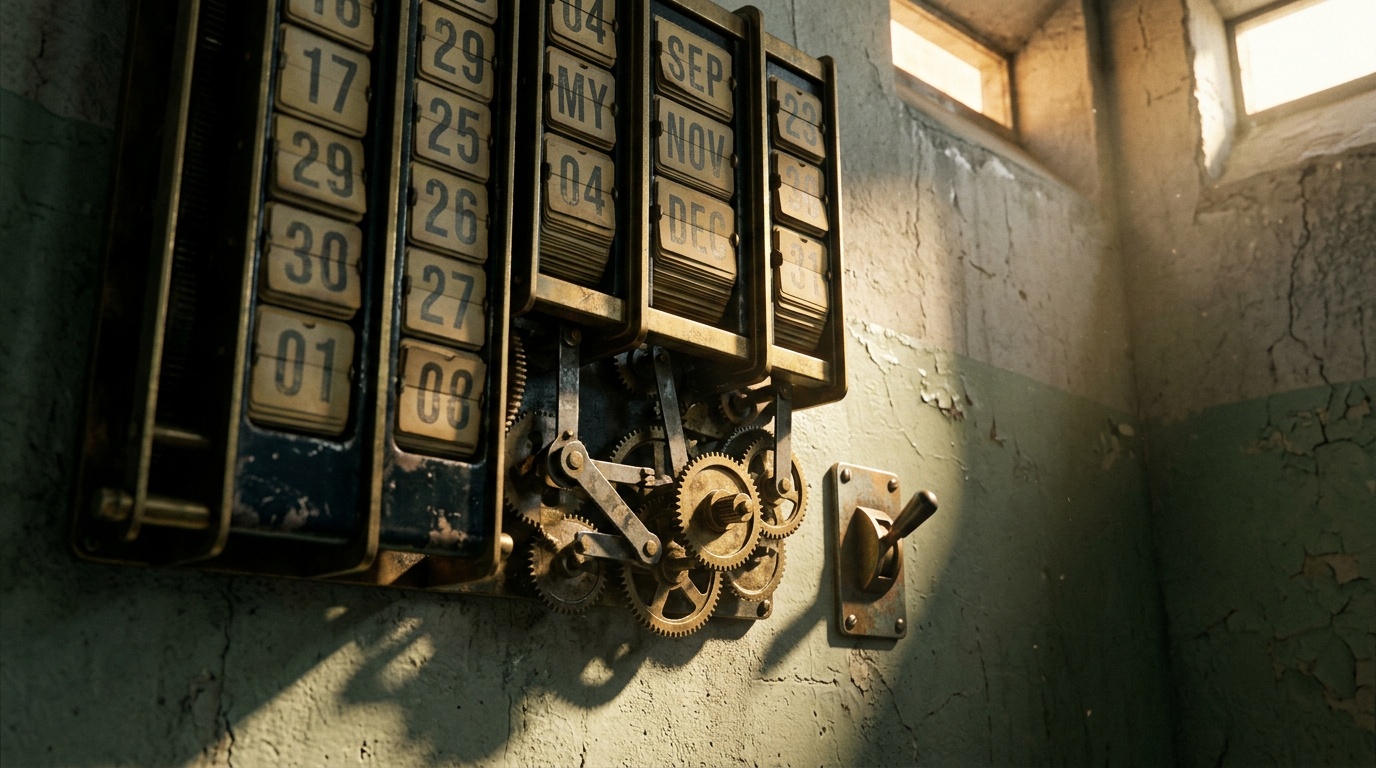
Cooper Howard is not merely a witness to the apocalypse but a causal variable inside it: his ticket purchase physically delayed the date of nuclear war by one month, according to House's own predictive system, and the show has not explained the mechanism. The original calculated end date also matches Cooper's daughter's birthday, a coincidence House's impersonal model has no framework to account for. If the bombs had fallen on the original date, Lucy MacLean would not exist, which means the entire post-war story may be a downstream consequence of a single decision Cooper made without knowing its weight.
How This Theory Works
Cooper Howard's ticket purchase moved the date of nuclear war by one month. That is the claim House makes directly, and the show has not explained the mechanism behind it. House does not offer one. He states it as a fact and moves on, which is the more unsettling choice, because it means the most sophisticated predictive system in the pre-war world registered a single actor's travel decision as a variable capable of reshaping the timeline of human extinction.
The Janey connection tightens the knot. The date House originally calculated as the end of the world is also Cooper's daughter's birthday. His model is built on impersonal systemic forces, not individual human beings, and this coincidence has no place inside it. Cooper's arrival in Vegas is the variable that breaks the model. This is not House demonstrating superiority over a would-be assassin. It is House telling Cooper that the mechanics of civilizational collapse bent around him, and House does not know why.
What the evidence actually implies is that Cooper Howard occupied a structural role in the pre-war order that no one, including Cooper himself, understood. House's intelligence network had penetrated Vault-Tec's inner circle deeply enough to anticipate the assassination attempt before it happened. His model presumably incorporated the cold fusion negotiations, Barb's work, and the full architecture of what Vault-Tec was building. Cooper was not in that model until he bought the ticket. The most uncomfortable reading is that his decision to come to Vegas, driven by loyalty to his wife and private doubts about what she was constructing, was itself the action that delayed the war. Not through weeks of political maneuvering. Through one purchase. If the bombs had fallen a month earlier, Lucy MacLean would never have been born. Cooper would have no reason to be looking for her now. The entire post-war story the show is telling may be a consequence of a variable the model never saw coming and cannot explain.
Is this theory convincing?
Key Evidence
House Names the Exact End Date
House tells Cooper he routinely runs mathematical paradigms on global political and socioeconomic conditions, and one morning the data told him exactly when the world would end: April 14th, 2065 at 5:17 AM.
Cooper's Ticket Shifts the Date
House states directly that the moment Cooper bought his ticket to Las Vegas, the predicted end date jumped forward by one month, framing Cooper's travel as a literal causal variable in the timeline of nuclear war.
End Date Matches Janey's Birthday
The date House originally calculated as the apocalypse is also Cooper's daughter Janey's birthday, a coincidence that visibly vexes House because his impersonal predictive model has no framework for a single individual's significance.
House Anticipated the Assassination
House approaches Cooper at the Lucky 38 already knowing Cooper came to Vegas intending to kill him, demonstrating that his intelligence network penetrated the operation deeply enough to anticipate individual actors before they acted.
Cooper as Unmodeled Variable
House's model incorporated vast systemic forces including the Vault-Tec cold fusion exchange, yet Cooper's presence only registered as a variable after he purchased a ticket, implying his significance to the outcome was invisible to the model until he chose to act.
Other Theories for S2E05
House Closed the Trap Before Cooper Reached Las Vegas
Robert House ran a two-stage operation against Cooper Howard: a pre-arrival intelligence assessment that identified Cooper as a recruitable asset alienated from Vault-Tec, followed by a deliberate penthouse encounter that converted Cooper's moral restraint — his refusal to use the poison — from a potential complication into the confirming data point House needed to finalize his decision.
Lucy MacLean Has Already Replaced Her Moral Framework — She Just Cannot Name What With
Lucy has not lost her moral framework.
Lucy Is the Key Cooper Plans to Use on Hank, Not on the Deathclaws
Cooper Howard has spent two centuries systematically eliminating empty vaults until Hank MacLean — a senior Vault-Tec operative with pre-war knowledge of the management facility beneath the Strip — became his only remaining compass needle.
Hank's Memory Wipe Is a Weapons Test
Hank's memory wipe program is not an interrogation tool or a punishment mechanism but a field-agent production system, and the salesman's survival marks the first confirmed proof that it can be applied to wasteland-native subjects.
Someone Unleashed the Deathclaws on the Strip
The deathclaws blocking access to the New Vegas Strip were deliberately driven there to seal the underground Vault-Tec management Vault from outside reach, functioning as a perimeter rather than a natural hazard.
Future Enterprise Ventures Is Vault-Tec's FEV Program
Future Enterprise Ventures is the institutional cover identity for Vault-Tec's FEV program, meaning the Vault experiments were never primarily social but biological, with selected populations serving as controlled subjects for the Forced Evolutionary Virus.