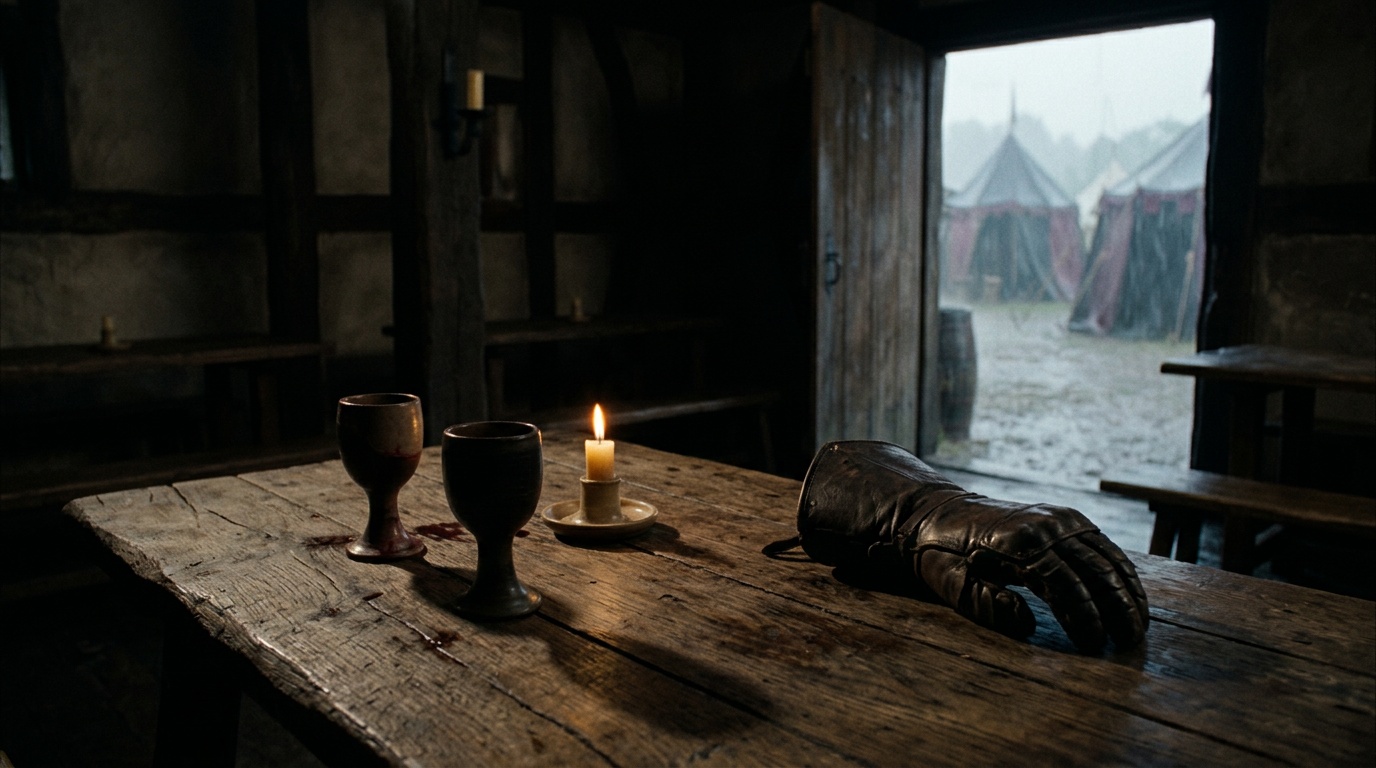
Daeron Dreams of Dunk Killing a Dragon
THE THEORY
Daeron has foreseen Aerion's death at Dunk's hands, and his drinking and absence from Ashford are not weakness but the behavior of a man who already knows how the trial of seven ends. Since no dragon of the dream's scale exists in Westeros, the vast dead beast in Daeron's vision must signify Aerion, who explicitly understands himself to be a dragon in human form. The sharpest implication is not that Dunk wins, but that Daeron has been carrying the knowledge of his brother's death alone, and warned the killer without warning the condemned.
How This Theory Works
Daeron already knows his brother Aerion is going to die, and everything he does at Ashford is the behavior of a man managing that knowledge. The vision he described to Dunk is precise: Dunk standing alive, a vast dead dragon with wings wide enough to shadow Ashford Meadow, fire surrounding the scene. That image has no literal referent. No dragon of that scale exists anywhere in Westeros in this era. The last real dragon died decades before these events and was a stunted, sickly creature. The scale of the vision demands a symbolic reading, and the symbol is already named by the text: Aerion Targaryen explicitly believes himself to be a dragon in human form. That belief is not incidental character color. It is why Aerion was so violently offended by a puppet show depicting a dragon dying. When Daeron dreams of a great dead dragon, the dream is telling him what Aerion's own mythology would call a death: a dragon falls.
The trial of seven is the mechanism that transforms prophecy into plot. Aerion engineered a confrontation in which seven champions fight seven champions, with Dunk at the center of one side. The dream places Dunk alive inside fire with a dead dragon fallen on him. That is a structural match for what the trial delivers: mortal danger, Dunk at its center, Aerion on the opposing side.
Daeron's drinking and his deliberate absence from Ashford are not vices or cowardice. They are the coping strategy of a man who has seen the outcome and cannot change it. He stays at the inn because he already knows what happens at the tourney. He drinks because the dreams are not clarifying gifts but burdens, and the heaviest burden here is that his brother is going to die and he has told no one except, obliquely, the very man who is going to kill him.
Is this theory convincing?
Key Evidence
Daeron's Self-Confirmed Prophetic Dreams
Daeron tells Dunk explicitly: 'My dreams are not like yours. Mine come true,' establishing that his visions are not wishes or fears but genuine foresight.
The Dead Dragon Vision Content
Daeron describes seeing Dunk alive surrounded by fire with a dead dragon fallen on top of him, its wings large enough to cover Ashford Meadow — a vision whose scale is impossible to reconcile with any literal animal in this era.
Aerion's Dragon Self-Belief
Egg and Baelor establish that Aerion Targaryen sincerely believes himself to be a dragon in human form, which is the direct reason he was violently offended by Tanselle's puppet show depicting a dragon dying.
No Living Dragons in Westeros
The last dragon in Westeros died decades before these events and was a stunted, sickly creature — nothing resembling the vast winged beast of Daeron's vision — forcing a metaphorical reading of the dream's dragon.
Trial of Seven as Dream's Fire
Aerion invokes the trial of seven, placing Dunk at the center of a life-or-death battle, structurally matching the fire and mortal danger that surrounds Dunk in Daeron's vision.
Daeron's Drinking as Suppression
Daeron drinks heavily enough to require it as a coping mechanism, suggesting the prophetic dreams are traumatic rather than clarifying — consistent with a man who has seen his own brother's death and cannot act to prevent it.
Daeron Abandons the Tourney
Daeron chose to remain at the distant inn rather than attend Ashford, and Egg describes him as having no interest in the lists — behavior consistent with someone who knows what the tourney holds and wants no part of witnessing it.
Other Theories for S1E04
Baelor Chose Honor Over Blood
Baelor Targaryen's support for Dunk is not honor overcoming politics but a calculated displacement of his own unresolvable conflict: he has privately concluded that legitimacy derives from conduct rather than birth, but he will not say so and survive, so he engineers a legal mechanism that might say it for him.
Nobody Wants to Fight a Targaryen
The trial of seven is a mechanism for converting Targaryen political dominance into a legal verdict: if no knight will risk royal displeasure to stand beside Dunk, that silence becomes proof of his guilt.
Dunk's Hesitation Discloses a Broken Chain: Two Fabricated Legitimacies, One Shared Silence
When Dunk says 'I shouldn't' before knighting Raymun, the show covertly discloses that Ser Arlan never formally knighted him, leaving a broken chain of conferral at the foundation of every legal right the episode depends on.
Aerion Thinks He Is Literally a Dragon
Aerion's dragon delusion is confirmed, but what the show has not yet made explicit is its structural consequence: Aerion has exited the shared framework of reality that law, family, and reason operate within, which means every institution trying to check his violence is reasoning in a language he no longer speaks.
Dunk's Moral Sincerity Is the One Thing the Westeros Architecture Was Never Built to Stop
The show is running the same argument through two registers at once: behaviorally, Dunk's unconditional goodness forces every character whose identity depends on the knightly-oath gap remaining unexamined into either honesty or a more naked form of dishonesty; symbolically, the elm on his shield names what that quality is.