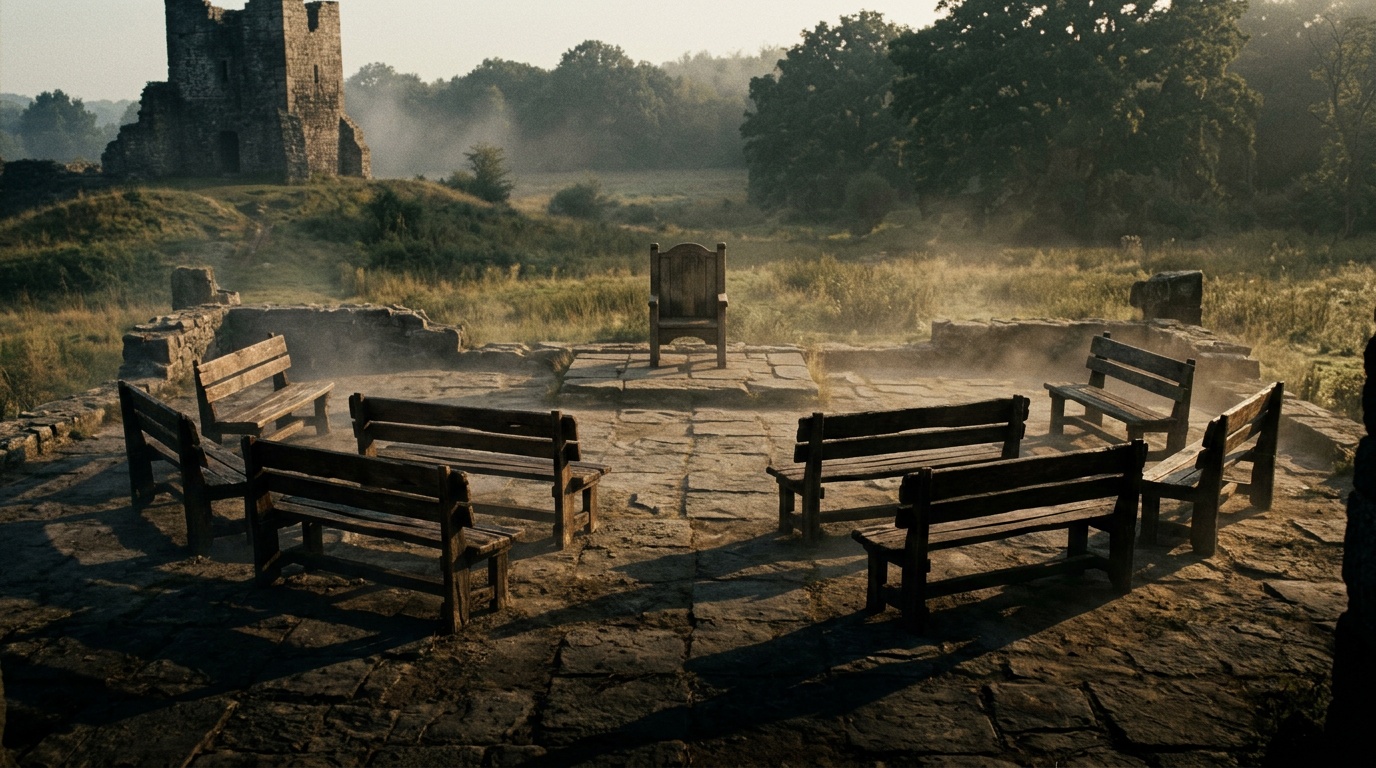
Nobody Wants to Fight a Targaryen
THE THEORY
The trial of seven is a mechanism for converting Targaryen political dominance into a legal verdict: if no knight will risk royal displeasure to stand beside Dunk, that silence becomes proof of his guilt. Fear of the throne, not absence of sympathy for his cause, is the real barrier, and Aerion's dawn deadline is designed to keep that fear atomized rather than organized. If Dunk does assemble his seven, the coalition that forms will reveal not a defense of Dunk but the first legible shape of opposition to Targaryen rule.
How This Theory Works
Aerion did not invoke the trial of seven out of religious conviction. He invoked it because he understands the math: a hedge knight with no house, no allies, and no political standing has almost no one to call on, while a Targaryen prince can draw on the fear and ambition of every lord camped at Ashford. The custom's obscurity is part of its cruelty. It gives the arrangement a veneer of ancient law while ensuring the structural disadvantage falls entirely on Dunk.
Any knight who joins Dunk's side is not merely agreeing to risk death in combat. He is publicly aligning himself against the ruling family in front of assembled lords. The question of whether Dunk can find six champions is really the question of whether any man in Westeros values justice over self-preservation when those two things point in opposite directions. Aerion has already framed the failure to recruit as moral proof of guilt, which means the political difficulty of opposing the throne becomes indistinguishable from a verdict on Dunk's innocence.
Steffon Fossoway's willingness to stand with Dunk is framed in terms of resentment toward Targaryen authority, not personal loyalty to Dunk. That framing is the sharpest thing the evidence reveals. If the only men willing to stand are those who already carry grievances against the throne, then the trial stops being about Dunk's innocence and becomes a proxy conflict between Targaryen power and those who chafe under it. Dunk becomes a vehicle for a fight that was never really his.
The dawn deadline sharpens this further. Grievance-driven solidarity only works if men have time to find each other in the dark and discover their shared resentment. Aerion's timeline is calibrated to prevent exactly that coalition from forming. A single night is long enough to technically satisfy the ancient requirement while short enough to keep Dunk's potential allies atomized, each man making his calculation alone, without the cover of knowing others have already agreed. The custom does not just exploit Dunk's isolation. It actively manufactures it in the hours when it matters most. The implication waiting at the end of this logic is that if Dunk does successfully assemble seven, the coalition itself will confirm that what assembled was not a defense of justice but the first visible outline of anti-Targaryen resistance -- and the crown will have to decide whether to treat it as such.
Is this theory convincing?
Key Evidence
Aerion Invokes Obscure Seven-Champion Rule
Rather than face Dunk in single combat, Aerion invokes the trial of seven, requiring Dunk to find six other willing knights by dawn or forfeit, a condition designed to exploit Dunk's social isolation.
Forfeiture Framed as Proof of Injustice
Aerion tells the assembled lords that if Dunk cannot find six champions, that failure itself proves his cause is unjust, weaponizing the political difficulty of opposing a Targaryen as a moral verdict.
Steffon's Grievance, Not Loyalty, Motivates Him
Steffon Fossoway agrees to join Dunk's side by citing resentment of the Targaryens as foreign tyrants, not any sympathy for Dunk, revealing that opposition to royal authority is the real engine of Dunk's coalition.
Dunk Acknowledges His Social Isolation
Dunk openly objects to the trial by saying he is a lone wandering knight who knows nobody at the tourney, making his structural disadvantage explicit before the recruitment even begins.
Dawn Deadline Designed to Maximize Pressure
The requirement that Dunk assemble his seven champions by dawn compresses any recruitment effort into a single night, limiting the time available for men to weigh the risk and decide to act.
Other Theories for S1E04
Baelor Chose Honor Over Blood
Baelor Targaryen's support for Dunk is not honor overcoming politics but a calculated displacement of his own unresolvable conflict: he has privately concluded that legitimacy derives from conduct rather than birth, but he will not say so and survive, so he engineers a legal mechanism that might say it for him.
Dunk's Hesitation Discloses a Broken Chain: Two Fabricated Legitimacies, One Shared Silence
When Dunk says 'I shouldn't' before knighting Raymun, the show covertly discloses that Ser Arlan never formally knighted him, leaving a broken chain of conferral at the foundation of every legal right the episode depends on.
Aerion Thinks He Is Literally a Dragon
Aerion's dragon delusion is confirmed, but what the show has not yet made explicit is its structural consequence: Aerion has exited the shared framework of reality that law, family, and reason operate within, which means every institution trying to check his violence is reasoning in a language he no longer speaks.
Dunk's Moral Sincerity Is the One Thing the Westeros Architecture Was Never Built to Stop
The show is running the same argument through two registers at once: behaviorally, Dunk's unconditional goodness forces every character whose identity depends on the knightly-oath gap remaining unexamined into either honesty or a more naked form of dishonesty; symbolically, the elm on his shield names what that quality is.
Daeron Dreams of Dunk Killing a Dragon
Daeron has foreseen Aerion's death at Dunk's hands, and his drinking and absence from Ashford are not weakness but the behavior of a man who already knows how the trial of seven ends.