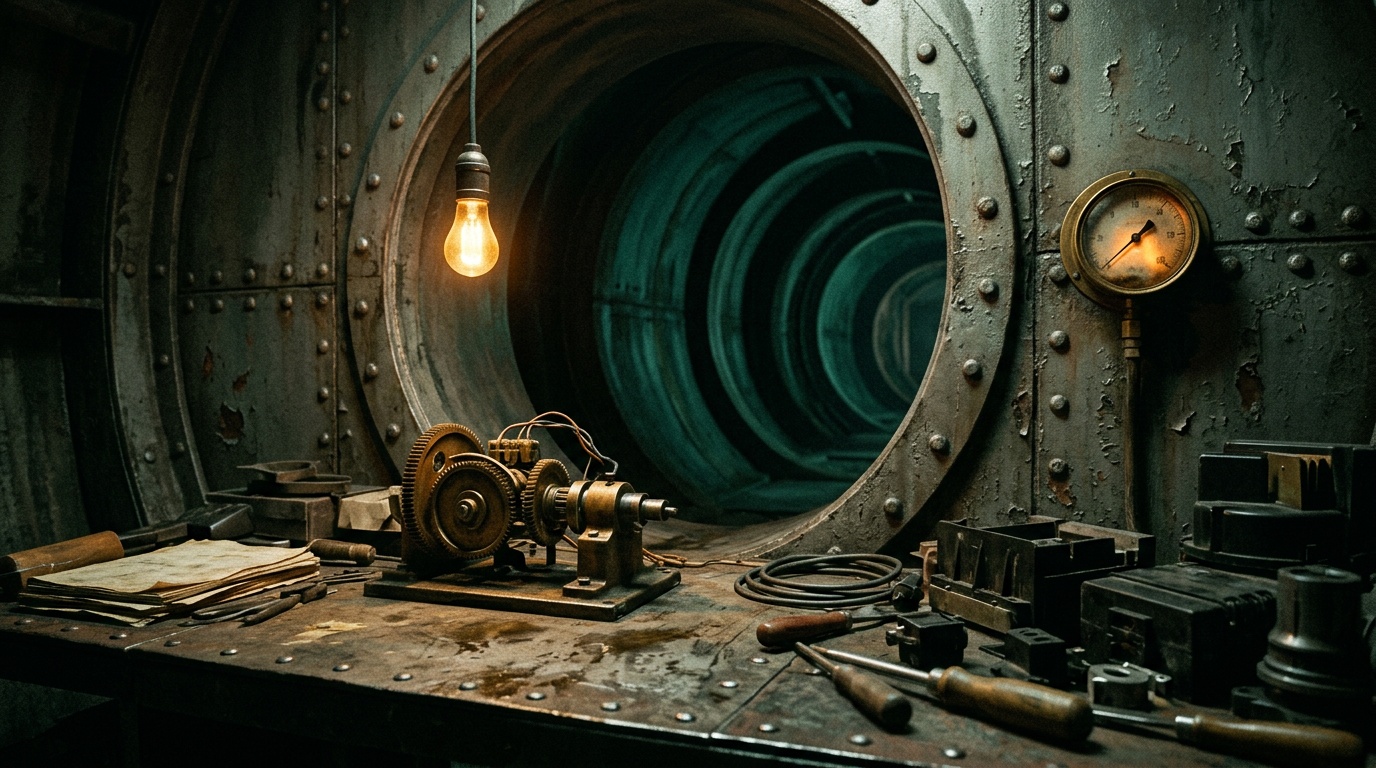
Knox Locked Down the Armory First
THE THEORY
Knox's two-part directive to his metal shop contact was not a precaution. It was the first tactical move of a war he had already decided to fight, before the uprising had any public shape. The show presents the conflict as a communal defense, but Knox was operating on a different calendar entirely.
How This Theory Works
The structure of Knox's instruction is what matters. He did not ask his contact to slow production or cache a few tools. He gave a two-part directive: refuse anyone else who comes asking, and manufacture exclusively for his team. That is not a defensive hedge. That is a monopoly, deliberately engineered at a moment when no open conflict had yet made such a monopoly necessary. You do not lock down a weapons supply before a war unless you have already decided the war is coming.
The downstream evidence confirms the strategy worked. The custom weapons visible during the episode 6 assault are consistent with sustained production from exactly the contact Knox secured. And the push to level 122, successfully driving the blockade ten floors higher against security forces, implies a materiel advantage that security did not anticipate. You do not improvise that kind of outcome. You build toward it.
What the evidence points toward, and what the show has not explicitly named, is that Knox had resolved the political question before Mechanical as a community had even fully framed it. Billings was still working official channels. The uprising had not yet declared itself. And Knox had already moved past legitimacy, past communal deliberation, past the question of whether force was justified. The metal shop directive precedes all of that. It is not a response to oppression. It is the quiet founding act of a faction preparing to win. The communal defense framing the uprising eventually adopts is, in Knox's case, a moral vocabulary applied after the strategic decision was already made and the hardware was already in production.
Is this theory convincing?
Key Evidence
Knox's Metal Shop Directive
Early in the season, Knox visited his contact in the metal shop and gave explicit instructions: do not make weapons for anyone who comes asking, but make weapons for Knox's team specifically.
Two-Part Instruction Structure
Knox's ask was not a single request but a two-part directive combining denial to others and exclusive production for his faction, indicating deliberate resource consolidation rather than opportunistic access.
Custom Weapons in Episode 6 Assault
The weapons carried by Knox and Shirley's group during the assault on the blockade appear to be custom-manufactured, consistent with ongoing production from the metal shop contact Knox secured early in the season.
Blockade Push Succeeding Against Security
Knox's group successfully pushed the blockade ten floors higher and claimed level 122, an outcome that implies a materiel advantage over the security forces that aligns with the weapons monopoly Knox arranged.
Knox's Consistent Factional Loyalty
Knox's instruction to his contact explicitly framed weapon production as being for his team rather than a neutral resource, establishing from the outset that he was preparing for a factional conflict rather than communal defense.
Other Theories for S2E06

Billings Chooses Law Over Bernard's Order
Billings's demand for a formal investigation into Meadows's death is not a good-faith procedural request.
Bernard's Blockade Destroyed Itself: How Coercive Pressure Handed the Down Deep Its Own Food Supply
Bernard's supply blockade has not merely failed — it generated the conditions for its own failure.
Billings' Herbs Were Making Him Sick
The herbs Billings takes for his Syndrome are likely causing his tremors, not suppressing them, meaning the silo's medical establishment has been administering a control mechanism disguised as treatment.
Quinn's Cipher Selects Its Own Heir, and Bernard Has Already Handed Over the Key
Bernard's offer to make Lukas his shadow is not mentorship but a coerced concession: the cipher in Quinn's letter exceeds Bernard's own capabilities, and Legacy access is the only bribe that keeps Lukas cooperative without a formal breach of protocol.
Bernard's Blockade Is the Order Executing Itself
The food blockade strangling Mechanical is not Bernard improvising under pressure but the Order's institutional protocol running exactly as written — a premeditated sequence with a calculated timer, no branch for truth, and no off switch.
Camille Is Using Protocol as a Weapon
Camille's deflection of Bernard using Judicial protocol was a prepared move, not improvised self-preservation, and preparation implies she coordinated with Robert Sims before the interrogation rather than after it.
Bernard Chains Lukas With the Legacy
Bernard's decision to make Lukas his shadow is a mechanism of capture, not a reward: the cipher in Quinn's letter did not convince Bernard that Lukas could help him, it convinced Bernard that Lukas was already dangerous enough to require containing.
Sims Never Planned to Pay Patrick
Sims recruited Patrick Kennedy with a payment he never intended to deliver, using an unverifiable promise of a memory-erasure drug as leverage against a man he designed to be ignorant of his own exposure.