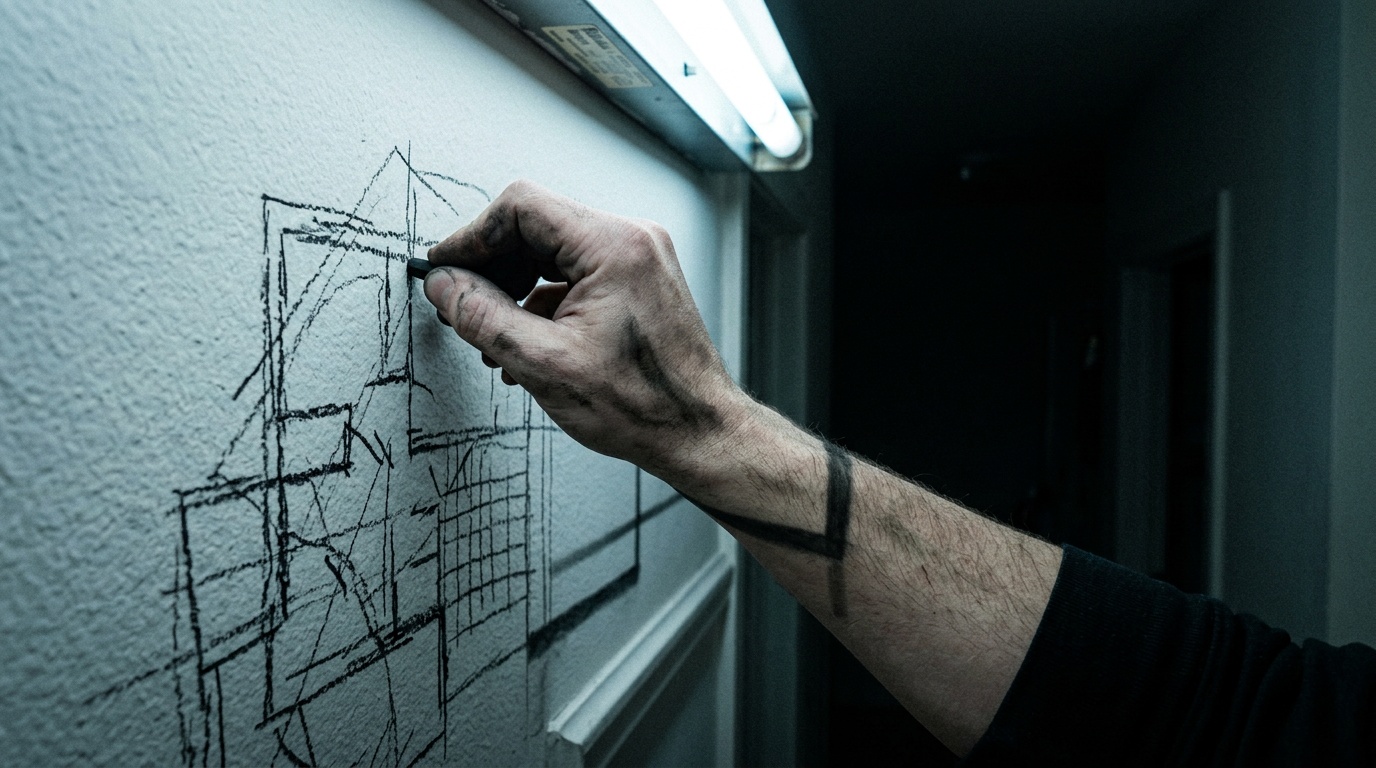
Irving's Paintings Are Messages to His Innie
THE THEORY
Irving's compulsive paintings are not artistic output but an unconscious attempt to reach a part of himself he cannot consciously access, which has accidentally exploited a structural flaw in severance's memory containment. The map found in his pocket, placed there with no conscious memory of doing so, confirms the channel already runs in both directions. What Irving's case proves, and what makes it structurally devastating for Lumon, is that the chip cannot suppress what was never stored as declarative memory in the first place: somatic compulsion, emotional orientation, and the body's own navigational intelligence.
How This Theory Works
Irving is not trying to communicate with his innie. He is trying to find him. The paintings are not a calculated exploit of a known flaw; they are the output of a man who cannot stop reaching toward a part of himself he cannot name or locate, and who has unconsciously discovered that repetition is the only tool available to him. The outie does not know why he paints. That ignorance is the point. It means the behavior is driven by something below conscious intention, which is the same layer the severance chip is supposed to own.
The severance chip suppresses declarative memory. It cannot suppress what was never encoded declaratively. Grief, compulsion, spatial familiarity, the body's trained orientation toward something it was once close to: these are not memory in the retrievable sense. They are states. Irving's outie does not remember the testing floor. He is drawn back toward it the way a body is drawn toward warmth, through mechanism rather than recollection. The paintings are the output of that mechanism made visible. By saturating his waking environment with a single image through sustained, repeated visual exposure, Irving forces that image across the barrier in a degraded form that his innie then investigates. The channel is not accidental noise. The innie's drawn attention to painted hallway imagery consistent with what the outie reproduces compulsively suggests the signal is directional. Something is being received.
The map in Irving's pocket closes the argument. Irving has no conscious memory of placing it there, and it carries actionable information about Burt Goodman's location. If images bleed from outie to innie through paintings, the map is evidence the inverse channel is also open, with the innie using the outie's body as a dead drop. The channel runs both ways. And crucially, neither half of Irving understands the system he has built. The outie has no vocabulary for what he is doing. The innie has no institutional support. What they have instead is a shared somatic substrate that the chip was never designed to silence.
This is where the structural argument lands. If the chip's containment model depends on suppressing conscious memory, it was always exposed to the layer beneath it: the body's own record-keeping, its unaddressed orientations, its compulsions. Irving stumbled into that layer by accident. A retired man in a house full of canvases has independently constructed a two-way communication system across a proprietary neurotechnological barrier through nothing more than compulsive repetition and grief he cannot explain. Lumon's confidence in severance as containment is not misplaced at the edges of implementation. It is misplaced at the level of what the chip was ever capable of suppressing.
Is this theory convincing?
Key Evidence
Compulsive Hallway Paintings at Home
Irving's outie fills his home with repetitive paintings of Lumon-style hallways and elevator imagery, suggesting deliberate and sustained visual reinforcement rather than casual artistic output.
Paint Bleeding Into Innie's Environment
Paint or painted imagery appearing in Irving's innie's workspace suggests the visual content from his outie's paintings is crossing the severance barrier in some degraded form.
Map Found in Irving's Pocket
After being fired, Irving discovers a map in his pocket with an X marking Burt Goodman's location, which he has no conscious memory of placing there, implying his innie used his outie's body to pass information outward.
Severance Shown to Be Permeable
The broader pattern of the show, including Mark's somatic grief responses and Irving's artistic reproduction of inaccessible innie environments, establishes that the severance chip cannot fully contain all forms of memory or experience.
Innie Investigating Painted Hallway
Irving's innie has been drawn to investigate imagery consistent with what his outie repeatedly paints, suggesting the subconscious channel is functional and directional rather than random leakage.
Other Theories for S2E02
Innie Mark Told Devon Gemma Is Alive
Innie Mark used the Overtime Contingency to deliberately reach Devon and tell her Gemma is alive, a revelation Lumon is now suppressing through an implicit threat against the innie's continued existence.
Lumon Fires Innies to Bury the Uprising
Lumon's terminations of Irving and Dylan are a targeted suppression strategy calibrated to map and seal the OTC breach before its scope can be documented or contested.
Lumon Built Cold Harbor From Grief
Lumon did not merely survive Gemma Scout's car crash.
Lumon Builds a World Without Testimony
Lumon operates a two-stage linguistic architecture of control: internally, corrective language reframes every punitive act as care, leaving employees with no vocabulary to identify or report what is being done to them; externally, Helena's apology video preemptively discredits any witness who breaks through anyway by reframing their account as personal instability.
Lumon's Advisory Council Is a Repeatable Containment Architecture, and Cobel Is Building It Herself
The Severance Advisory Council is not a reward for Cobel's crisis competence but a purpose-built psychological cage, constructed around her specific vanity and designed to neutralize her unsanctioned knowledge without releasing her from Lumon's legal and institutional orbit.
Irving Is Running a Secret Anti-Lumon Network
Irving's outie is an operative inside an organized anti-Lumon network, not a bystander who grew suspicious, and he was placed inside Lumon already recruited.
Cold Harbor Closes on Mark: How Lumon Converts His Moral Architecture into the Trap
Lumon's post-reintegration strategy operates on two interlocking levels: institutionally, every concession — the fired team's reinstatement, the board's reversals, Helena's 'long enough' framing — is calibrated to keep Mark compliant only until Cold Harbor is complete, after which his innie becomes expendable; psychologically, Milchick's parting line converts the final act of that institutional trap into something Mark experiences as a moral obligation, making refusal feel like cruelty rather than resistance.
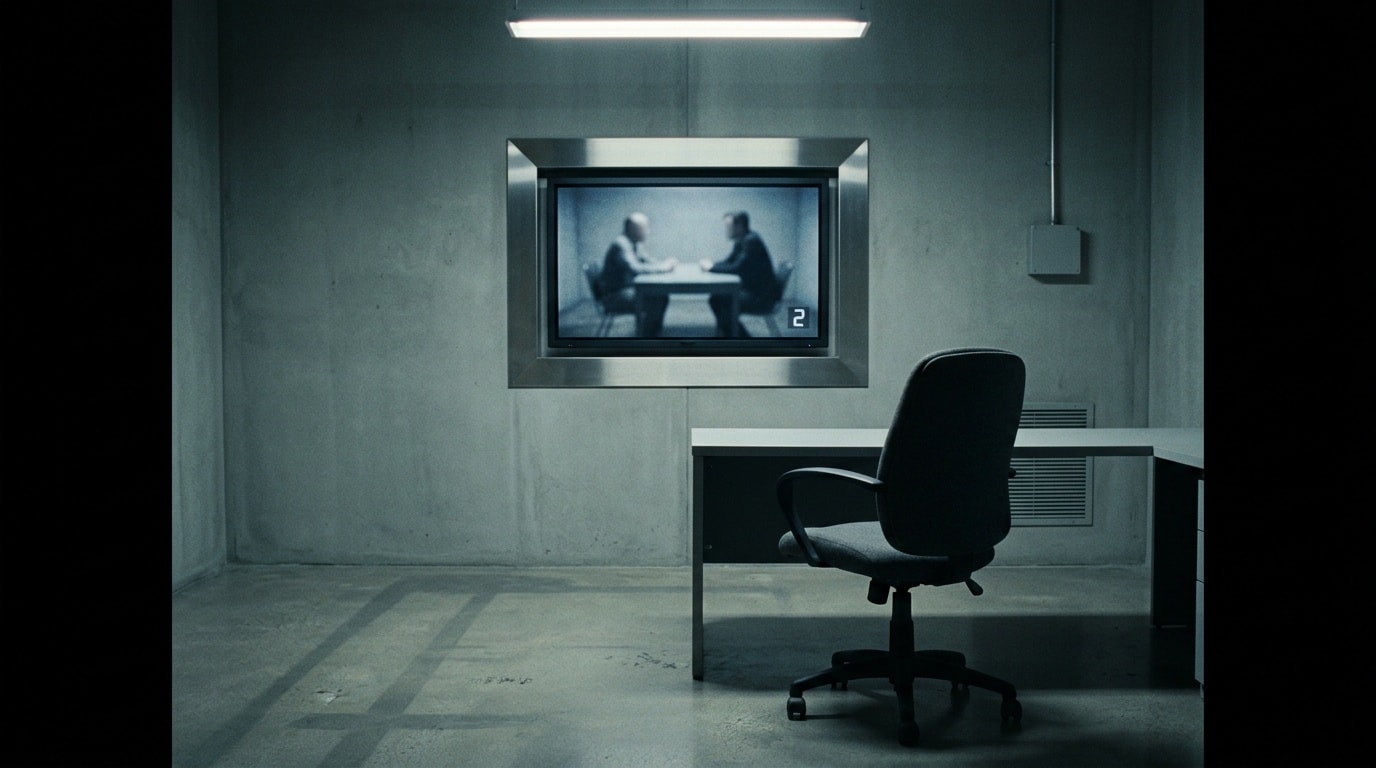
Helena Is Studying Her Innie To Replace Her
Helena Eagan is cataloguing her innie's established intimacy with Mark in order to replicate it on the severed floor, not to assess damage but to prepare for substitution under the one condition where substitution is hardest to sustain.