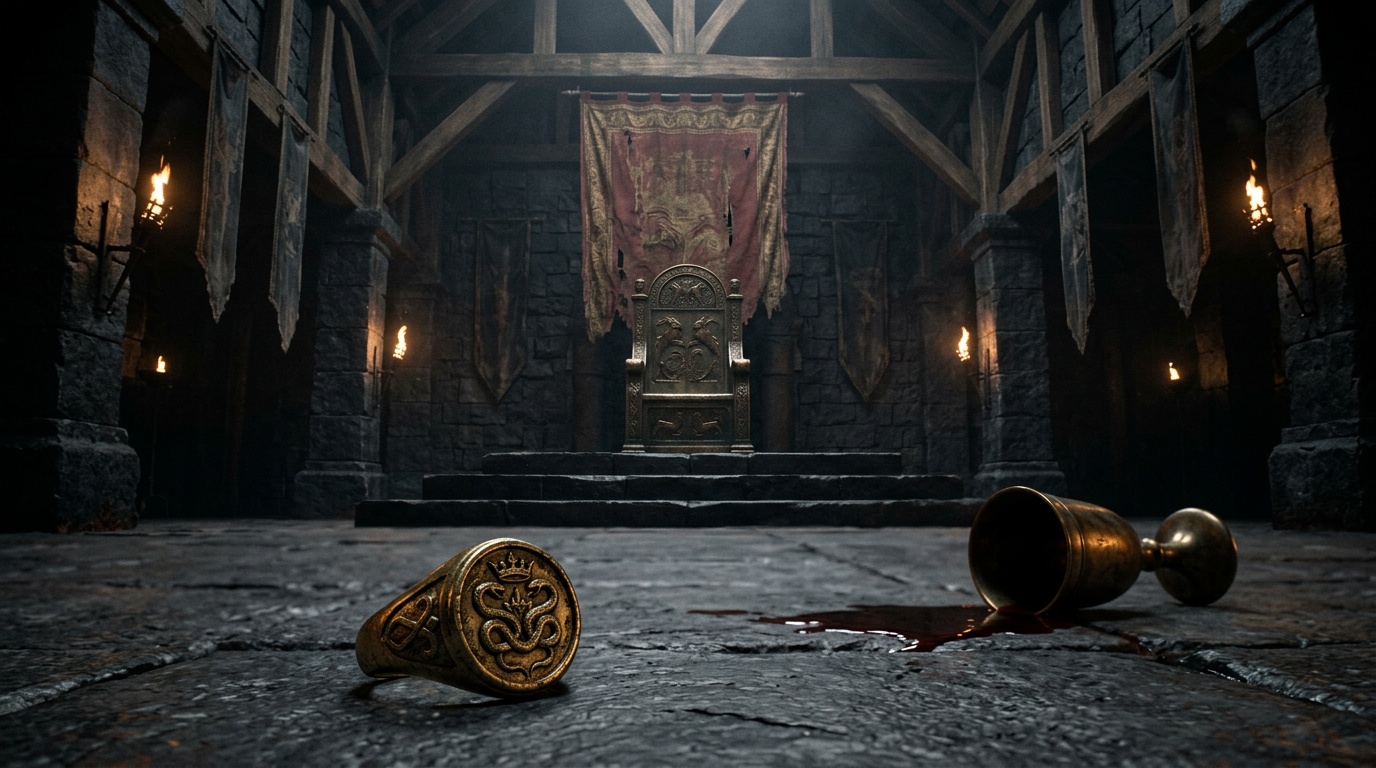
Aemond's Purge Is Larys's Harvest: How Absolute Rule Builds Its Own Blind Spot
THE THEORY
Aemond is not filling a power vacuum; he is deliberately manufacturing one, removing every institutional check on his authority in a sequence too coherent to be reactive. Larys Strong is not a casualty of this purge but its primary beneficiary, routing his most important move through Aemond's contempt rather than around it. The Triarchy alliance is not a strategic miscalculation Aemond could have caught; it is the logical endpoint of a system that has eliminated everyone capable of interrupting it.
How This Theory Works
Aemond's consolidation of power is not a series of reactive decisions made under wartime pressure. It is a sequential purge of institutional checks conducted in a specific order for specific structural reasons, and the war is not the cause; it is the cover. The removal of Alicent is the clearest evidence that the logic is deliberate rather than circumstantial: when Aemond tells her that his father is dead, his brother will soon be dead, and he has no further use of her, he is not speaking in anger. He is speaking in accounting. The conditions that once justified her council seat have changed; the seat is therefore revoked. The cruelty is in the precision. Criston Cole's dispatch to Harrenhal follows the same logic: not punishment but subtraction, removing the one voice capable of challenging Aemond's military judgment from within the chamber. And Larys, the most dangerous figure remaining, is handled through a maneuver of apparent contempt: mocked for presuming the Hand's position, then neutralized by a summons to Otto Hightower, a man who has gone silent in Oldtown and may never arrive. Otto is named not out of deference but as a tool for keeping Larys subordinate without granting him anything. What remains is a stripped-down council of Larys Strong and Jasper Wylde: not a temporary consequence of depleted ranks, but the destination Aemond has been building toward all along.
The error in reading this architecture is to assume that Larys is its victim. He is its beneficiary, and the Aemond scene is the proof, though it requires reading in reverse. Larys does not arrive to secure the Handship and fail. He arrives to be rejected for it. He frames the smallfolk crisis as a governance problem requiring structural remedy, allows the suggestion to carry an implicit candidacy that Aemond will find contemptible, and Aemond obliges precisely on schedule: the public mockery, the dismissal, the naming of an absent Otto. This is not a setback Larys must recover from. This is the outcome Larys required. By producing a nominal Hand who is geographically unavailable, he neutralizes Criston Cole's proximity to power without ever naming Cole as the target. He avoids the exposure of holding the title himself. He extends the vacancy he needs to remain indispensable. He did not maneuver around Aemond's contempt. He routed the play through it. The scorn was the instrument.
That the humiliation was the instrument becomes fully legible only in the scene that follows it. Within the same episode, Larys appears at Aegon's bedside and delivers a warning: that Aemond holds power and Aegon's life is forfeit as long as that remains true. The sequence of these two scenes is the argument. The public scorn gave Larys the raw material he needed to approach Aegon from a position of apparent vulnerability rather than calculated interest. He then deploys two moves that work together: he draws an explicit parallel between his club foot and Aegon's permanent injuries, establishing trust through manufactured kinship (two marginal men against a court that has never taken either seriously), and he counsels Aegon to refuse the milk of the poppy on the grounds that it clouds judgment. The disability parallel builds the emotional architecture. The counsel against sedation ensures Aegon emerges from recovery alert, functional, and capable of acting on the fear Larys has just planted. A man who wanted Aegon pliable would encourage the poppy. A man who wanted Aegon indebted would do exactly this. By the time Aegon begs Larys for help, Larys has already sequenced three preparatory moves: he has been publicly scorned by the rival, arrived as a fellow sufferer rather than a schemer, and steered the king toward the cognitive clarity required to understand the danger Larys described. The desperation is real. The conditions that produced it are not accidental.
This is where Aemond's competence and Larys's harvest converge on a single structural irony: the move Aemond executes most deliberately, mocking Larys and installing the absent Otto, is the move that produces Larys's most valuable outcome. Aemond has confused the elimination of dissent with the elimination of threat. Larys is not a dissenter. He does not oppose Aemond; he harvests the vacancies Aemond's competence requires him to create. Every figure Aemond removes to clarify his authority is a figure Larys converts into an obligation. The system Aemond is building is, from Larys's perspective, a machine for generating the political raw material he needs: fearful kings, empty council chambers, absent Hands, on which Larys's indispensability depends.
The Triarchy alliance is where this architecture produces its terminal consequence. Aemond overrules every voice in that chamber: Tyland Lannister and Criston Cole on military risk, Alicent on the proven historical untrustworthiness of these same fleets, established at cost during Viserys's reign. He does so not by refuting their arguments but by asserting authority. His tactical reasoning, that the Triarchy's fleets are geographically closer than Lannister and Hightower ships sailing around Westeros, is coherent in isolation. It fails entirely to account for why those fleets would remain loyal once deployed, what they will demand for their service, and what happens when those demands arrive. He even names the instability himself, acknowledging that their motivation is vengeance against Corlys Velaryon: grievance-based loyalty rather than interest-based loyalty. He proceeds anyway. That is not pragmatism. That is a man telling himself the danger is manageable because admitting otherwise would require him to listen to people he has just finished overruling. Alicent's removal is the sharpest edge of this problem: she was the institutional carrier of Stepstones memory, and she was also the person whose removal Aemond had the oldest and most personal reasons to engineer. The remaining council will evaluate Triarchy demands without the context that made those demands recognizable as a trap the last time. But more than that, the governing logic Aemond has constructed treats the absence of opposition as the achievement of clarity. When silence registers as confirmation rather than warning, the betrayal does not catch him because he failed to imagine it. It catches him because he built a system that converts the removal of dissent into the feeling of having been right, and Larys, having positioned himself as the sole remaining figure with access to both brothers, will be the only one in the room who saw the trap clearly and had every reason not to say so.
Is this theory convincing?
Key Evidence
Aemond Removes Alicent Mid-Session
After the Small Council meeting adjourns, Aemond tells Alicent his father is dead, his brother will soon be dead, and he has no further use of her, then formally removes her from the council and dismisses her to 'domestic pursuits.'
Aemond Overrules Criston Then Sends Him Away
Aemond dismisses Criston Cole's military objections about marching on Harrenhal and orders him to muster and march, physically removing his most experienced military voice from the council chamber.
Larys Blocked From Hand Appointment
When Larys suggests Aemond name a new Hand of the King, Aemond scornfully mocks him for presuming the position would go to Larys, then instead summons the absent Otto Hightower.
Stripped-Down Second Council Session
Aemond's second Small Council meeting is attended only by Larys Strong and Jasper Wylde, two figures with no independent military power or popular legitimacy, previewing the compliant council Aemond is assembling.
Alicent Insists on Her Tempering Role
Alicent tells Aemond she is needed on the council to provide a tempering voice, and Aemond replies he has too many of those already, explicitly identifying independent counsel as the thing he is removing.
Larys Warns Aegon of Assassination Risk
Larys visits the recovering Aegon and warns him that Aemond intends to kill him, with Aegon begging for help — confirming that Aemond's consolidation has a living obstacle he has not yet neutralized.
Otto Hightower's Suspicious Silence
Both Alicent and Orwyle confirm that Otto has not responded to any ravens summoning him to King's Landing, and Aemond orders his recall — a summons to a man who may never arrive, which neutralizes Larys without elevating him.
Other Theories for S2E06
Mysaria Weaponizes Hunger Against the Greens
Mysaria is running a coordinated two-stage operation that inverts the political meaning of Rhaenyra's own blockade: her agents seed the taverns of Flea Bottom with messaging that Aemond feasts while commoners starve, then food boats arrive under Rhaenyra's banner to ensure relief is credited to the Blacks.

Seasmoke Runs a Two-Condition Screen the Crown Cannot Pass
Seasmoke's selection logic requires both Velaryon blood and the absence of presumptive claiming: a dual criterion that operates entirely outside royal authority.
Aemond's Coldness Is Childhood Wound, Not Politics
Aemond does not know that his removal of Alicent is a personal sentence.

Alys Rivers Killed Grover Tully on Purpose
Alys Rivers orchestrated Grover Tully's death to manufacture a political outcome she had already promised Daemon as prophecy, converting herself from counselor to hidden architect of the Riverlands campaign.
Dragon Seeds Will Undermine Rhaenyra's Legitimacy
Rhaenyra's dragon seed program will succeed militarily while simultaneously destroying the ideological premise of her claim.

Rhaena Is Being Handed Sheepstealer
Lady Jeyne Arryn's 'alas, still wild' is an invitation, not a warning, and Rhaena is the intended recipient.
Aegon Remembers Everything and Fears Aemond
Aegon is performing amnesia about Rook's Rest because he remembers enough to know Aemond tried to kill him, and saying so while bedridden and surrounded by Aemond's allies would finish the job.
Otto Hightower Is Deliberately Staying Away
Otto Hightower's silence across every channel simultaneously is not absence but strategy: he has privately concluded that the Green cause under Aemond is unrecoverable, and he is preserving his distance from that failure so he can negotiate or reattach himself to whatever outcome survives.