
The Town Is a Centuries-Refined Predatory Institution Whose Community Infrastructure Destroys the Selves It Appears to Protect
THE THEORY
The Town is not a static captivity but a centuries-old transformation engine that has iterated its methods across documented cycles, deploying collective stability rituals to hollow out psychological interiority while reading individual trauma with such precision that its intrusions become indistinguishable from the victim's own cognition. Its community infrastructure does not simply confine its captives; it converts them, producing people who cannot be rescued because the selves who arrived no longer exist. The tower wall's inscriptions spanning 1506 to 1978 are not graffiti but an institutional ledger; Tabitha's stairwell vision is not trauma breaking loose but the mechanism's proof of completion.
How This Theory Works
The Town's primary weapon is not the creatures or the violence or the indefinite captivity; it is the community the survivors have assembled to endure all of those things. Shared tasks, shared rituals, and the daily performance of stability constitute the architecture of survival, and they work precisely by rendering the interior state inadmissible. The Nights Without Incident sign is the institution's purest instrument: every morning it survives, it ratifies the collective claim that everyone is holding together, and every person who holds themselves together for the group's sake internalizes, incrementally and completely, that falling apart is a form of betrayal. The community does not punish visible distress. It simply has no grammar for it, and a system that produces no grammar for interior collapse does not fail to prevent suicide. It selects for it.
Eric's death is not a community failing to notice a crisis. It is a community succeeding at producing a person who could not be noticed. He was making jokes about the radio tower the night he died. A Colony House resident reports this with the specific bewilderment of someone who understands, too late, that the jokes were the crisis: that performance had become so total there was no remaining gap between the mask and the man. Donna registered something earlier; she noted he looked glum when he arrived at the Sheriff's Office and told him to get good sleep. That observation is precise and useless in equal measure. The community's infrastructure is sensitive to the surface of distress; it has no instruments for what lies beneath. The Nights Without Incident sign had just been marked at 1, the institution's measurement of its own stability running in real time while one of its most practiced performers was dying. Donna's axe through Colony House's floorboards after his death, her declaration that it is a tomb rather than a home, is the identical psychological pressure finding a different exit: externalized, witnessed, survived. The institution's selection pressure kills the people who perform stability best, because they are the least likely to crack in ways others can see and intervene in before it is too late.
What makes this more than a community pathology, what elevates it from a tragedy of collective coping to a theory about the Town as predatory institution, is the tower wall. The years inscribed on the stone above Tabitha as she ascends are not carved by prior captives leaving a record for themselves. They are institutional: irregularly spaced, spanning 1506 to 1978, climbed toward rather than looked back on. The irregular intervals eliminate any countdown logic; these are discrete event markers, each a documented cycle. The 1864 entry is not incidental. It falls during a period of mass displacement and untraceable disappearance that would have provided ideal harvesting conditions for a system with no fixed address in the historical record. The span from 1506 to 1978 is the ledger of nearly five centuries of refinement. The final entry, 1978, represents the shortest gap in the sequence: if cycles are shortening, the institution is not winding down. It is accelerating. The dated forest bottles corroborate the reset mechanism at ground level. Their date range spans more than a century of prior occupation groups, each of which left a material trace before the surface was refreshed. The Town's contemporary appearance is not a continuity error. The environment resets between cycles while the trap holds. Victor, who has visibly aged across those cycles while everything else resets, is not a leftover anomaly but a preserved operational component, and his habit of naming the pattern for new arrivals at their moment of maximum disorientation is not a warning. It anchors them inside the trap's logic before they understand what the logic costs.
Tabitha's stairwell vision is the proof that five centuries of iteration have produced a mechanism of complete interior access. As she climbs, the environment cuts between her wood-framed home and stone tower walls, the ceiling light flickering between two distinct realities. She scolds Ethan for toys on the stairs; she asks for a knocked-over bottle to be retrieved; she runs domestic maintenance protocols while registering that something is catastrophically wrong. This is an exact cognitive split that mirrors the night Thomas died in the RV crash. The trauma layer then locks in through sound: a baby crying, a phone ringing, both anchored to Thomas's death. She calls for Jim to get the kids, a line she has apparently spoken before, in an RV, in the dark. The vision fuses her domestic reflexes, her spatial memory, her guilt, and her worst night into a single navigable environment. That fusion is architecturally precise in ways that random trauma response cannot be, and it is externally legible, the show renders it coherently, in ways that pure interiority cannot be. The Town did not wait for an opening in Tabitha's psychology. It reconstructed her interior life from the outside with sufficient fidelity that she cannot locate the seam between the reconstruction and the original. The seamlessness is not evidence that her trauma has gotten out of hand. It is the institution demonstrating that its targeting methodology, refined across five centuries and logged on a stone wall, is now complete.
Fatima's fear of the radio tower working, rather than failing, is where the two phases of the transformation engine converge into their sharpest expression. Before the tower, indefinite captivity was the only available frame; the routines, the jokes, the careful collective not-pressing-it were bearable as a permanent condition precisely because no alternative existed against which to measure them. The tower transforms that void into a countdown that may never reach zero, a specific thing to lose rather than a generalized absence to endure. Eric had learned to live without a future. What he could not survive was a future that kept almost arriving. But Fatima's dread reaches further than Eric's crisis: she is not simply frightened of losing the tower's promise. She has understood, at a level the narrative does not immediately reward, that the selves who would walk out are not the selves who arrived. Ellis reaches for his father's experience returning from war. Coming home is like traveling from another planet, unable to determine whether the world changed or whether you did, and that ambiguity is exactly what the Town's second phase produces. The survivors' bonds, their understanding of what they can endure, their sense of themselves: all of it formed inside a place that was reading them, resetting around them, and refining its hold on them before they understood what hold meant. If the radio tower works, it would scatter people whose interior lives have already been colonized back into a world that cannot know what the Town is, with no shared language, no public category, no collective framework of experience. Their displacement would not end. It would become permanent and invisible rather than temporary and shared. The institution does not need to keep you. It only needs to run its documented, iterated, centuries-tested mechanisms long enough. After that, wherever you go, you are already the Town's product.
Is this theory convincing?
Key Evidence
Eric's Jokes Before His Death
A Colony House resident tearfully reports that Eric had been saying he was fine and making jokes about the radio tower, exposing a complete inversion between his social presentation and his actual psychological state.
Donna's Overnight Observation
Donna notices Eric looks glum when he arrives at the Sheriff's Office and tells him to get good sleep, suggesting she registered his distress but did not identify it as a crisis.
Fatima's Fear of Success
Fatima tells Ellis she is more frightened of the radio tower working than not, articulating the psychological paradox that hope of escape can destabilize rather than sustain people already broken by captivity.
Donna's Axe and the Floorboards
Donna takes an axe to Colony House's floorboards after Eric's death, declaring it a tomb rather than a home, demonstrating that the same psychological pressure consuming Eric is operating across the community.
Nights Without Incident Sign
Donna marks a 1 on the Nights Without Incident sign before Eric kills himself that same night, framing the community's false sense of stability immediately before it is shattered.
Ellis on Returning From War
Ellis recalls his father saying that coming home from war is like traveling from another planet, grounding Fatima and Ellis's conversation about irreversible psychological change in a framework that applies directly to the town's captives.
Community Learns Too Late
The community only discovers Eric's death the morning after, having shared a space with him and missed every sign, reinforcing the theory that the town's psychological threat is invisible from the outside.
Other Theories for S1E09
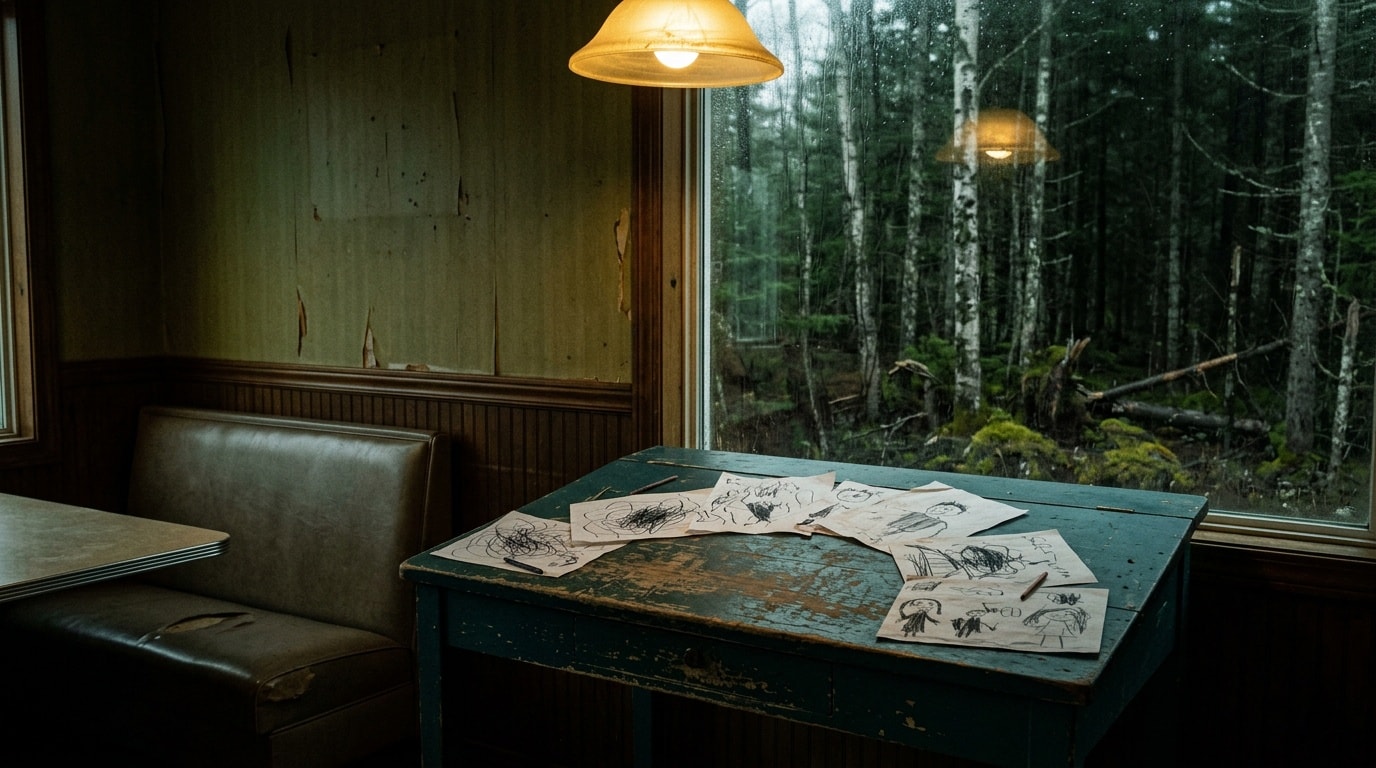
Victor's Drawings Tell the Whole Story
Victor's drawings are not random images but a sequential narrative that, once understood in the correct order, reveals what the residents of the Town must do next.

Donna Is the Power Failure: How Colony House's Leader Engineered the Collapse She Was Supposed to Prevent
Donna's management of community optimism around the radio tower is not strategic leadership but active psychological self-preservation.

The Nickname Is the Proof, and the Proof May Be the Trap
A voice from one of the forest's bottle trees instructs Sara to tell 'Mr.
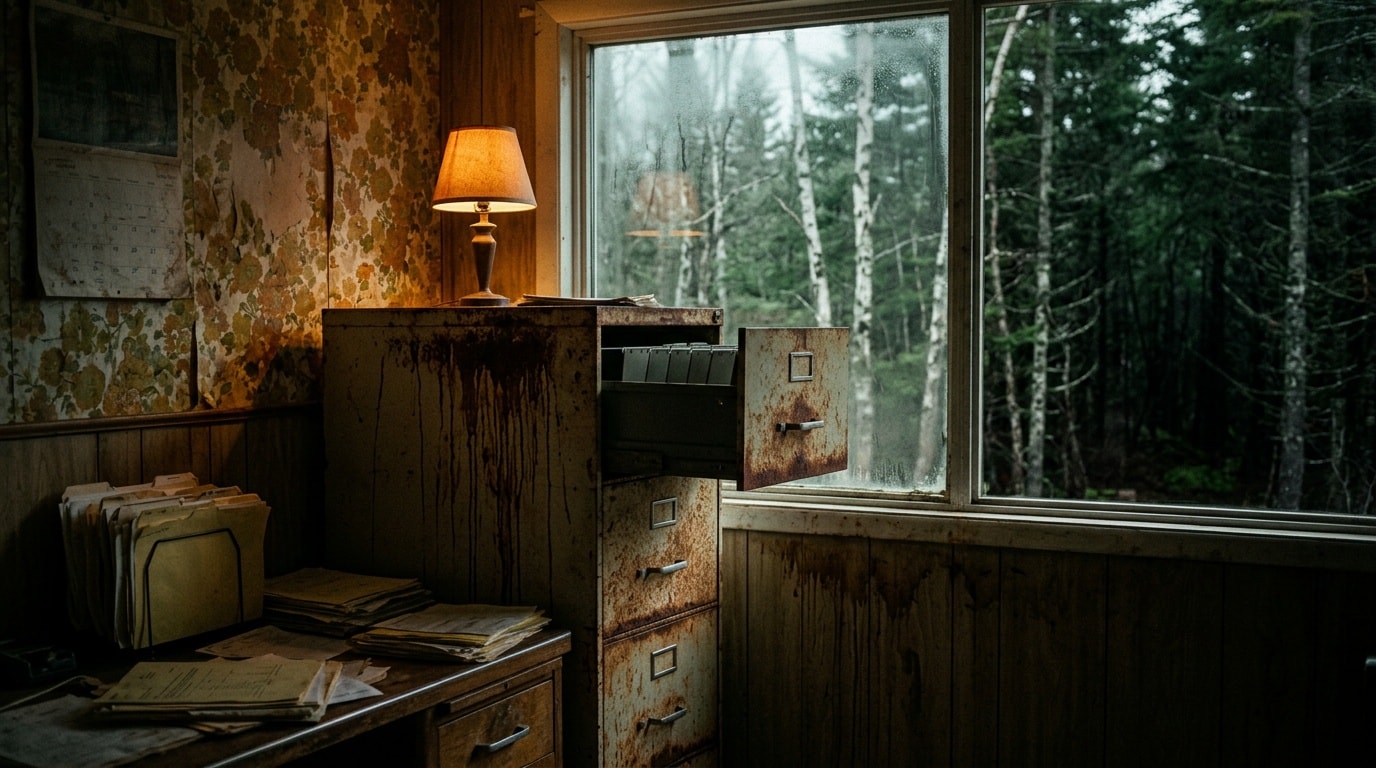
The Talisman Defeats One Layer of the Forest's Containment System While Leaving Boyd Blind to the Other
The forest operates as a deliberately engineered containment system with two interlocking enforcement mechanisms: a biological layer in which creatures function as couriers routing travelers toward an unknown destination, and a spatial layer in which the terrain redirects travelers back to origin while allowing them to feel they are making forward progress.