
Donna Is the Power Failure: How Colony House's Leader Engineered the Collapse She Was Supposed to Prevent
THE THEORY
Donna's management of community optimism around the radio tower is not strategic leadership but active psychological self-preservation. She is maintaining belief in a rescue plan she knows to be technically unsolved because the fiction of Colony House as a functioning home is the last structure keeping her functional. The power shortage is not a solvable engineering problem sitting in the community's future; it is a known void she has chosen to build on, in a town whose electrical infrastructure has already demonstrated that the gap between functional appearance and functional reality is not accidental. When that void surfaces publicly, the casualty will not be the rescue plan but the believability of Donna herself, because the audience will have watched her knowingly construct hope on a foundation the town may have designed to collapse under exactly this kind of pressure.
How This Theory Works
The power shortage Jade names to Jim is not a future risk the community is racing to solve. It is a present fact: charging the tower's batteries would drain Colony House's other resources almost immediately. Donna's leadership has chosen to construct community-wide emotional investment on top of it anyway. That distinction is the load-bearing one. When Donna tells Dale to stop voicing his pessimism because the other residents need something to believe in, she is not managing morale around a plan that might fail. She is managing morale around a plan that has already been identified internally as technically unsolved. The instruction is less a strategic calculation than a self-prescription: Donna needs the community to keep believing because she cannot afford to be the person who admits, before the axe scene forces it, that there is nothing underneath the belief.
What sharpens the problem considerably is the nature of the town's electrical system itself. The infrastructure Colony House depends on was not built to power anything human beings need to power. Surface components mimic familiar function while the underground architecture operates on entirely different principles: conductorless transmission, a convergence point that goes nowhere a rescue plan could use. The residents have been drawing real power from a system that was apparently designed to be traced to nothing. Donna's power shortage is not a failure of human planning inside a neutral environment. It is a human planning failure inside an environment whose infrastructure may have been constructed to produce exactly this outcome: the appearance of solvability wrapped around a technical void. She is building on a void, in a place built of voids.
Donna's authority has never rested on charisma or rank. It rests on a specific institutional fiction: that Colony House is a home worth defending rather than a holding pen. That distinction is structural, not sentimental. As long as Colony House is a home, Donna has a role. When Kenny raises the possibility of scavenging its floorboards for the radio tower, he is not asking for lumber. He is asking her to ratify the reclassification of everything she has organized her life around as temporary salvage material, and he is doing it in the same breath as asking her to accelerate a rescue plan she already knows cannot be powered. Her deflection of his comfort after Eric's death is the first visible tell. She redirects to work immediately, which is precisely what she does when the structure is still holdable. Eric made jokes; Donna made decisions. Both were performing normalcy as a survival strategy, and his death should have told her something definitive about where that strategy terminates. It did not stop her. What stopped her was the axe.
The axe into the kitchen floorboards is the moment the two pressures, the tower's known technical void and Colony House's impending symbolic reclassification, arrive at the same instant in the same body. She does not break because she is grieving, though she is. She breaks because the only frame that made the grief manageable has been physically dismantled by the same conversation that exposed the rescue plan as hollow. The destruction is not impulsive. It is the logical conclusion of a leader whose identity structure has just been asked to donate its walls to a project she knows will not work. What follows, Donna saying out loud, to Kenny and Jim, that Colony House is a tomb, is the moment the show makes the fiction's collapse irreversible. She has not thought it privately. She has named it to an audience, in the room where she has always been the person holding everyone else together.
Fatima's confession that she is more frightened of the tower working than of it failing adds the theory's sharpest second axis. If rescue is the goal, fear of success is incoherent, unless the community has, at some level, absorbed Donna's unspoken knowledge that the rescue scenario requires confronting everything the fiction was built to avoid. Who are these people now? What does returning home demand of them? The power problem is not purely technical. The uncertainty about whether the batteries can sustain the tower mirrors a larger uncertainty about whether rescue would resolve anything at all, or whether it would simply relocate the same psychological emergency to a different address. And if the town's infrastructure was never designed to yield a usable power source to begin with, Fatima's dread may be less irrational than it appears: the tower working would require the town to cooperate with a purpose it was not built to serve. Fatima's fear is the community's fear, expressed honestly by the one person who has not been instructed to suppress it.
The porch scene, Donna alone, regaining composure after the breakdown, frames what follows as a temporary rupture. That framing is the show's most dangerous misdirection. A leader can recover her composure. What she cannot recover is the audience's pre-axe belief that her confidence was grounded. The people who watched her name Colony House a tomb, in the same season she has been actively engineering belief in a radio tower with no confirmed power source, have seen the source code fail in real time. When the power shortage surfaces publicly, as it must, the damage will not register as a technical setback. It will register as confirmation of something the audience already suspects: that Donna has been managing a void, not a plan, and that the community's hope has been running on the same unspoken fiction that kept Donna herself upright. The collapse of the rescue narrative and the collapse of Donna as a functional leader are not separate events. They are the same event, arriving in sequence.
Is this theory convincing?
Key Evidence
Donna Calls Colony House a Tomb
When confronted about destroying the floorboards, Donna explicitly tells Kenny and Jim that Colony House is no longer a home but a tomb, framing her destruction as a conscious symbolic act rather than mere impulse.
Axe Taken to Kitchen Floorboards
Donna physically drives an axe into Colony House's kitchen floor after Kenny raises the possibility of scavenging its wood for the radio tower, making her psychological breaking point visible through direct destructive action.
Deflecting Kenny's Concern
When Kenny tries to comfort Donna about Eric's death, she rebuffs him and redirects to work, demonstrating the sustained suppression of grief that precedes her eventual breakdown.
Eric's Death as Leadership Failure
Eric had been making jokes and signaling normalcy before his suicide, mirroring the same performance Donna enacts as a leader, and his death forces her to reckon with the cost of that performance.
Colony House as Accumulated Meaning
The theory reads Donna's reaction as inseparable from Colony House's symbolic weight as a functioning community structure, which the tower project's material demands effectively dismantles.
Donna Storming Onto the Porch
After the axe scene, Donna goes to the porch alone to regain composure, visually marking the breakdown as a temporary rupture in her otherwise rigid self-control rather than a total collapse.
Other Theories for S1E09

The Town Is a Centuries-Refined Predatory Institution Whose Community Infrastructure Destroys the Selves It Appears to Protect
The Town is not a static captivity but a centuries-old transformation engine that has iterated its methods across documented cycles, deploying collective stability rituals to hollow out psychological interiority while reading individual trauma with such precision that its intrusions become indistinguishable from the victim's own cognition.
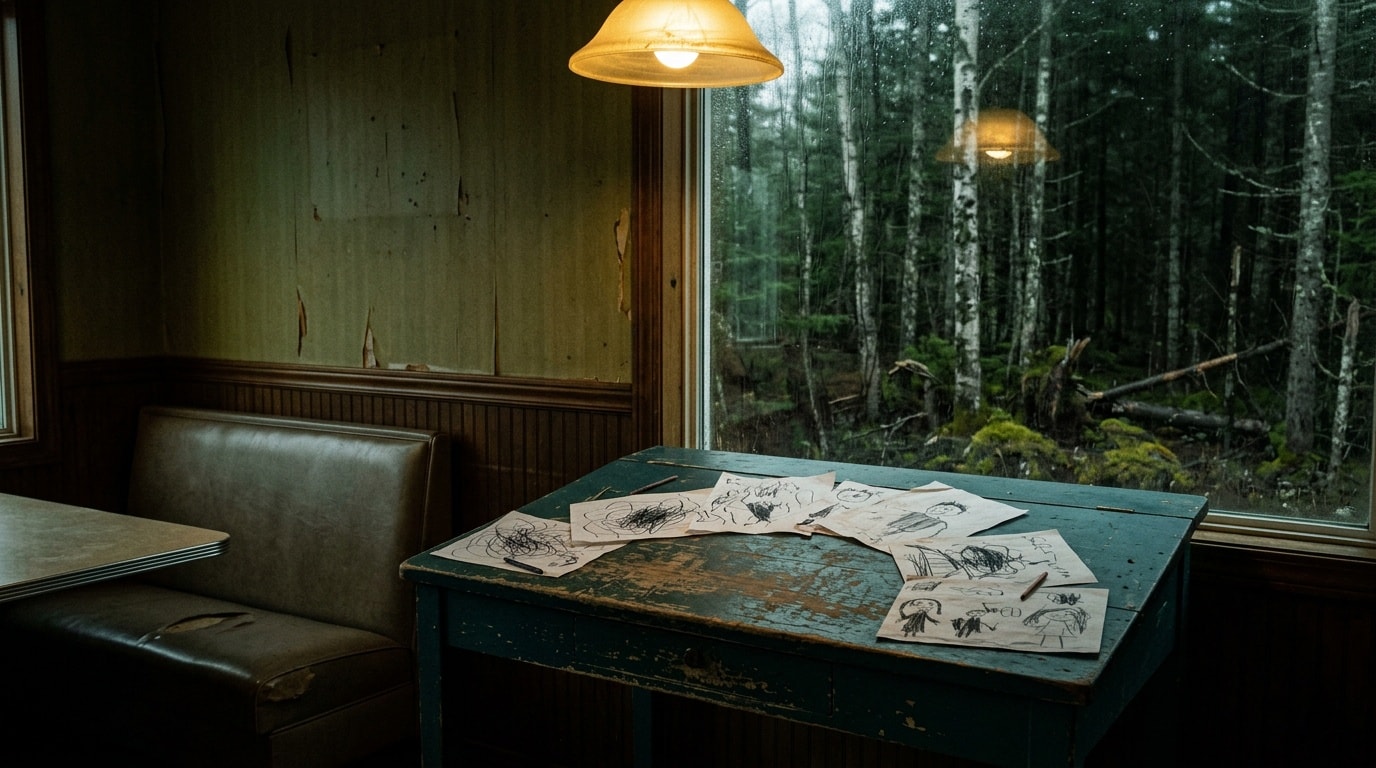
Victor's Drawings Tell the Whole Story
Victor's drawings are not random images but a sequential narrative that, once understood in the correct order, reveals what the residents of the Town must do next.

The Nickname Is the Proof, and the Proof May Be the Trap
A voice from one of the forest's bottle trees instructs Sara to tell 'Mr.
The Talisman Defeats One Layer of the Forest's Containment System While Leaving Boyd Blind to the Other
The forest operates as a deliberately engineered containment system with two interlocking enforcement mechanisms: a biological layer in which creatures function as couriers routing travelers toward an unknown destination, and a spatial layer in which the terrain redirects travelers back to origin while allowing them to feel they are making forward progress.