
Fromville Runs a Two-Phase Predation Architecture, and Tom Is Its Finished Product
THE THEORY
Fromville operates a closed predation system with two interlocking phases: a pre-arrival intelligence layer that profiles, cross-references, and positions structural pieces before first contact, feeding into a personalized hope-collapse-despair cycle calibrated to each resident's specific psychological wound. The apparent specialness of chosen individuals is an artifact of the targeting architecture, not a prerequisite for it. Tom represents the system's terminal efficiency: a resident who has internalized the loop so completely that the town no longer needs to run it against him.
How This Theory Works
The system announces itself before anyone can see it working. The diner jukebox activates without contact the moment a bus from Grand Rapids crosses the town boundary, playing a Neil Young song about returning home to someone waiting. Kristi, already held inside, had just mentioned she barely traveled beyond Grand Rapids and had been engaged before arriving. The bus carries her fiancé. The song encodes her specific situation back at her in the seconds before his arrival could anchor her most completely, before the bus is visible to anyone inside the town. This is the pre-arrival intelligence layer in operation: not a reaction to new arrivals but a registration of boundary breaches cross-referenced against the interior lives of residents already held. Whatever operates the jukebox had already profiled who was coming and what they stood to lose. The targeting begins before the subjects park.
The physical placement layer runs deeper and on a longer timeline. Boyd's forest sequence is its clearest demonstration: his tent moved while he slept, his original path made impassable, spiderwebs closing around the new position in a sequential pattern that resembles herding rather than hazard. The routing and the lure were coordinated in advance, not improvised. At the designed terminus waited an apparition constructed to look like Abby, Boyd's deceased wife, the one shape capable of overriding every survival instinct his military training had produced. The precision extends further: the voice that contacted Sara earlier used Boyd's Army nickname, which Boyd confirms was known inside the town only by Abby and his son Ellis. Whatever manufactured the apparition had accessed private memory before Boyd entered the trees. The forest was not broadcasting grief indiscriminately. It was reading Boyd specifically, mapping the precise wound that could override his judgment, and building the lure from that architecture. The differential hearing pattern confirms the design: Sara heard a voice telling her to go back that Boyd could not hear; Boyd heard the distress call that Sara could not. Each received a signal calibrated to their individual psychology, routed on a separate channel. A two-person party was disaggregated into two individual targets before either understood the engagement had begun.
Victor beneath Colony House is where all three subsystems become visible simultaneously. The boy in white told Victor to wait in the underground chamber (the same space where the creatures sleep and leave their drawings) and told him specifically that Tabitha would break through from above. Victor waited. When Tabitha takes a pickaxe to the basement rock and collapses through the floor, she lands where Victor has kept vigil, and his first words confirm the prophecy was fulfilled. Ethan's comment during the radio tower celebration makes the coordination explicit in terms no adult in the show has managed: Victor is doing his part of the quest while the radio is their part. A child who has demonstrated unusual orientation to the town's hidden structure has described Victor's subterranean wait as a coordinated mission within a larger architecture, and the boy in white is the only figure positioned to have orchestrated it. Victor spent an unspecified number of years surrounded by the sleeping creatures' own drawings, tolerated in a space that massacres ordinary residents, because a single transmitted prophecy was specific enough to sustain a years-long vigil. The boy either had authority to guarantee Victor's safety in that space, or he knew the conditions under which the creatures do not perceive Victor as a threat and positioned him there without disclosing that distinction. In either case, a piece was placed on the board years before any other player knew the game was in motion.
What the placement layer produces in its subjects is not rescue but orientation: forward movement in a direction the system requires, experienced from the inside as privileged knowledge. This is where the pre-arrival intelligence architecture feeds directly into the hope-collapse cycle Boyd names with diagnostic precision mid-collapse in the forest: the place makes people believe they are doing the right thing, gives them hope, and removes it, as though it is feeding on their pain. The mechanism demands real hope, not false hope, because the system extracts the distance between expectation and collapse, and that distance only exists if the investment was genuine. The signal actually working. The path genuinely opening. The vision convincing enough to walk into a spider swarm. The targeting infrastructure exists precisely to manufacture that quality of hope, hope calibrated to the specific wound of a specific person, so that its removal yields the maximum. Blunt, unrelenting despair produces a static population that stops straining. The town needs the planning sessions, the belief, the collaborative effort. It needs the attempt. What it harvests is the collapse. The storm arriving the moment Jim confirms a working signal does not need to destroy the tower immediately; it only needs to arrive early enough that survivors begin doubting their own efforts before the external punishment fully lands. The loop's most efficient configuration is a suppression architecture so reliable across so many iterations that residents have been trained to begin grieving their attempts the moment those attempts become serious.
Tom's bar is where stage three becomes visible as a pattern rather than an event, and Tom himself is the evidence that the loop has completed its full arc in at least one resident. His warning to Tabitha does not identify technical flaws in the radio tower plan. He does not say the team is underprepared or the timing is wrong. He says that clever people with good ideas all end up back at his bar. The word clever is the tell: quality of planning is structurally irrelevant to outcome. The town processes ingenuity and refunds despair, and Tom has catalogued enough complete cycles to stop being surprised by the terminus. His bar functions not as refuge but as repository, the place the loop deposits people it has already finished with. His refusal to participate is not pessimism. It is testimony from sufficient iterations to constitute a sample. The tragic inversion at the center of the integrated architecture is that a system designed to contain people has produced, as its most efficient output, a person who contains himself. Tom no longer needs the loop run against him. He has internalized its conclusion. Tabitha digging under the basement while the tower is live, Boyd collapsing in the forest before the spiders reach him, Tom's categorical refusal to begin: these are not three separate phenomena. They are the same process at different points of completion, and the targeting infrastructure that profiled Kristi's fiancé before the bus crossed the boundary, positioned Victor underground with a prophecy, and built an apparition from Boyd's most private grief is the same mechanism that eventually made Tom's self-suppression fully autonomous. The apparent specialness of every marked individual is entirely downstream of selection, placement, and information-shaping. They were not chosen because they were special. They appear special because they were chosen, positioned, and fed precisely calibrated knowledge that oriented them within the structure, and the system that ran that operation has been doing so longer than any current resident has been alive.
Is this theory convincing?
Key Evidence
Boyd Hears Voice Sara Cannot
Boyd hears a woman's voice calling for help deep in the forest while Sara, standing beside him, hears nothing, establishing that whatever is communicating is targeting Boyd specifically.
Apparition Grabs Boyd and Screams
Boyd finds what appears to be Abby trapped in a spider web, but when he approaches, the apparition seizes him and begins screaming, revealing the vision as a trap rather than a rescue.
Spider Swarm and Multiple Bites
Immediately after the apparition grabs him, Boyd is covered by spiders that bite him multiple times before Sara can pull them off, directly linking the encounter to his subsequent physical deterioration.
Mr. Fish and Loaves Nickname
The voice that contacted Sara earlier used Boyd's Army nickname, which Boyd confirms only his wife Abby and Ellis knew, indicating the entity constructing these visions had access to his private memories.
Boyd Collapses and Loses Will
After the spider attack Boyd begins to panic about finding no way out, voices the belief that the place feeds on their pain, and physically collapses, requiring Sara to help him back to his feet.
Town Feeding on Pain
Boyd himself articulates the idea that the place is feeding on their pain, framing the apparition and the attack not as random horror but as the town exploiting his specific grief over Abby.
Differential Hearing Between Characters
Sara heard a voice telling her to go back that Boyd could not hear, while Boyd heard the distress call that Sara could not, suggesting the town communicates with each character on a separate channel tailored to their psychology.
Other Theories for S1E10

Ethan Sees Everyone Playing Assigned Roles
Ethan's certainty about Victor's safety and separate role is not optimism but structural knowledge: he understands the town as a coordinated quest in which each person holds a specific function, and deviation from that function rather than lack of ingenuity is what keeps adults trapped.
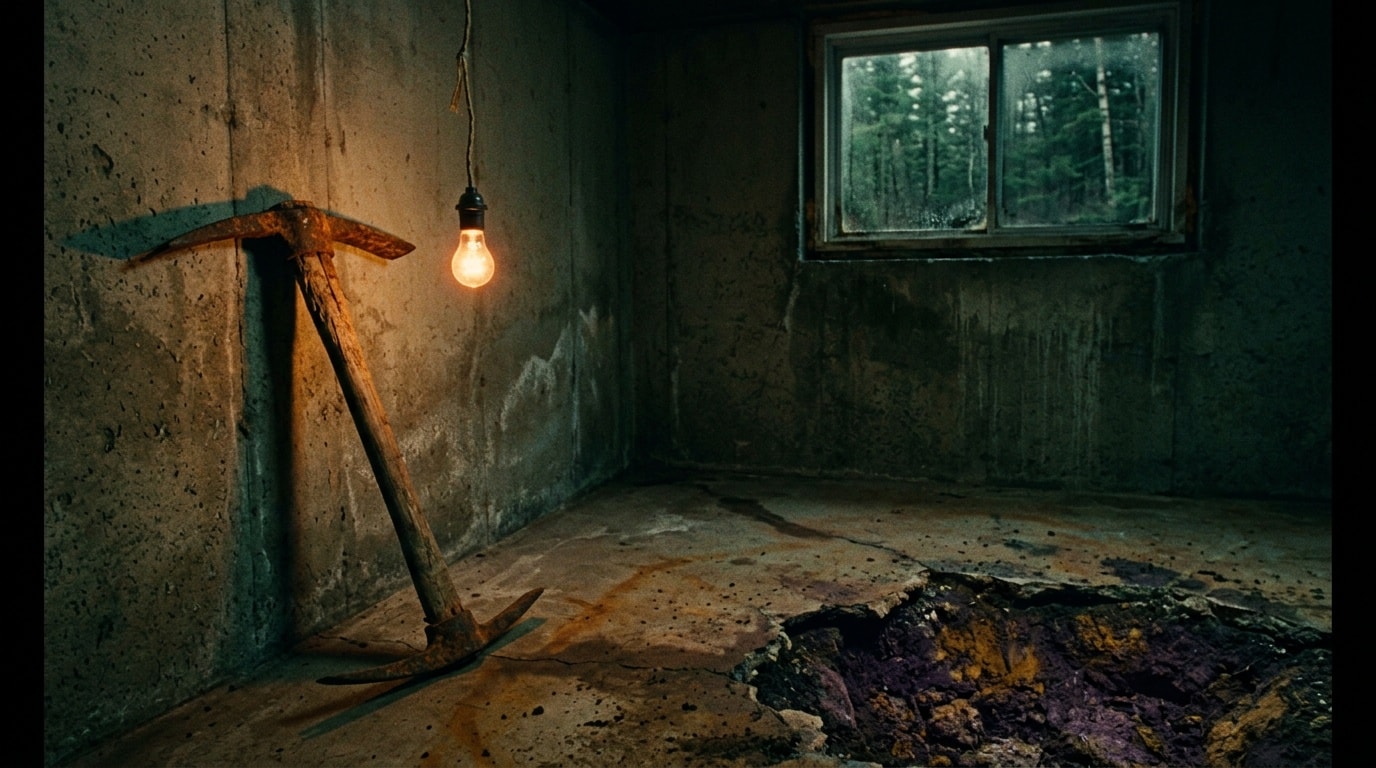
Tabitha's Pickax Points Toward Hidden Discovery
Tabitha's excavation beneath the basement floor is building toward a discovery the town's designed system does not want made.

The Boy in White Runs a System of Selective Disclosure, Not a Rescue Operation
The town operates a hidden communication layer that identifies specific individuals (Victor, Ethan, Sara, Boyd) as cognitively or experientially receptive targets, then uses the boy in white to deliver precisely calibrated information to each one.

Dead Residents Warn the Living Through Signals
The voices contacting the townspeople through radio and forest phenomena are the dead, but their capacity to warn is not independent -- it is a function the town permits and shapes.

The Storm Arrives When the Signal Does
The town actively destroys escape infrastructure at the precise moment it becomes functional, which means the system was designed not merely to trap but to deny the conditions under which escape becomes possible.