
Wilzig's Briefing Came From Moldaver's Network, and Moldaver's Network Got It From Lucy's Mother
THE THEORY
Wilzig's unprompted recognition of Lucy by name, vault, and family detail was not observation — it was intelligence, assembled by Moldaver's network before the two ever met. The organizational infrastructure capable of building that file traces to Enclave-era research networks Wilzig himself inhabited, and the individual-level source most consistent with the evidence is Lucy's mother, already inside Moldaver's operation. Wilzig's repeated instructions to turn Lucy around are not warnings from a stranger. They are targeted instructions from someone who knows exactly where she is headed and why she must not arrive.
How This Theory Works
Wilzig knows Lucy's surname before she speaks it. He names her vault, identifies its primary agricultural output, and references a specific internal technology — the telesonic projector — that would not appear in any surface-level observation of a sealed vault. Lucy's visible alarm at hearing her own name establishes that this knowledge is not incidental. The question the scene forces is not whether Wilzig holds a profile on her but how that profile was assembled, and by whom, before a chance encounter in the wasteland.
The delivery chain points directly to Moldaver. Ma June was already waiting for Wilzig when he arrived, confirming he was traveling a pre-arranged route with known logistics contacts rather than improvising his movement. Lucy's subsequent discovery of Moldaver's name in Ma June's ledger closes the loop: the people expecting Wilzig are the same network that took her father. Wilzig was not wandering toward Moldaver's operation at the same time Lucy was. He was already inside it, moving along sanctioned routes, which means any intelligence he carried about Lucy was sourced from within that same structure.
The organizational history of that structure matters for explaining the file's depth. Wilzig spent years inside an Enclave research facility — an institution with the documented institutional reach to run biomedical experiments, breed specialized military assets, and maintain operational security against surface threats. An organization at that scale would plausibly have built and maintained surveillance records on vault populations it oversaw or intended to leverage. Vault-level data — crop yields, designated numbers, internal technology catalogues — sits within what such an apparatus could assemble from population-level records. A specific resident's surname does not. That granularity requires a targeted file built around a particular family, and the Enclave's research network provides the infrastructure through which Moldaver, herself operating in that institutional tradition, could have assembled and maintained it.
Lucy's mother is the variable the show keeps withholding. Moldaver's operation is framed throughout as a personal matter rather than a general faction conflict, and the target of what looks like a directed extraction is Lucy's father specifically — not the Vault, not its technology, not its population. A scientist briefed on Lucy's family at the individual level, traveling a route controlled by the network that took her father, and instructed to turn Lucy around before she reaches the destination — that chain of facts requires a source with both personal knowledge of Vault 33's inhabitants and active investment in keeping Lucy away from what she is walking toward. The most structurally coherent candidate is someone who knew Lucy before the surface, whose absence from the Vault is the premise of the entire storyline: her mother. If her mother had a prior life connected to the surface, or left the Vault and found her way into Moldaver's network, that history is the only available explanation for why Moldaver holds individual-level intelligence on Vault 33's residents rather than institutional-level data on the Vault itself.
Wilzig's twice-repeated instruction that Lucy go home carries the weight of this reading. Generic wasteland caution would not be delivered with that insistence or that specificity. The response of someone who knows what she will find — who has been told enough about her situation to assess that she is in particular danger, not merely out of her depth — is the response of someone operating from a brief. Moldaver gave him that brief. The brief came from someone who already knew Lucy's name, her vault, her father's role, and the exact danger she would be walking into. The show has not confirmed her mother's location or allegiance, but every piece of evidence in this chain points toward the same withheld conclusion: she is with Moldaver, and has been long enough to become the source.
Is this theory convincing?
Key Evidence
Wilzig Recognizes Lucy Immediately
Wilzig identifies Lucy as a Vault dweller and demonstrates knowledge of her specific Vault before she has introduced herself, behavior that implies prior briefing rather than simple observation.
Wilzig's Repeated Warnings to Lucy
Wilzig tells Lucy to go home not once but twice, with a specificity and insistence that suggests he knows what she will find if she continues rather than offering generic wasteland caution.
Ma June's Hostile Reaction to Moldaver
Ma June shuts down the conversation and orders Lucy out of her store the moment Moldaver's name is spoken, indicating a relationship charged with more than ordinary criminal business.
Ma June's Ledger Lists Moldaver
Lucy finds a recorded transaction in Ma June's ledger bearing Moldaver's name, confirming Moldaver is the arranged client for Wilzig's extraction and placing Moldaver at the center of the network Lucy has stumbled into.
Moldaver's Network Knows the Vault
The convergence of Wilzig's surface knowledge of Lucy, Ma June's pre-arranged transport deal, and Moldaver's name in the ledger suggests a connected operation with prior intelligence on Vault 33's inhabitants.
Other Theories for S1E02

Wilzig Was Moldaver's Operative, and His Head Is the Delivery Vessel She Commissioned
Wilzig's departure from the Enclave was not an escape Moldaver reacted to but an extraction she orchestrated, with Ma June's Sundries functioning as a pre-arranged waypoint in her network.

Lucy's Vault Morality Will Not Survive
Wilzig's warning that Lucy will become 'a different animal' is a structural prediction about identity collapse, not a metaphor for danger: her Vault-bred values are pre-adaptation traits the surface will select against, and her arc is the gradual dissolution of the person who left Vault 33.
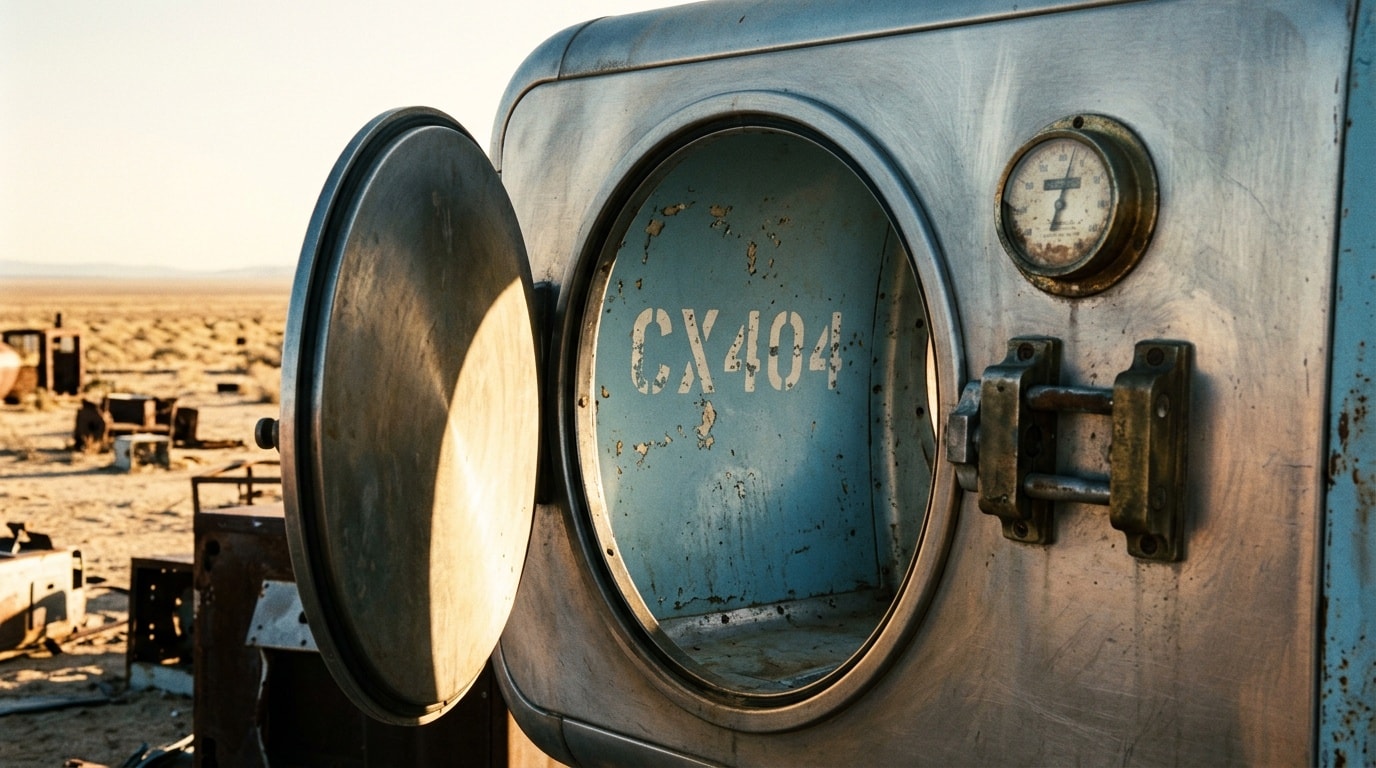
CX404 Is an Enclave Weapons Asset
CX404 is a purpose-bred Enclave combat asset whose handler was switched, not a companion animal with unusual training.

Vault-Tec Sold Suicide as a Feature
Vault-Tec built a tiered corporate protocol that assigned branded suicide pills to people it had already determined would not receive vault access, transforming mass death into a managed product offering rather than an abandonment.