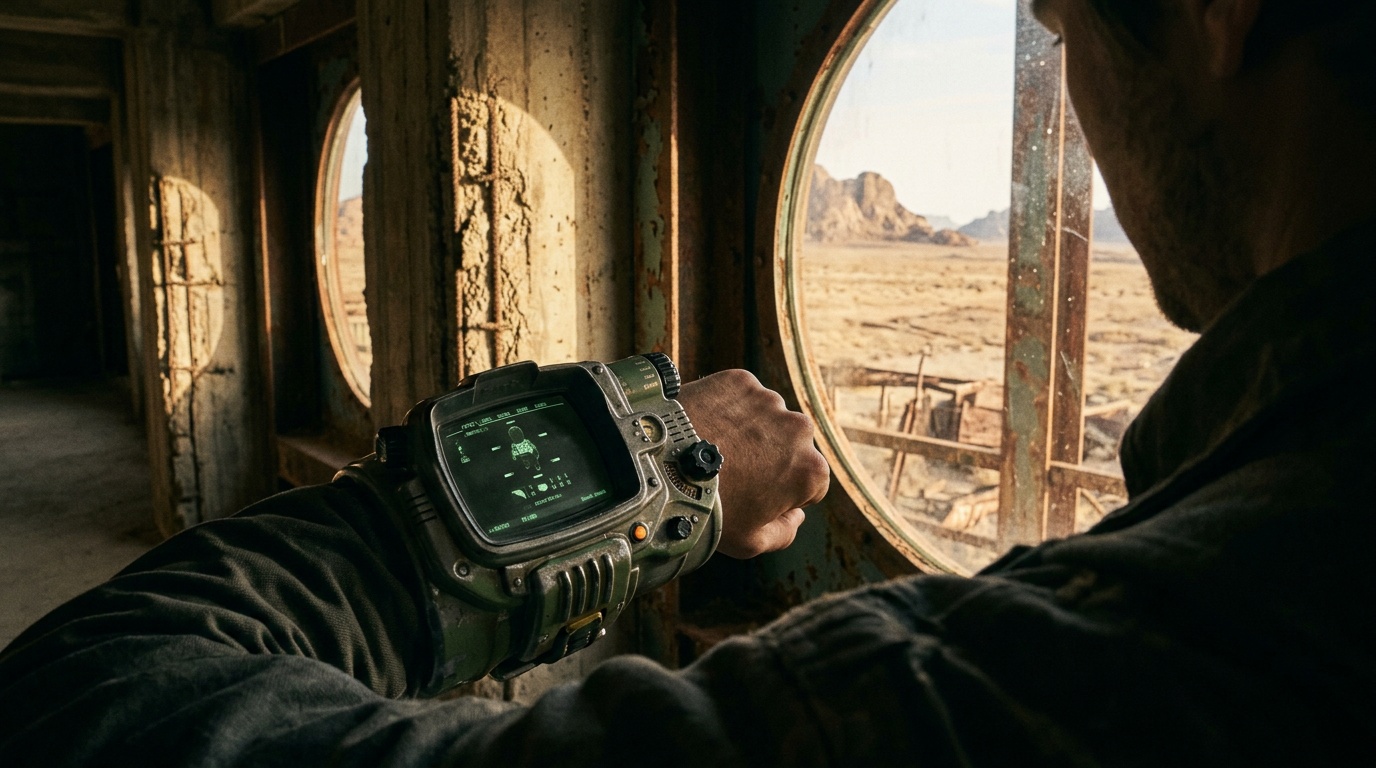
Lucy's Vault Morality Will Not Survive
THE THEORY
Wilzig's warning that Lucy will become 'a different animal' is a structural prediction about identity collapse, not a metaphor for danger: her Vault-bred values are pre-adaptation traits the surface will select against, and her arc is the gradual dissolution of the person who left Vault 33. Every tool she brings from the Vault fails on contact with the wasteland, not because she uses them wrongly but because the environment does not register them. The theory holds that when Lucy finds her father, the desires that sent her looking for him will already be gone.
How This Theory Works
Wilzig's warning that Lucy will become 'a different animal' is not idle philosophy but a structural prediction about identity collapse: the values and desires she carries out of the Vault will be shed as survival demands replace them, and the Lucy who eventually finds her father will not be the Lucy who left Vault 33. That distinction matters. The warning is not about physical danger but about the dissolution of wanting itself.
Wilzig frames the prediction through evolutionary biology, and that framing is load-bearing. The radroach became a fast and predatory killer through adaptation. CX404 was saved from incineration as an undersized puppy and engineered into a lethal instrument. When Wilzig says 'a different animal altogether,' he is pointing at a biological process, not a metaphor. The implication is that what Lucy currently calls her values are pre-adaptation traits that the surface environment will select against. The creature that survives is not the creature that entered.
Every tool Lucy brings from the Vault fails on contact with the surface. Her tranquilizer gun does nothing to the Ghoul. Her attempt to de-escalate the Filly shootout through invoked authority and reason is ignored entirely. The wasteland does not punish her value system; it does not register it. This is not a story about a principled person being tested and prevailing. It is a story about a principled person being made unrecognizable. The question the series is building toward is not whether Lucy will survive, but whether anything she currently values will survive inside her.
Is this theory convincing?
Key Evidence
Wilzig's 'different animal' warning
Wilzig directly tells Lucy: 'Will you still want the same things when you have become a different animal?' framing her transformation as an inevitable consequence of surface survival rather than a possibility.
Radroach evolution as framing device
Wilzig's warning follows his explanation that radroaches evolved from harmless cockroaches into fast, predatory killers, positioning Lucy's potential transformation within an explicitly biological and evolutionary framework.
Lucy's failed de-escalation attempt
Lucy steps into the Filly shootout attempting to non-violently defuse the conflict by invoking authority and reason, a Vault-dweller social script that the Ghoul ignores entirely, demonstrating her current values are functionally useless on the surface.
Tranquilizer gun ineffectiveness
Lucy shoots the Ghoul with her non-lethal tranquilizer gun, the literal embodiment of her preference to avoid killing, and it has no effect whatsoever, signaling that her moral tools are incompatible with the environment she now occupies.
Lucy's stated unwillingness to return
When Wilzig urges her to go home, Lucy refuses, asserting she will not return without her father, establishing a fixed desire that Wilzig's warning specifically targets as something that may not survive her transformation.
CX404 as transformation precedent
CX404 was saved from incineration as an undersized puppy and engineered into a lethal protector, functioning as a visible model of how surface survival reshapes a creature into something unrecognizable from what it began as.
Other Theories for S1E02
Wilzig Was Moldaver's Operative, and His Head Is the Delivery Vessel She Commissioned
Wilzig's departure from the Enclave was not an escape Moldaver reacted to but an extraction she orchestrated, with Ma June's Sundries functioning as a pre-arranged waypoint in her network.

CX404 Is an Enclave Weapons Asset
CX404 is a purpose-bred Enclave combat asset whose handler was switched, not a companion animal with unusual training.
Vault-Tec Sold Suicide as a Feature
Vault-Tec built a tiered corporate protocol that assigned branded suicide pills to people it had already determined would not receive vault access, transforming mass death into a managed product offering rather than an abandonment.

Wilzig's Briefing Came From Moldaver's Network, and Moldaver's Network Got It From Lucy's Mother
Wilzig's unprompted recognition of Lucy by name, vault, and family detail was not observation — it was intelligence, assembled by Moldaver's network before the two ever met.