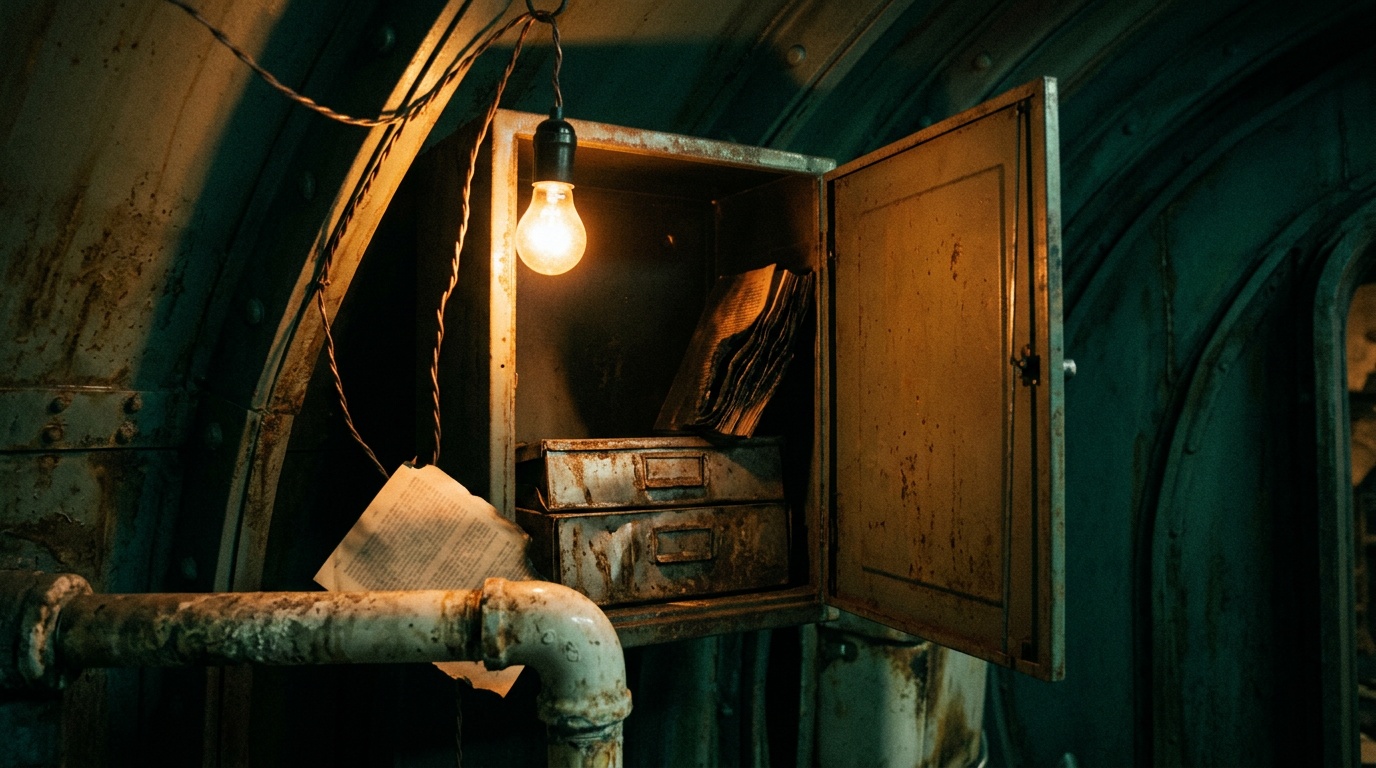
Billings Burns the Book, Keeps the Truth
THE THEORY
Billings burns the Georgia book to perform institutional compliance while tearing out and retaining a single page -- an act that reveals he has already concluded the institution does not deserve to know everything he knows. Operating entirely outside orders and reporting nothing to Judicial, Sims, or Bernard, he leaves Juliette's apartment carrying private proof that the Silo's account of the outside world is false. The burn is cover; the page is a verdict he has rendered alone.
How This Theory Works
Billings has already chosen, and the burn is cover for that choice. By the time he tears out the page, he is not an enforcer experiencing a moment of weakness. He is a man performing compliance for an audience that is not present, which is a more deliberate and more compromising act than simple hesitation.
He reaches the discovery not because he was sent but because he went, operating entirely outside any chain of command. That independence is not incidental. It means no one is watching, no one is expecting a report, and no one will know what he found unless he tells them. The concealment is available to him before he even opens the cover.
Reading the book before acting is where the theory's weight sits. He does not find the book and immediately destroy it. He sits with it. A travel guide for children describing Georgia's landscapes is not ambiguous contraband -- it is a direct contradiction of the Silo's foundational claim about the world outside. Billings has already been pressing against his own capacity for concealment, weighing whether to disclose his Syndrome diagnosis. His faith in the official order is not intact when the book reaches his hands. It is already fractured, and the book is what falls through the crack.
His response splits the act of destruction from the act of preservation, and the split is deliberate. Burning the book is the performance. Tearing out the page is the intention. He does not report the discovery to Judicial, does not pass the page to Sims or Bernard, and leaves carrying evidence of the outside world on his person. The burn gives him deniability. The page gives him something else: proof, held privately, that the institution's account of reality is false.
The direction of that choice is what the theory cannot afford to leave unspoken. The page does not point toward Judicial or Bernard or Sims. It points toward Juliette -- not as loyalty to a person but as alignment with a question she asked that the Silo forbids. What Billings is concealing is not just evidence. It is the fact that he has already agreed with the evidence. He does not become a rebel in this moment. He becomes something more structurally dangerous: an enforcer who has assessed the institution's foundational lie, pocketed his conclusion, and returned to his post to keep enforcing. The Silo does not fear the person who breaks and runs. It should fear the one who stays, serves, and privately knows.
Is this theory convincing?
Key Evidence
Book Hidden in Bathroom Cabinet
Billings finds 'Amazing Adventures in Georgia: A Travel Guide For Kids' concealed behind the medicine cabinet in Juliette's apartment, a hiding spot he locates by remembering how Juliette planted evidence in a bathroom cabinet during a previous case.
Billings Reads Before Burning
Billings sits in Juliette's apartment and reads the Georgia book before taking any action to destroy it, suggesting the content had time to register and affect him emotionally.
Page Torn Out Before Burning
Billings tears a single page from the book and sets it aside before placing the rest in Juliette's oven and turning it on, a deliberate act of preservation in the middle of an act of destruction.
Page Kept on His Person
Billings leaves the apartment holding the torn page, having not reported the book's existence to Judicial or to Sims, which makes the retained page an active concealment of evidence rather than an oversight.
Discovery Made Without Orders
Billings breaks into Juliette's apartment independently after being turned away by the official Judicial team, meaning his entire investigation and subsequent discovery of the book unfolds outside any chain of command.
Pact Loyalty Already Under Strain
Earlier in the episode Billings debates with his wife whether to confess his Syndrome diagnosis, framing concealment of the truth as a threat to his family, which positions his later decision to conceal the book as part of an escalating pattern of divided loyalty.
Other Theories for S1E09
Number 18 Marks a Larger Hidden Network
Bernard's alert device was flashing the number 18 before Lukas named it, which means the device is not responding to artifact tracking but to a signal that precedes and operates independently of anything inside the silo.
The Mirror That Watched Back
Someone installed a two-way mirror in Juliette's apartment without her knowledge, and the missing vent cover is the specific detail that places the modification outside her own doing, because an occupant running her own surveillance operation has no reason to conceal construction work from herself.
The Sims Family's Quiet Play for Power
The Sims family is running a dual-track survival strategy premised on Bernard Holland's removal, not his continuation.