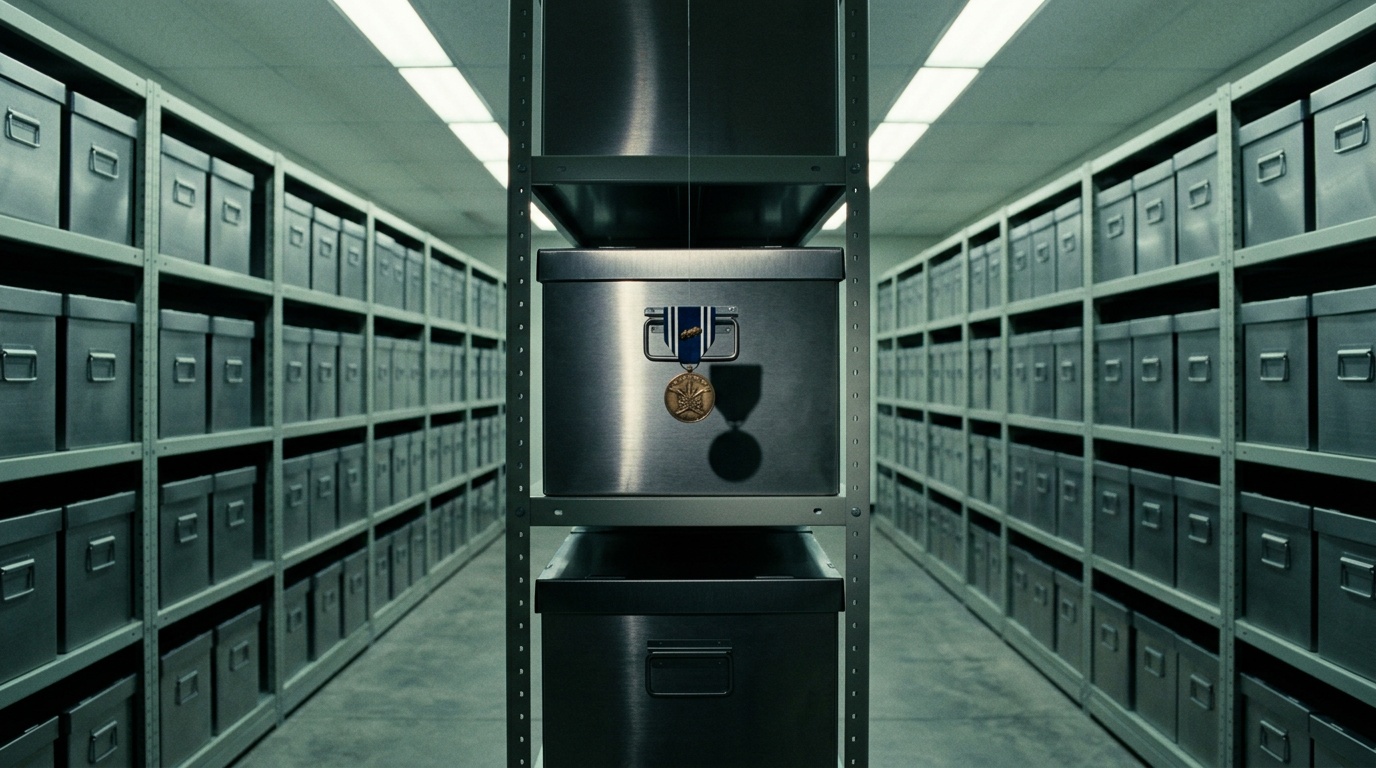
Radar the Dog Signals Irving's Naval Past
THE THEORY
Irving's innie has reconstructed an ideological commitment to authority from a behavioral residue left by his outie's military background, without any memory of where that commitment came from. The military medals in his outie's home and a dog named Radar are coordinated details pointing toward prior service that the show has not confirmed in dialogue. If that reading holds, severance has not merely separated Irving from his memories but produced in his innie a belief system built from conditioning he cannot access or question.
How This Theory Works
Irving's innie does not follow rules because he was trained to follow rules. He follows rules because severance stripped the context from his outie's military formation while leaving the emotional residue intact, and that residue has been reconstructed, without access to its source, into something that feels to Irving like personal conviction. That distinction is where this theory presses hardest.
The outie's home contains military medals and a dog named Radar. Neither detail has been explained or referenced in dialogue. The name Radar does not read as arbitrary. In military and naval contexts, radar operators are critical to navigation and threat detection, and the name carries enough cultural specificity to function as a deliberate signal embedded in set design. A viewer who registers both details in the same space is justified in reading them as coordinated, not coincidental.
What those details would mean for the innie is the operative question. Irving is the most procedurally rigid member of the Macrodata Refinement team, the one most distressed by handbook violations, the one who treats protocol as something close to sacred. If the outie spent years inside a military structure, that orientation may have crossed the severance barrier not as memory but as affect, as a disposition that arrived without its explanation. The innie would have no access to why hierarchy feels right to him. He would only feel that it does.
The sharpest pressure point is that Irving's innie experiences his rule-following as belief rather than reflex. He does not comply with the handbook the way someone follows an order. He defends it. That is the profile of a person who has built an ideology, not inherited a behavior. If his outie's military past is the source material, then severance may have produced something more disturbing than a conditioned soldier: a man who reconstructed an entire relationship to authority from a behavioral residue he cannot examine, question, or remember acquiring. The medals and the dog's name become, in this reading, the only surviving record of a formation process that Irving inside Lumon is re-enacting in full, with all the emotional weight of conviction and none of the history that would let him interrogate it.
Is this theory convincing?
Key Evidence
Military Medals in Irving's Home
Irving's outie home contains visible military medals and memorabilia, which have not been explained or referenced in dialogue.
Dog Named Radar
Irving's dog is named Radar, a name with strong military and naval associations that appears too specific to be accidental character detail.
Innie's Rule-Bound Behavior Pattern
Irving's innie consistently defaults to protocol, hierarchy, and handbook compliance in ways that could reflect a military discipline absorbed by his outie.
Other Theories for S1E09
Gemma Is Alive Inside Lumon
Lumon did not hire a grieving man.
Irving's Outie Has Been Mapping Lumon
Irving's outie was running a targeted investigation into Lumon's severed workforce before his innie had any basis to prompt it, and the severance procedure itself may have been Lumon's instrument for containing him rather than a choice he made freely.
Helly's Outie Owns Her Own Cage
Helena Eagan did not enroll in severance as a victim.
Lumon's Real Product Is Severance Itself
Lumon's actual product is the severance procedure itself, and its goal is mass deployment across the broader population, not the protection of internal data operations.