Refusing the Hive's Bread to Stay Free
THE THEORY
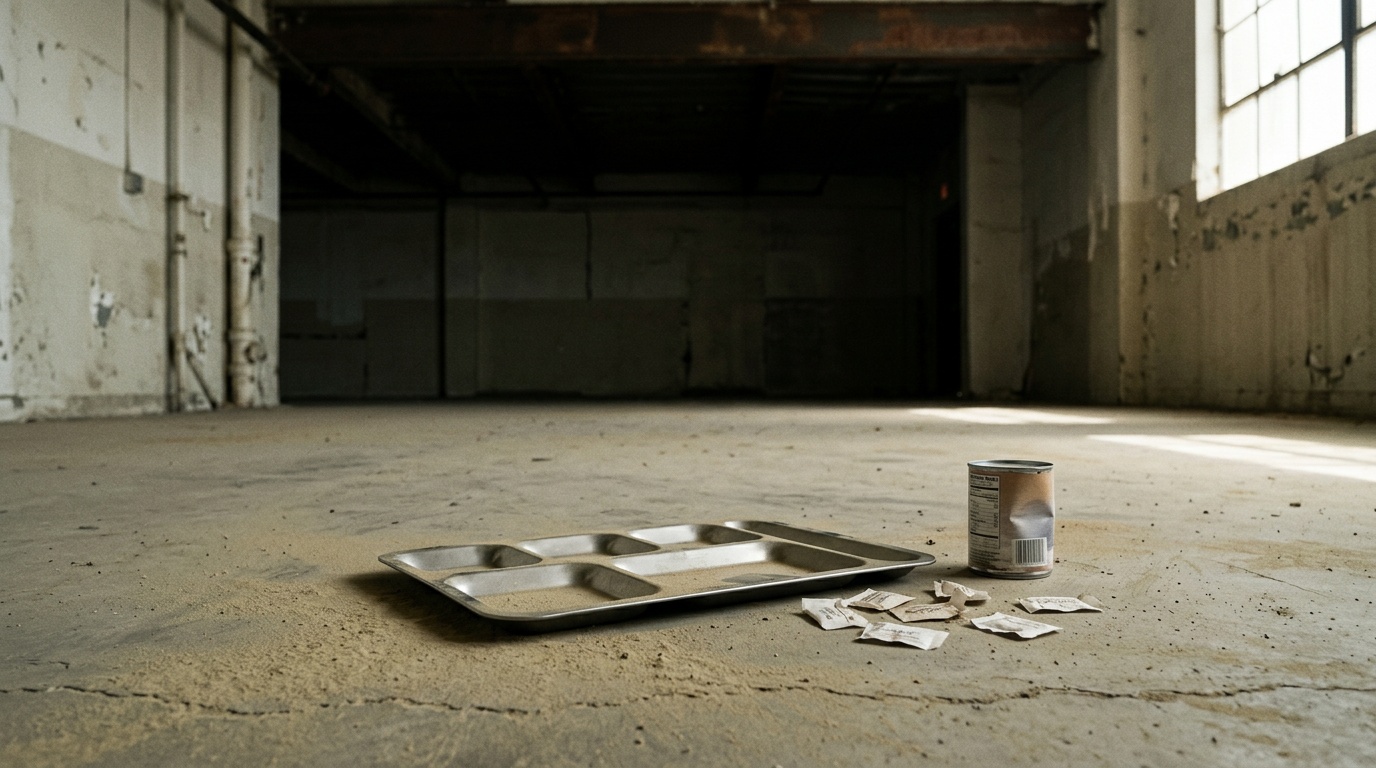
Manousos's refusal of the Joined's food is an act of identity construction, not survival strategy. Accepting their meal would install them as providers and pull him into a relationship of dependency he regards as a form of absorption. Dog food and sugar packets are not a sacrifice but a declaration that he will not exist inside any economy the Hive controls.
How This Theory Works
Manousos does not fear the Hive's food. He fears what accepting it would make him. The refusal is not about contamination, though that suspicion likely exists as a secondary layer. It is about the relationship the meal would inaugurate. To eat food provided by the Joined is to allow them to function as a lifeline, and that functional role carries a psychological consequence: it positions Manousos inside their economy of provision, where survival is something they grant and can therefore withdraw. The crowbar strike forecloses that economy before it can open.
What he does instead is the argument's sharpest evidence. He scavenges storage units and subsists on sugar packets and dog food. The degradation of that alternative is not incidental, it is the point. Dog food and sugar packets carry no social meaning, no implied relationship, no debt. They exist outside any system of obligation. The Hive's meal, however gourmet, is a symbol of incorporation before it is a bite of food. By choosing the worse option, Manousos is not sacrificing comfort for principle. He is constructing an identity as someone who exists entirely outside the Hive's framework of provision.
The parallel to Carol reinforces the structural logic. Both characters operate on principle rather than survival calculus. Carol runs dangerous experiments on herself and handcuffs herself to Zosia rather than work within the Hive's framework. Neither is holding out for better terms. Both are refusing the framework in which terms are offered at all.
The crowbar matters for a specific reason: verbal refusal would still leave Manousos in dialogue with the offer. A returned tray is a response; a destroyed one is a termination. Making the rejection physical, making it a destruction rather than a return, eliminates the possibility that he is negotiating. He is not waiting for a safer meal or a more trustworthy provider. He is acting out the belief that no meal from the Hive could be acceptable, because the problem was never the meal.
Is this theory convincing?
Key Evidence
Crowbar Knocks Tray Away
Manousos physically strikes the offered meal to the floor with a crowbar rather than simply refusing it verbally, a gesture that frames rejection as an active, forceful assertion rather than passive avoidance.
Dog Food Over Hive Meal
After refusing the Joined's food, Manousos scavenges storage units and subsists on sugar packets and dog food, choosing a degraded alternative over a comfortable one provided by the Hive.
Dependency as the Real Threat
The theory frames Manousos's logic as recognizing that eating the meal would be an acknowledgment that he cannot survive without the Hive, making the food refusal a rejection of that dependency rather than just a fear of tampering.
Parallel Stubbornness with Carol
Both Manousos and Carol operate on principle rather than survival calculus in this episode, with Manousos refusing Hive food while Carol runs dangerous drug experiments on herself rather than submit to or accept the Joined's framework.
Contamination Suspicion as Secondary Motive
Manousos likely suspects the offered food could be tampered with or designed to draw him into the hivemind, adding a pragmatic layer to what is primarily a symbolic act of defiance.
Other Theories for S1E04
Carol Has Proven the Reversal Exists, the Hive Is Suppressing It, and Will Kill to Keep It Hidden
Carol has not merely deduced that the Joined state is reversible — she has conducted three sequential proofs: a logical trap that extracts structural confirmation from Zosia's silence, a pharmacological experiment designed to breach conscious suppression entirely, and an involuntary demonstration by the hive that the secret is worth a member's life.

Helen Lied the Same Way the Others Do
Helen concealed her true opinion of Carol's work not despite loving her but as the primary expression of that love, making her structurally the first member of the hivemind Carol ever formed.
Carol's Unresolved Confession and the Paradox That Killed the Interrogation
Carol entered the sodium thiopental interrogation already destabilized by her own drug-compelled admission of attraction to Zosia, which she had filmed, watched, and not resolved.
Carol's Heroin Past Shapes Her Present Choices
Carol's history with heroin has not just informed her comfort around dangerous substances — it has calibrated her entire approach to pharmaceutical risk in ways the show has not yet made explicit.
Carol Has Reverse-Engineered the Joined's Behavioral Architecture as a Complete Counter-System
Carol is not a passive survivor of the hive's devotion but its most dangerous active opponent, running a covert dismantling program that exploits the Joined's behavioral constraints on two axes simultaneously.
Manousos: The Undetected Man in Paraguay
Manousos has spent his seven-plus days of undetected survival actively cataloguing immune individuals through radio scanning and phone contact, using the Joined's own infrastructure as a detection tool.