Some Hosts Die Rather Than Assimilate
THE THEORY
The hive-mind virus kills some hosts rather than assimilating them, and the collective treats this as an acceptable and already-resolved outcome. Helen's death, distinguished by red facial markings absent from standard infection, indicates a physiological incompatibility that terminates the bonding process rather than completing it. The government official's count of eleven immune individuals worldwide is not a measure of resistance but of survival, meaning those who could not assimilate and could not achieve full immunity are already dead and uncounted.
How This Theory Works
The hive-mind virus has a biological ceiling the collective has already accepted. Helen's death proves it. She convulses, briefly smiles, and then dies rather than joining the collective, her face marked by red striations around the eyes and nose that do not appear on successfully assimilated hosts. The precise mechanism the show still needs to account for is what physiological difference causes the infection to produce a fatal reaction rather than a completed psychic bond. Without that explanation, the distinction between Helen's outcome and Carol's total immunity remains descriptive rather than causal.
The theory holds that this failure is structural, not random. Something in Helen's physiology prevents the bonding process from completing, and the virus kills the host it cannot use. This is not an edge case the collective is working to fix. The hive mind pivots immediately to pursuing Carol after Helen dies, without hesitation or apparent recalibration, which means fatal incompatibility is a known variable in the collective's accounting, not an anomaly that demands attention.
Carol's immunity and Helen's death may share a common biological origin that expresses differently depending on the degree of resistance. If that spectrum exists, the collective's project of universal assimilation is not merely incomplete but permanently bounded. The government official's figure of eleven worldwide immune individuals does not measure how many people resisted the virus. It measures how many people survived resisting it. Everyone else whose biology rejected the process without producing full immunity is already gone, absorbed into the outbreak's body count without the collective treating their deaths as anything other than arithmetic. Helen is the visible representative of a category that has otherwise disappeared without record.
Is this theory convincing?
Key Evidence
Helen's Death After Infection
Unlike every other infected person shown in the episode, Helen does not join the hive mind but instead dies after convulsing, suggesting her body could not complete the assimilation process.
Red Markings Around Helen's Face
Helen displays red markings around her eyes and nose as she dies, a visual detail that distinguishes her reaction from the standard infection response and implies a physiological failure rather than a normal transformation.
Hive Mind Does Not Revive Helen
When Helen dies, the collective does not attempt to revive her or treat her death as an error, implying that fatal incompatibility is a known or accepted outcome of the infection process.
Carol's Immunity as Parallel Case
Carol's complete immunity invites comparison to Helen's fatal reaction, raising the possibility that different biological profiles produce a spectrum of outcomes ranging from full assimilation to death to total resistance.
Collective Still Tracks Carol After Helen Dies
The hive mind pivots immediately to pursuing Carol after Helen's death, treating Carol's resistance as the primary problem without pausing over Helen, which implies fatal incompatibility is not a novel or alarming result for the collective.
Other Theories for S1E01

Carol's Immunity Is a Structural Absence the Collective Cannot Resolve
Carol is one of eleven people worldwide who cannot be absorbed into the hive mind, but her biological resistance and her psychological architecture operate on the same principle: there is no available interior surface for merger.
Countdown Clock Targets the Infection Outbreak
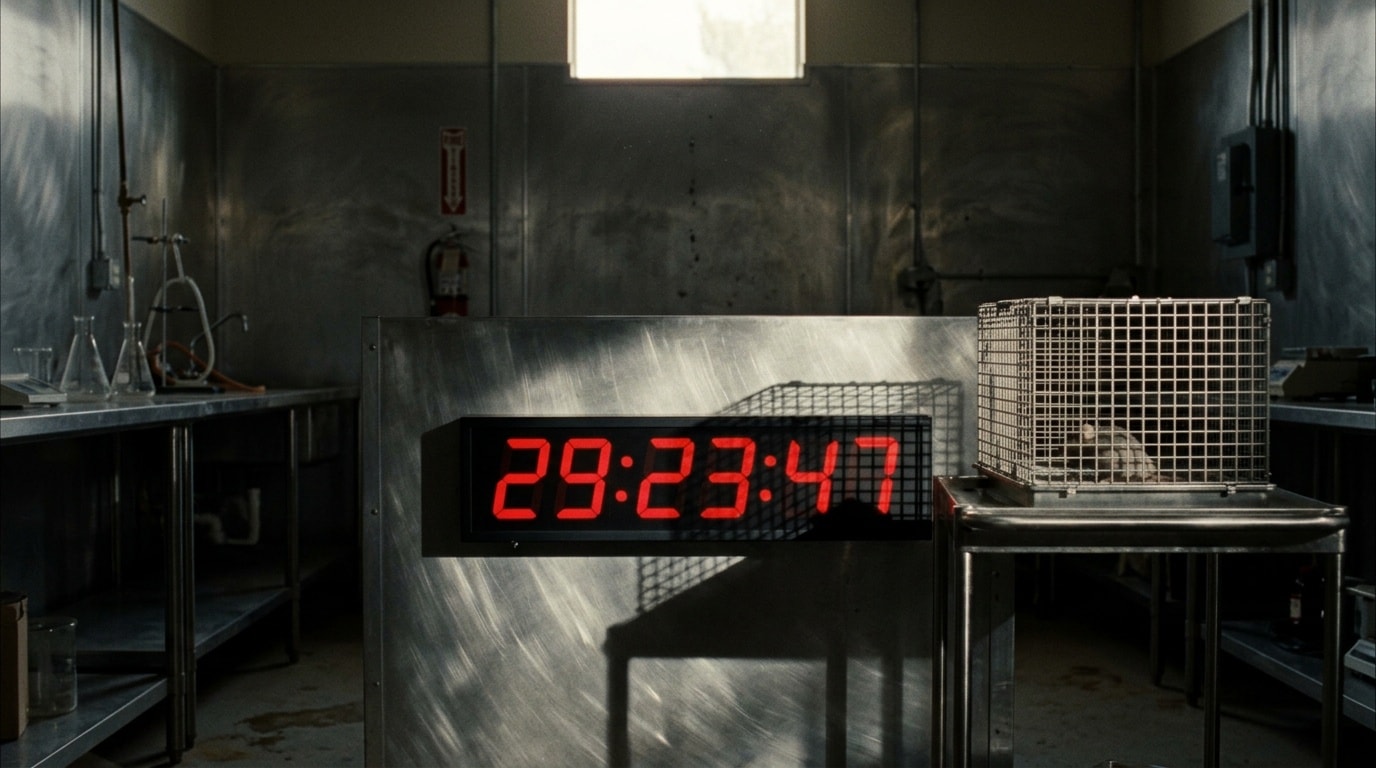
The 439-day countdown visible at the episode's opening is ticking down to the mass infection event, not to the alien signal's arrival.
The Collective Cannot Take What It Needs: Seduction as the Only Available Architecture
The alien RNA collective is incapable of absorbing an unwilling consciousness without inheriting its fracture, which means Carol is not a target to be eliminated but a structural gap that can only be closed through consent.