Alys Rivers Used Harrenhal's Curse as a Targeting System
THE THEORY
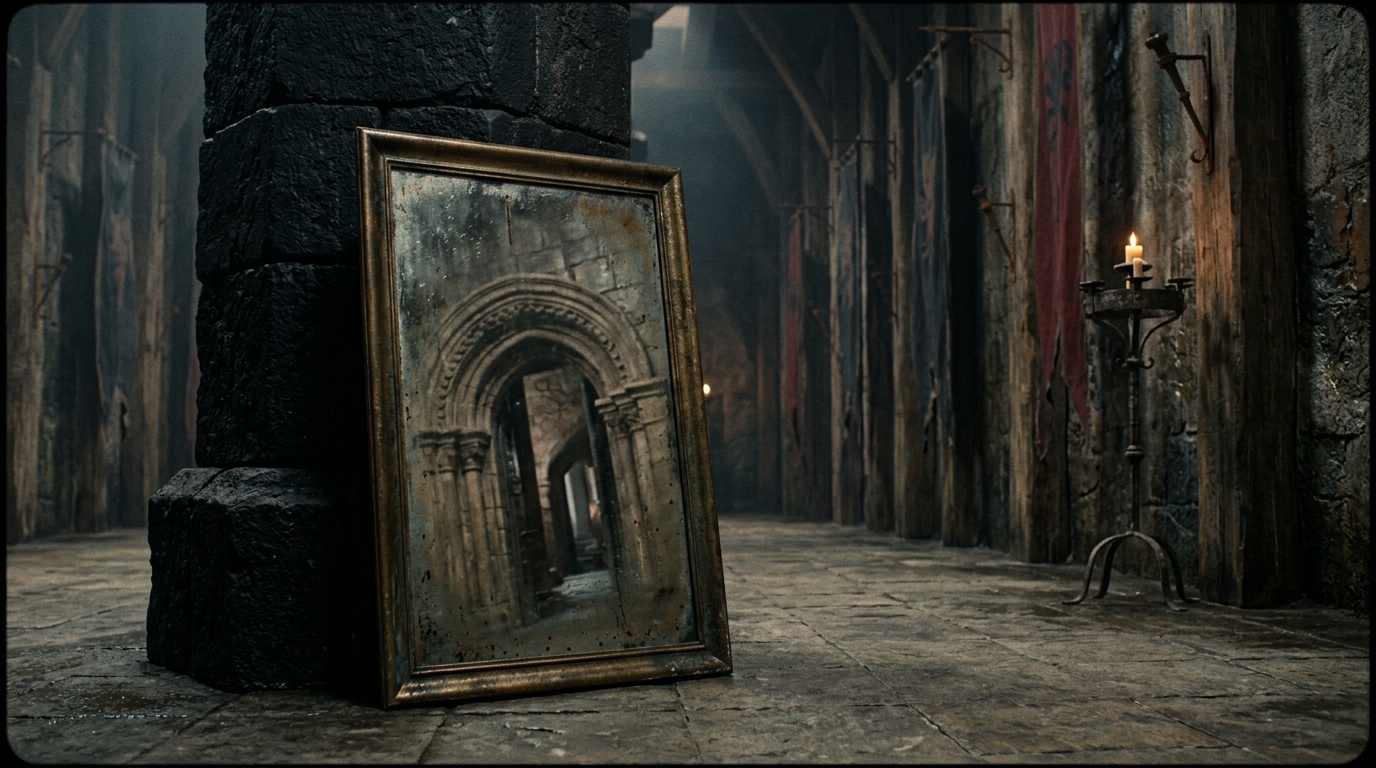
Daemon's psychological collapse at Harrenhal is not ambient; it is coordinated. The castle's weirwood-infused curse provides the architecture of his vulnerabilities, identifying the precise wounds around borrowed identity and parasitic significance, while Alys Rivers functions as a prepared operational agent who uses an administered drink to strip his agency and deliver him into a chemically softened state where those wounds are fully exposed. Neither force is sufficient alone: what dismantles Daemon is the combination of a supernatural targeting system and a person who knew how to aim it before he arrived.
How This Theory Works
The visions Harrenhal produces are too precise to be ambient. A genuine curse acting on guilt without direction would surface diffuse shame: dead wives, lost battles, accumulated grievances. What Daemon actually experiences is surgical. Young Rhaenyra indicts him in the specific language of Viserys's preference, locating the exact wound where love and resentment cannot be separated. The figure Daemon pursues through the castle corridors wears Aemond's hair and eyepatch (the external enemy, the usurper of significance), and when he catches it, the face is his own. These are not random projections. They are the two relationships that most expose the thing Daemon has organized his entire identity around concealing: that his sense of significance has always been borrowed, parasitic on those he simultaneously loves and resents. The curse does not produce his guilt. It reads his coordinates and delivers visions shaped to those coordinates with the precision of something that has been watching him far longer than anyone at Harrenhal has.
Alys Rivers enters at exactly the moment this targeting is legible. She tells Daemon he must feel conflicted serving a queen he doted on as a girl: not as a question, not as a provocation, but as the kind of flat statement you make when you already know the answer. She has not asked him anything. She names the wound before he articulates it, which is either supernatural accuracy or the behavior of someone in prior possession of detailed intelligence. She then explains the weirwood curse with the casual fluency of structural knowledge rather than folklore, framing Harrenhal's mechanism of deterioration as local common sense. Neither of these is what a servant knows. Together they constitute the profile of someone who has studied what the castle does to the people inside it and arrived with a plan for how to use that.
Alys's operational position makes this reading unavoidable. She installed herself as unofficial maester after the previous one fled, a role that grants her unsupervised access to every preparation, remedy, and ingested substance in the castle. The drink she offers Daemon is framed as a sleep aid, which is simultaneously a plausible cover and the exact mechanism required to produce what follows: a blackout ending at a morning dining table with no memory of the intervening hours. Daemon calls her a witch with contempt, but the accusation is the most diagnostically accurate line he delivers. The lost time is not the manipulation itself. It is the window through which the manipulation passes, the interval during which Alys has uncontested access to a man whose psychological defenses have already been partially dissolved by the visions the castle prepared him with.
The crucial structural claim the synthesis forces is this: neither layer is sufficient without the other. The curse without Alys is ambient. It targets Daemon's wounds with precision but has no mechanism for deepening the incision, no way to chemically lower his defenses and place him in a state of enforced exposure. Alys without the curse's targeting is merely a poisoner operating blind, administering a substance to a man whose interior coordinates she would have to guess. What makes Harrenhal genuinely dangerous to Daemon is the combination: the castle identifies exactly where he is vulnerable, and Alys uses that map to administer something that holds him open at those coordinates long enough for whatever comes next. When Daemon accepts the remedy, he is not seeking relief from the curse. He is surrendering the last boundary between himself and whatever has already decided what it wants to show him, and he does it voluntarily, which is the thing the castle's targeting made inevitable.
The hardest implication of this reading is what it says about Alys's foreknowledge. The specificity of her naming Daemon's wound about Rhaenyra, before he has spoken it, requires that she arrived with information about his interior life that ordinary observation of a man who has just reached Harrenhal cannot supply. If the weirwood network carries the memory of the castle's history, which Alys explicitly claims it does, then she may have access to something the trees themselves have registered: the emotional signature Daemon has been broadcasting across his entire relationship with the Targaryens. She is not reading him in the room. She may be reading what he has already written into the architecture of a cursed place that was waiting for exactly this kind of wound to walk through its gates.
Is this theory convincing?
Key Evidence
Dream beheading of young Rhaenyra
Daemon dreams of young Rhaenyra on the throne accusing him of wanting to destroy her because Viserys loved her more than he loved Daemon, and he beheads her with his sword before being awakened.
Aemond's face becomes Daemon's own
Daemon pursues a figure with Aemond's hair and eyepatch through the castle at night, but when he catches the figure its face is his own, collapsing the external enemy into his own identity.
Alys Rivers' preemptive knowledge of Daemon's conflict
Alys tells Daemon he must feel conflicted serving a queen he doted on as a girl, naming his psychological wound before he has articulated it, with an accuracy that exceeds what any ordinary observer could possess.
Weirwood curse as castle's mechanism
Alys explains that Harrenhal is cursed because Harren the Black used weirwood trees in its construction, providing a specific supernatural mechanism for the visions and hallucinations Daemon experiences.
Vision of Laena in a servant
Daemon sees the image of his late wife Laena Velaryon in a servant's face while Ser Willem Blackwood pledges his house's armies, suggesting the castle's influence extends into waking perception as well as dreams.
Daemon accepts Alys's sleeping remedy
After mocking Alys as a witch and resisting her probing, Daemon nonetheless accepts her offer of a remedy to help him sleep, voluntarily taking something of unknown provenance from the figure most closely associated with the castle's curse.
Hallucinations blurring sleep and waking
Daemon finds himself in the dining hall the next morning with no clear memory of the transition from his encounter with Alys, suggesting the boundary between his nightmares and waking experience has already eroded.
Other Theories for S2E04

Alicent Knows She Built a Lie
Alicent has privately concluded the Green succession was built on a misreading of Viserys's final words, and her search through historical texts is an attempt to find external justification for a war she suspects was started on a lie.
Larys Holds the Cup Over Alicent
Larys Strong is hoarding knowledge of Alicent's affair with Criston Cole as leverage rather than weaponizing it immediately, and his deliberate restraint is the tell.
Larys Surrendered Harrenhal to Destroy Daemon
Larys Strong surrendered Harrenhal not as a military failure but as a targeted psychological operation, using the castle's cursed deterioration to destroy Daemon's mind while preserving House Strong's wealth outside the Blacks' reach.
Aemond Secured the Perfect Witness, But Not the One He Thinks He Has
Aemond engineered Aegon's incapacitation at Rook's Rest through a sequence of private coordination with Criston Cole, a staged Small Council announcement, and dragonfire directed at both Sunfyre and Meleys once Aegon was committed past retreat.
Alicent's 'Nothing' Sends Aegon to War
Alicent's dismissal of Aegon is not background noise before the battle at Rook's Rest.
Daemon's True Enemy Has Always Been Rhaenyra
Daemon's participation in the Dance of Dragons is not loyalty to Rhaenyra but a sustained attempt to win a posthumous argument with Viserys, using her victory as proof that her elevation over him was the error.
Rhaenys Chose Death Over Retreat
Rhaenys chose her death at Rook's Rest with full tactical awareness, not because she misjudged the engagement but because she had already decided not to leave it.