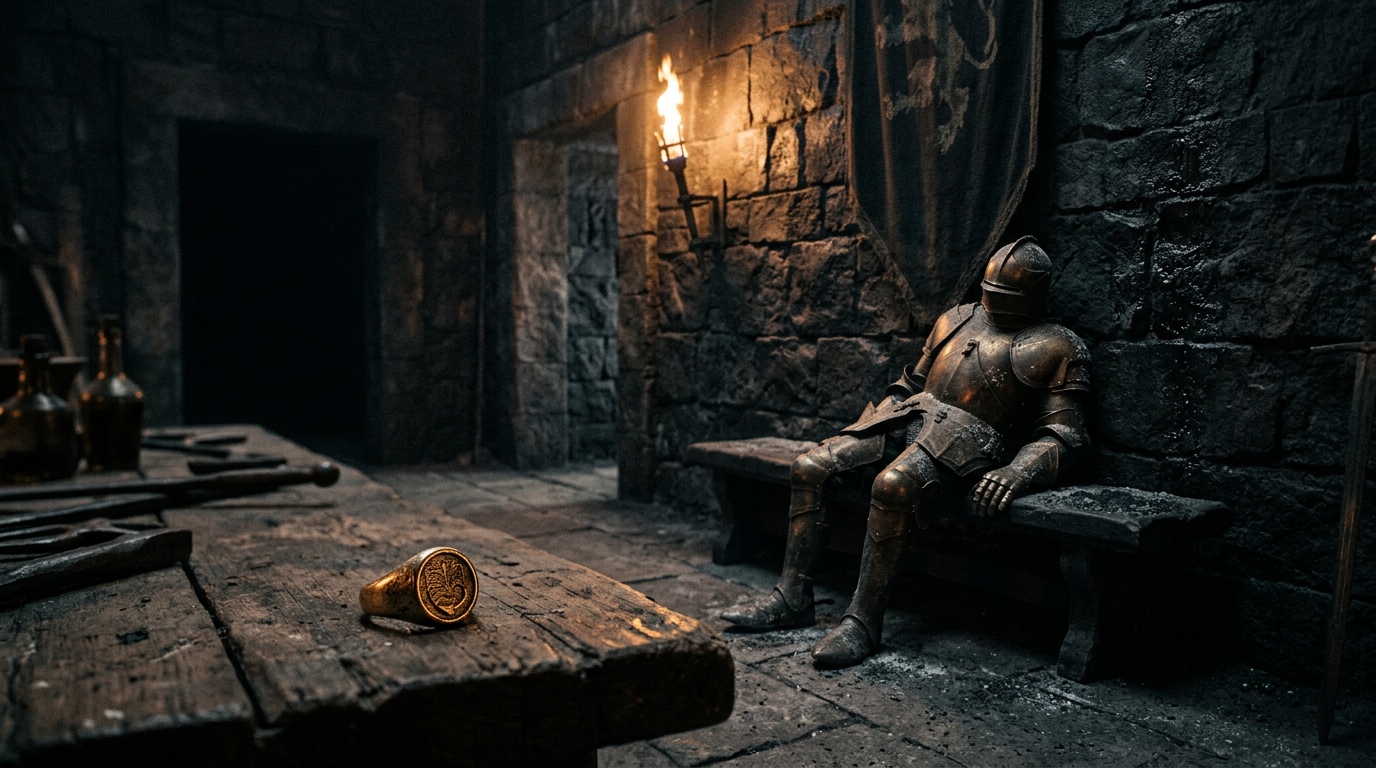
Cole Sends Arryk to Die to Bury Two Confessions at Once
THE THEORY
Criston Cole's decision to send Arryk Cargyll on a fatal solo mission to Dragonstone is not a military calculation but a mechanism for destroying the one witness who can place Cole's absence during Jaehaerys's murder, an absence caused by his presence in Alicent's chambers. Because Cole cannot confess the dereliction without confessing the relationship, and cannot confess the relationship without destroying the only private claim he still holds on Alicent, the two secrets have fused into a single confession he has decided can never be spoken. Arryk dies carrying the weight of both.
How This Theory Works
The structural fact that drives everything else is this: Cole was in Alicent's chambers when Jaehaerys was murdered. That means the dereliction of duty and the unnamed relationship are not two separate problems; they are the same confession, and saying one aloud requires saying the other. Cole cannot tell anyone where he was without telling them why he was there, and he cannot tell them why he was there without giving a name to something that, between him and Alicent, has no name either of them can afford to speak. This is the interior impossibility. It does not begin with Arryk. It begins with the locked door between two kinds of grief Cole has decided will never be opened.
The vigil at the dismantled crib is the first behavioral evidence of how Cole manages that impossibility. He enters Jaehaera's chambers and stands watching servants take apart the slain prince's furniture, a scene with no command function, no audience, no operational purpose. It reads as deliberate self-exposure: a man forcing himself to look at consequences he cannot confess caused. He cannot grieve the child without proximity to the grief, but he cannot confess the grief without confessing its cause, so what remains is the vigil: suffering without language, punishment without accountability. The scene establishes that Cole has already judged himself guilty and already decided that guilt will not be spoken. Everything that follows is the management of that decision.
The absolution scene with Alicent converts that private judgment into something externalized and lethal. Cole tells her directly that there is no absolution to be found for what he has done. That is not modesty. That is a man foreclosing the only path that would require full disclosure, placing himself permanently beyond forgiveness by his own decree. The scene that immediately follows, in which Cole enters the barracks to construct an honor-restoration framework for Arryk, reveals the precise shape of the displacement. Cole refuses absolution for himself, then manufactures a version of it for someone else at that person's mortal expense. The inversion is not accidental. Cole is doing to Arryk what he will not permit himself: assigning a path out. The difference is that Cole's path out requires Arryk's body to travel it. He cannot externalize his own guilt through action, so he externalizes it through another man's death, which he then gets to frame, in the Kingsguard record, as sacrifice.
The forensic structure of the confrontation confirms that the honor-restoration framing is a construction, not a conviction. Cole opens not by appealing to Arryk's loyalty or the mission's strategic value, but by demanding Arryk account for his own position on the night of the murder, shifting the frame of accountability before any argument is made. When Arryk asks Cole the same question, Cole responds with a public threat to his reputation rather than an answer. The humiliation over the muddy cloak that opens the scene further suggests staging: Cole establishes hierarchical control before any accusation, which is the behavior of a man who knows his argument cannot survive interrogation. Arryk then names the mission's fatal flaws explicitly, and Cole dismisses every objection without engaging a single one on strategic grounds. That is not the confidence of a commander who believes in the order. That is a man who cannot afford to hear the objection, because hearing it would force him to recognize that what he is issuing is not a command but a burial: Arryk's death as the event that converts Cole's paralysis into something that, from the outside, resembles decisive action.
The selection of Arryk is the theory's sharpest point. Cole does not send a random Kingsguard on a suicide mission. He sends the one man whose twin's defection already makes his loyalty suspect, whose position on the night of the murder is the natural counterpoint to Cole's own unaccountable absence, and whose death would simultaneously silence the witness most positioned to ask the wrong question and produce, in its framing as heroic sacrifice, the story of command that Cole needs the record to contain. The honor-redemption argument is not a rationalization Cole tells Arryk. It is a rationalization Cole needs to tell himself, and it only works if Arryk does not come back. The coercion, the loyalty threat, exists precisely because the logic does not hold without it. Cole already knows this. He issues the threat not because he has run out of arguments but because argument was never the mechanism. The mechanism is that Arryk leaves the room, and takes both confessions with him.
Is this theory convincing?
Key Evidence
Cole's pre-confrontation absolution refusal
Immediately before coercing Arryk, Cole tells Alicent there is no absolution to be found for what he has done, establishing that he has already judged himself guilty and foreclosed confession as a path forward.
Cole interrogates Arryk's whereabouts first
Cole opens the confrontation by demanding Arryk account for his own position during the assassination, shifting the frame of accountability before any honor-restoration argument is made.
Loyalty threat forces compliance
Cole threatens to publicly question Arryk's loyalty to the King if he refuses the mission, revealing that the honor-redemption framing requires coercion to function and cannot stand on its own logic.
Arryk names the mission's fatal flaws
Arryk explicitly points out the massive problems with the plan before being silenced by the loyalty threat, and Cole dismisses every objection without engaging any of them on strategic grounds.
Affair as direct cause of security failure
Cole was in Alicent's chambers during the murder of Jaehaerys rather than commanding the Kingsguard, making the affair the proximate reason for the catastrophic security lapse he now assigns to Arryk's twin.
Muddy cloak admonishment as dominance ritual
Cole enters the barracks by publicly humiliating Arryk over a soiled cloak, establishing hierarchical control before any accusation, suggesting the confrontation is staged rather than spontaneous.
Action as substitute for confession
Cole's insistence that Arryk restore honor through action directly mirrors and inverts Cole's own refusal of verbal absolution, showing that he seeks to externalize through another's body what he will not face in himself.
Other Theories for S2E02
Otto Hightower's Propaganda Has Two Instruments: A Dead Child and a Living Widow
Otto Hightower does not believe Rhaenyra ordered Jaehaerys's murder and does not need to.
Two Mirroring Pathologies: Why the Aegon–Otto Rupture Was Structurally Inevitable
The dismissal of Otto Hightower was not a political miscalculation that a shrewder Hand could have avoided; it was the predetermined outcome of two incompatible pathologies colliding.
Aegon II's Two-Part Declaration: The Viserys Model Dies First, Then Otto's War Does
Aegon II's destruction of Viserys's Old Valyrian model and his mass execution of the rat catchers are not separate emotional episodes but a sequential governing argument delivered in rapid succession.
Aemond's Remorse Is Real But Privately Contained
Aemond has engineered a confession that costs him nothing.
Daemon's War Is His Own, Not Hers
Daemon ordered the assassination of Jaehaerys not to serve Rhaenyra's cause but to prosecute a decades-old grievance against his dead brother, with the Crabfeeder precedent and the Blood and Cheese moment both confirming that Daemon's defining response to powerlessness is unilateral, irreversible action taken on his own timeline.
Aegon's Mace Sealed the Conspiracy's Secret
Aegon's execution of Blood did not only express grief, it permanently sealed the conspiracy's chain of command from investigation.
Aemond's Guilt Will Break the Green Cause
Aemond Targaryen has already emotionally defected from the Green cause, and the show has constructed that defection with precision.
Mysaria Spotted Arryk and Saved Rhaenyra
Mysaria recognized Arryk Cargyll as an infiltrator and directed Erryk to intercept him, making her the unacknowledged reason the assassination attempt on Rhaenyra failed.