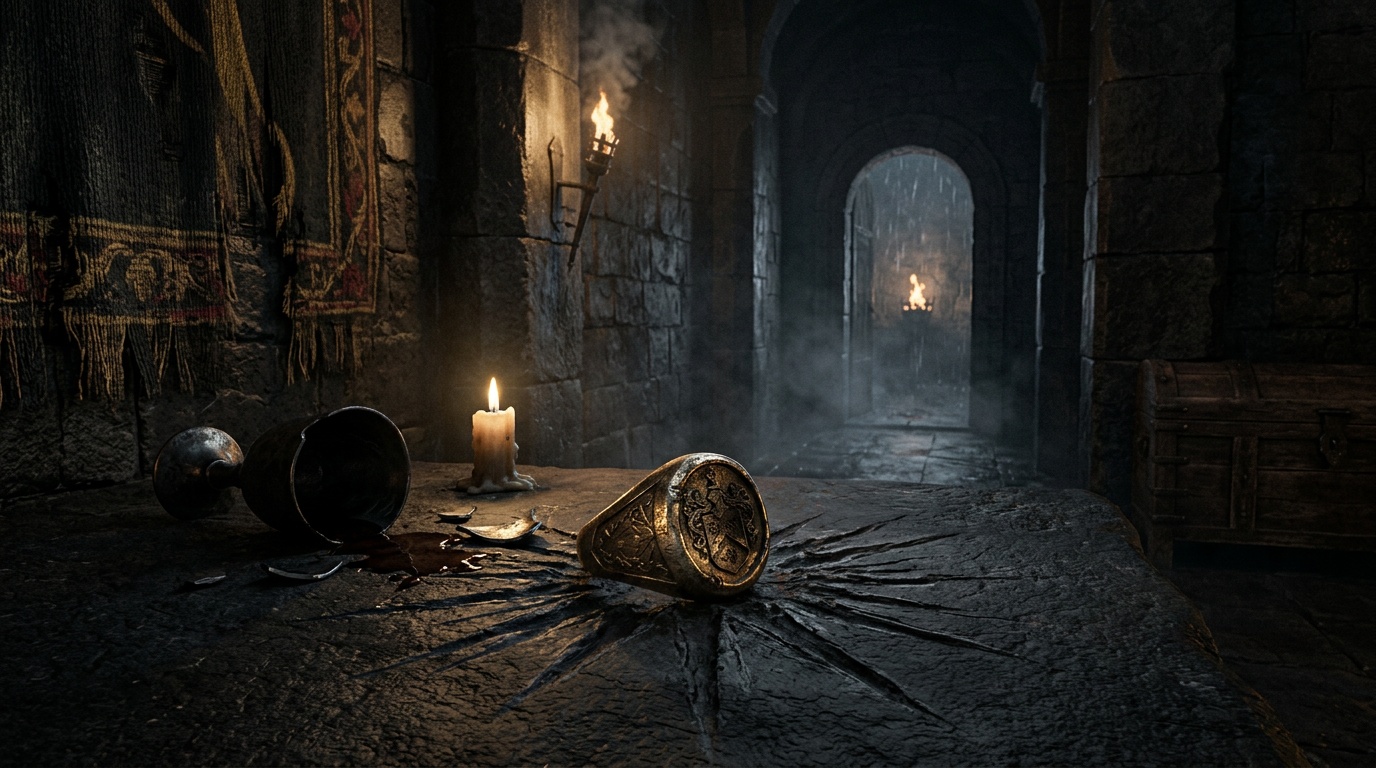
Cole Killed Joffrey to Destroy the Man Who Would Have Said Yes
THE THEORY
Criston Cole's murder of Joffrey Lonmouth was not a jealous outburst or a calculated silencing but a deliberate act of self-annihilation: a man destroying the negotiable, compromised version of himself before it could become permanent. The violence did not break Cole; it reorganized him, converting private shame into a durable ideology in which honor functions as a weapon constructed from the ruins of his own violated conscience. What the killing produced, however, was not only doctrine but a man perfectly shaped to be owned. Alicent's intervention the same night did not rescue Cole from his collapse so much as it annexed it, inheriting a self-destruction already in progress and redirecting its energy into permanent obligation.
How This Theory Works
The killing only makes sense if you read it backward from its most important feature: Cole beat Joffrey to death in front of the assembled court at a royal wedding. A man protecting a secret does not do this. A man who has already decided the secret is indefensible does. To understand why Cole had already reached that conclusion before Joffrey said a word to him, you have to understand what the Essos proposal actually was and what Rhaenyra's refusal actually destroyed.
Cole's proposal to flee and marry was not a declaration of love. It was a moral transaction. If Rhaenyra agreed to build a life with him under new identities, his oath-breaking could be retroactively converted from a violation into the cost of a truer loyalty. He was not offering her a future. He was asking her to provide him with one that made his past bearable. Cole came from a house with no name, no land, no inheritance. The Kingsguard vow was not a career; it was the only structure that converted his existence into something with inherent dignity. The affair had already destroyed that structure in private. The proposal was the one available architecture for repair, and Rhaenyra's refusal did not wound him romantically. It annihilated the last framework through which he could understand himself as a man of honor rather than a man of appetite. He arrived at the wedding feast not grieving a lost relationship but grieving the loss of any available account of himself that he could live with.
The confession to Alicent earlier that same day clarifies the trajectory. Cole did not confess to manage risk or seek absolution; he confessed because he was already disbanding himself in advance, surrendering the secret before it could be leveraged, performing a kind of preemptive demolition. He reached the feast without a self left to protect. Then Joffrey approached him. The evidence on what Joffrey actually said matters here: if he proposed mutual silence between two men who occupied structurally parallel positions as royal paramours, a pragmatic arrangement between peers, Cole heard something far more intolerable than a threat. He heard proof that he had become exactly what a man of his origins was always at risk of becoming: a managed secret with negotiable value. Exposure you can survive. Being administered is a more complete annihilation, because it confirms that your transgression was never even worth punishing; it was only worth filing away. Joffrey, crucially, understood the structural reality of his situation and operated within it without demanding the world reorganize itself around his private wound. That composure was its own indictment. Cole could not do what Joffrey was asking, not because the terms were dangerous but because accepting them would require acknowledging that his honor had a price.
So Cole destroyed Joffrey, publicly, visibly, in a manner extreme even by the brutal standards of the court, not to silence a threat but to silence the version of himself that would have negotiated. The murder was an act of authorship. By making the violence undeniable and unstrategic, Cole forced the night to be legible as breakdown rather than transaction, as a man overwhelmed rather than a man making arrangements. He needed witnesses not to escape suspicion but to ensure that what he was doing could not be read as calculation. The confession, the refusal, the killing: these are not three escalating failures of control. They are a single continuous act of self-destruction performed in three movements, each one closing off an available exit. Cole was constructing a version of events in which his ruin would read as loyalty rather than exposure, as honorable violence rather than a paramour's desperation.
What this act produces is where the analysis has to go further than Cole's own intentions. A man acting from heartbreak is volatile but exhaustible. A man acting from shame that has been given a founding myth is something more durable, but a man who has completed that self-destruction in public and then attempted to complete it physically is something more useful still, to the right observer. The confession Cole made to Alicent before the feast was already the act of a man trying to close all exits. When Alicent chose silence over punishment and then intervened to stop his suicide, she was not rescuing a loyal servant. She was inheriting a collapse that had nowhere left to go. Cole had performed the self-destruction so completely and so publicly that the only remaining question was whose terms he would live under. Alicent provided those terms, and what looks like loyalty is the permanent residue of a debt incurred not by her kindness but by the fact that she was present when he had nothing left to bargain with. The founding lie is not simply that Cole killed Joffrey in passion rather than authorship. It is that the alignment with Alicent which followed was conviction rather than the only available structure for a man who had already demolished every other one.
Every position Cole holds afterward, his ferocious alignment with Alicent, his ideological hostility toward Rhaenyra, his investment in a version of honor that functions less as a code than as a weapon, follows from this template: the night he chose annihilation over negotiation and then had that annihilation converted into obligation by someone who recognized its value. He will need Rhaenyra to be monstrous so that his own collapse reads as a response to her monstrousness rather than a revelation of his own fragility. The founding lie of Ser Criston Cole is not that he killed Joffrey in a moment of passion. It is that the man who killed Joffrey was the man he had always been, uncorrupted and responding to provocation, rather than the man he made himself in that moment by refusing the only exit available and then being claimed, in his emptiness, by someone who understood exactly what a man with no exits is worth.
Is this theory convincing?
Key Evidence
Rejection and Elopement Proposal Refused
Cole asked Rhaenyra to abandon her royal life and elope with him to Essos, was refused, and arrived at the wedding feast already emotionally devastated by that rejection.
Joffrey Identifies Cole as Paramour
Joffrey Lonmouth observed Cole brooding and staring at Rhaenyra across the dance floor and correctly deduced he was her secret lover before approaching him.
Veiled Threat About Shared Secrets
Joffrey approached Cole and delivered comments about their shared closeness to the royal pair along with what several accounts characterize as a veiled suggestion that their mutual secrets tied their fates together.
Cole's Prior Confession to Alicent
Before the wedding feast, Cole confessed his affair with Rhaenyra to Alicent, suggesting he was already attempting to shed the secret before Joffrey made it a negotiating chip.
Honor as Low-Born Knight Identity
Cole came from a house with no name or lands, making his Kingsguard vow the entire foundation of his identity, which the affair with Rhaenyra had already privately destroyed before Joffrey's approach.
Public Murder in Full Court View
Cole beat Joffrey to death visibly, in front of the assembled wedding guests, in a manner the show presents as extreme even by the standards of the realm, indicating this was not a calculated silencing but a complete psychological break.
Open Marriage Arrangement Revealed
The broader context of Rhaenyra and Laenor's open marriage arrangement, in which both parties would keep paramours, was disclosed during the feast period, compounding Cole's understanding that his role had been reduced to a managed secret.
Other Theories for S1E05
Larys Chose Alicent Over Chaos
Larys Strong is not a loyalist who found a patron.
Daemon's Dance Is a Throne Play
Daemon's wedding conduct is a coordinated throne play in which Rhaenyra's desire for him is not the occasion for seduction but its deliberate output.
Alicent Converts Criston's Panic Into Loyalty
Alicent Hightower does not spare Criston Cole out of mercy.
Rhea's Taunt Triggered an Unplanned Murder
Daemon did not ride to Runestone with the intention to kill.
Otto Made Alicent Believe Murder Was Inevitable
Otto Hightower's parting warning was not fatherly concern but a precision instrument: by framing Rhaenyra's threat to Alicent's children as structural rather than personal, he installed an unfalsifiable premise that converts Alicent from a grieving friend into an ideological enemy regardless of what Rhaenyra actually intends.