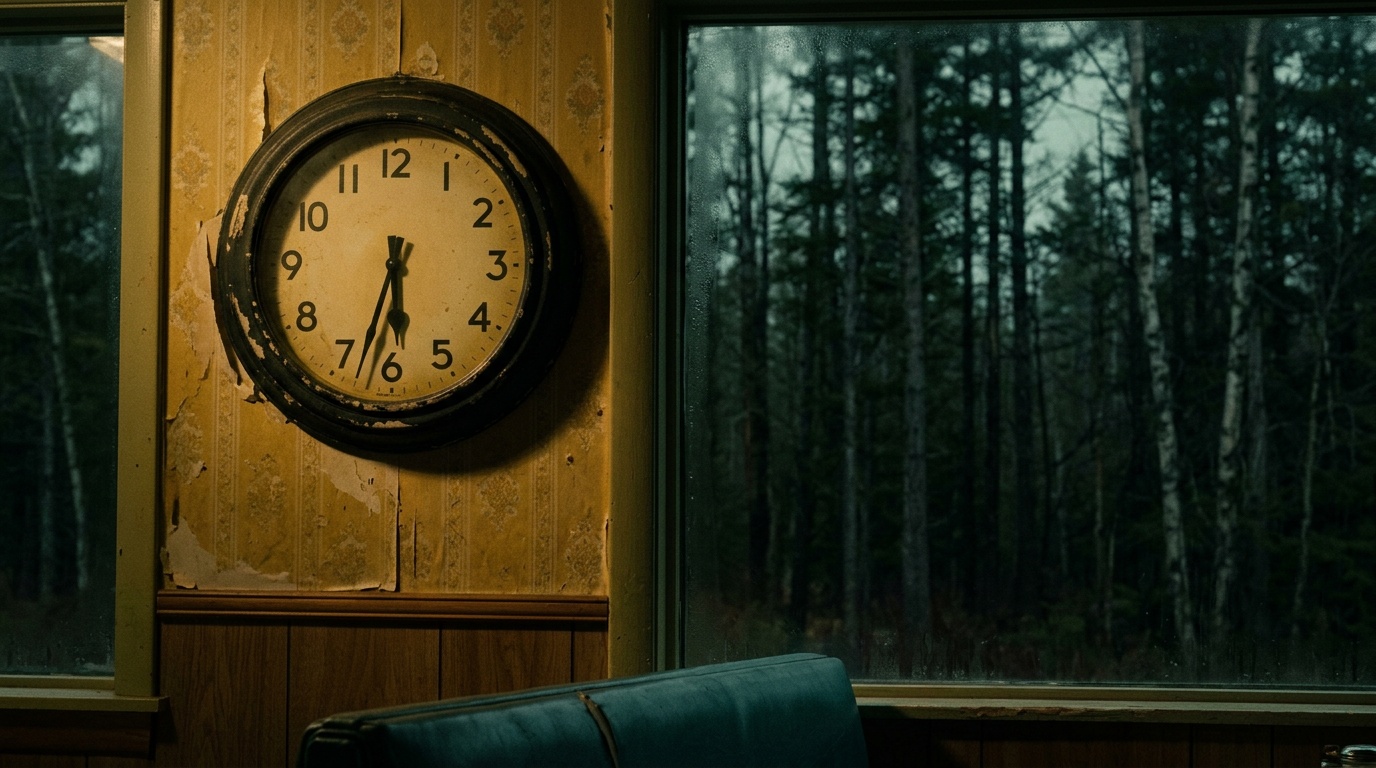
Nightfall as the Town's Ultimate Enforcer
THE THEORY
Boyd's authority as the town's de facto sheriff is structurally hollow. He cannot fully enforce the community's rules because the creatures do it for him, making darkness the real power and Boyd's legitimacy dependent on a mechanism he did not create and cannot control. If the creatures are functioning as outsourced punishment, then whoever or whatever designed this place built a justice system into the town's architecture from the start.
How This Theory Works
The clearest evidence is Boyd's conditional warning to Jim: if the person in question returns before dark, the community will handle it themselves, but if she does not, then it is handled. That phrasing is doing real work. Boyd is not describing a threat. He is describing a procedural outcome. The creatures are the fallback enforcement mechanism, and Boyd is simply announcing the deadline. Human deliberation is not the final word. The clock is.
This reframes how the town's rule structure actually functions. Residents do not stay inside after dark because they are afraid. They stay inside because going out is effectively a sentence. The Clinic, the Colony House, the Bar all operate within a window defined by when the creatures become active. Night is not the absence of safety. It is the presence of consequence. The community has internalized this so completely that the curfew requires no announcement and no enforcement from Boyd at all.
The uncomfortable implication is that Boyd's role depends entirely on this arrangement remaining stable. He does not need a jail or a court because the darkness handles the cases he cannot. That is not authority. It is delegation to a force he does not understand and did not choose. If the creatures are not random predators but instruments of a system designed into this place, then Boyd is not the sheriff of the town. He is a middle manager for something far older, and every judgment he renders only holds until nightfall makes it irrelevant.
Is this theory convincing?
Key Evidence
Boyd's Dark Conditional Warning
Boyd tells Jim that if the person in question returns before dark, the community will handle it themselves, but if she does not, then it is handled, implying the creatures will eliminate her without any human intervention required.
Nighttime Movement as Implicit Curfew
The show establishes through its recurring structure that residents do not move freely outside after dark, treating nightfall as a hard boundary that constrains all outdoor activity and social engagement.
Creatures as Outsourced Punishment
Boyd's framing treats the creatures not as an external threat to be managed but as an instrument that resolves situations the community would otherwise have to adjudicate, suggesting a functional alignment between darkness and consequence.
Other Theories for S1E05

The Town Heals What It Doesn't Kill
The town operates a biological sorting function, accelerating recovery in bodies fighting toward repair while accelerating deterioration in bodies already trending toward collapse.
Dead Wife's Sign Validates Boyd's Escape
The town of FROM is not a passive trap.
Sara Arrived Already Broken: Nathan Is Both Her Reason and Her Sacrifice
Sara did not develop her capacity for a devastating act inside Fromfield; she brought the psychological architecture for it with her, pre-built around Nathan's rescue.
The Town's Recruitment Channel: Sara as Advanced-Stage Instrument
The town operates a systematic recruitment mechanism that selects residents by psychological vulnerability and establishes communication through physical disruption: seizures, tremors, inscriptions.

The Fallen Tree Is a Threshold, and Tabitha Has Already Crossed It
The fallen tree's appearance across arrivals from different roads and regions is not a supernatural coincidence but evidence of a controlled intake mechanism that selected every resident in advance.

Jade's Logic Breaks Against the Town
Jade's crisis in the Town is not grief and not a breakdown but a structural attack on the only identity he has ever trusted: the belief that his intelligence makes him categorically different from people who fail.

Past Monsters Prepared Fatima for This One
Fatima's survival framework was built for a specific kind of monster, one with faces and motives and doors it can be kept from, and the town is none of those things.