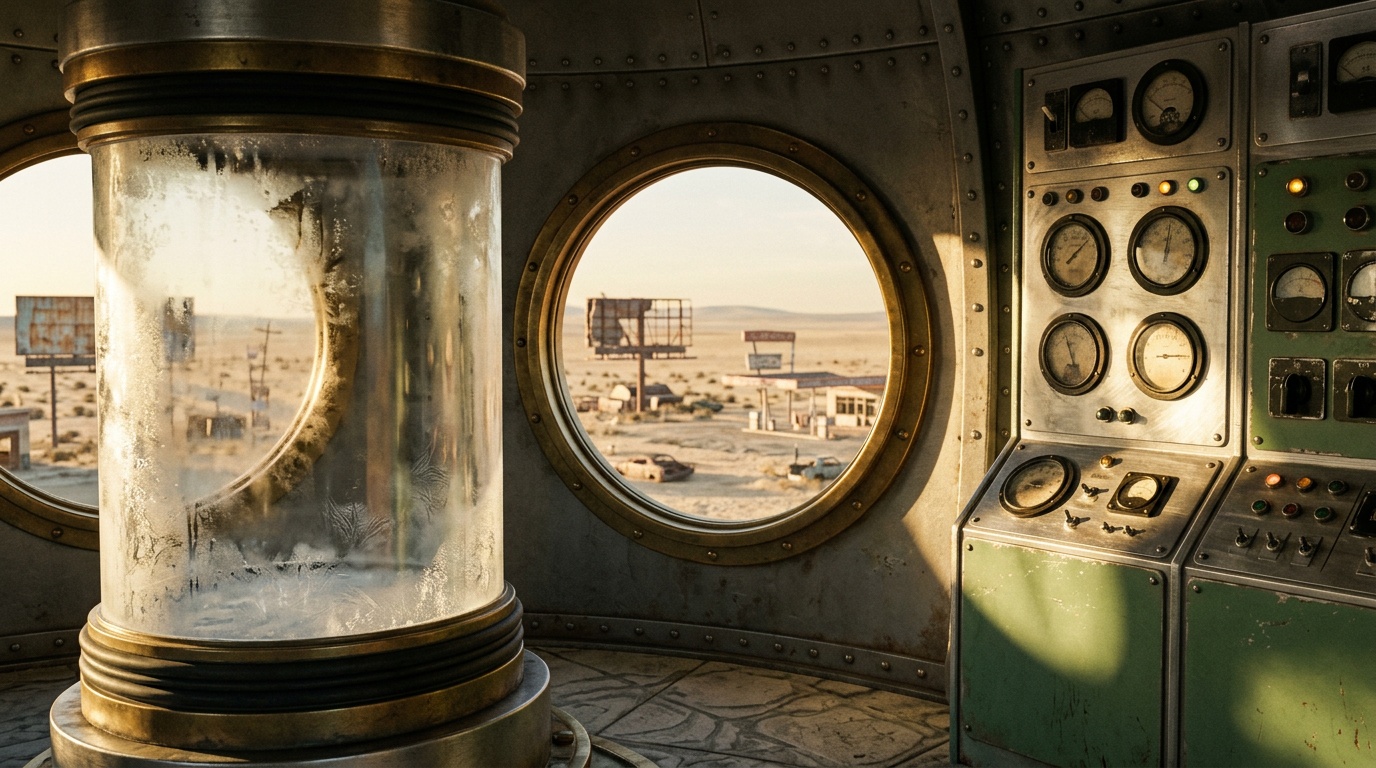
The Enclave Administered the Apocalypse: A Vertically Integrated Operation from Corporate Shell to Individual Fate
THE THEORY
The Enclave did not survive the Great War — they managed it, running a three-tiered operation that used Vault-Tec as a disposable shell corporation, the post-war wasteland as a deliberate experimental dataset, and the fates of specific individuals as engineered variables. What remains unconfirmed is the full vertical integration of that design: that the same institutional hand which placed agents inside Vault-Tec's hierarchy also orchestrated the surface conditions generating two centuries of observed data, and left handwritten breadcrumbs in cryo tubes for people it expected to survive long enough to follow them.
How This Theory Works
The question worth pressing is not whether the Enclave embedded themselves inside Vault-Tec. House confirms that in S2E8. The question is the scope and depth of the architecture that embedding served. Influence over a corporation is one thing. Designing the corporation's entire output — its vault experiments, its population selection, its physical infrastructure — as pre-war scaffolding for a post-war order the Enclave intended to inherit is something categorically different. The evidence, assembled across three nested levels, points toward the second interpretation.
At the institutional level, the embedded-agent structure is too architecturally deliberate to be mere investment. Hank's radio communication — telling his contact that no one in Vault-Tec knows he is there — is not the language of a corporate liaison. It is the operational signature of a placed agent maintaining cover inside an organization he was never loyal to. Stephanie's independent Enclave contact follows the same structure: two figures operating at different levels of Vault-Tec's hierarchy, both reporting to a command chain the organization itself could not see. This is not post-war infiltration or opportunistic penetration. It is a planted architecture, installed before the bombs fell, designed to survive them. House's admission that the Enclave outclassed him entirely in post-war planning anchors the institutional argument. He predicted the nuclear exchange with near-perfect accuracy and maintained surveillance infrastructure across decades. For the Enclave to remain invisible to him across the entire pre-war period required organizational concealment maintained at remarkable scale — and the management Vault beneath Vegas, built without his knowledge under one of the most monitored cities in the pre-war world, is the physical proof of that concealment.
At the experimental level, Hank's statement to Lucy is the theory's sharpest load-bearing claim: the vaults are the control group, the surface is the active trial, and two centuries of human suffering above ground have been the Enclave's primary dataset. This is not a metaphor about perspective. It is a structural claim about experimental architecture that retroactively reframes everything the audience attributed to chaos. The management Vault's mainframe, still uploading programming into new Black Box chips on Lucy's arrival, is not archival infrastructure. It is a forward base executing a timed sequence. Hank responding to 'initiate phase two' with 'this is Hank MacLean reporting for duty, sir' is not improvised post-war survival. It is a handoff that predates the bombs, triggered on a schedule, confirming that whatever infrastructure the Enclave built before the war is still running. House's attribution of the Freeside deathclaw deployment to deliberate Enclave orchestration in the present timeline confirms the same thing: the experimental apparatus is active, not historical. Every surface faction — its wars, its collapses, its civilizational attempts — has been generating observable data for an institution with the patience and infrastructure to collect it. A system designed with this architecture was not built to save humanity. It was built to sort it, keeping a clean sample stable in vaults while engineering and measuring the conditions everything outside was exposed to.
The Barb Howard postcard is where the abstract becomes concrete, and where the theory's most disturbing implication materializes at human scale. Barb left a handwritten postcard in her empty cryo tube — her own handwriting, a Colorado address. That single artifact requires explanation the show has not yet provided. An organization capable of constructing covert infrastructure below Vegas without House's detection is capable of relocating a senior Vault-Tec insider and her daughter to a secure facility before the bombs fell without a traceable record. The absence of Barb and Janie from the vault is not a survival mystery. It is a logistics mystery, and the Enclave is the only established entity with the operational reach to resolve it. But the harder question is not whether Barb survived. It is whether she wrote that postcard knowing Cooper would reach it — knowing what he would become, how long it would take, and what two centuries of the specific suffering required to make him useful would do to him. If the postcard is a forwarding address written for a man who did not yet know he was going to become a ghoul, then Barb Howard knew more about the bombs, the timeline, and her husband's fate than she ever told him. The postcard is not a farewell. It is evidence of premeditation at the individual scale.
The synthesis of these three levels produces a single, coherent thesis. The Enclave did not react to the apocalypse, did not exploit its aftermath, and did not merely survive it better than everyone else. They administered it — vertically integrated from the corporate shell they used to engineer the vault system's population inputs, through the experimental architecture that made the surface two centuries of intentional data, down to the orchestrated trajectories of specific individuals whose fates were planned in advance and whose breadcrumbs were laid before the first bomb fell. The suffering attributed to Vault-Tec's experiments and the wasteland's chaos was always the output of something colder and more deliberate, run by people who chose their casualties, designed their variables, and expected to govern whatever the experiment ultimately produced.
Is this theory convincing?
Key Evidence
House Confirms Enclave as Investors
In S2E8, House tells Cooper that he allowed Vault-Tec to build the management Vault under Vegas but did not realize it was being constructed for the Enclave, who had embedded themselves as Vault-Tec's investors without his knowledge.
House Admits Being Outclassed
House acknowledges that despite predicting the nuclear war, he was completely outclassed by the Enclave in planning for what came after the bombs, having only detected their existence through Cooper's encounter in the snow.
Hank's Secret Radio Contact
In a prior episode, Hank tells his radio contact that no one in Vault-Tec knows he is there, a statement that implies he was reporting to a chain of command entirely separate from Vault-Tec's own hierarchy.
Stephanie's Separate Enclave Contact
Stephanie was shown contacting the Enclave independently, establishing that at least two figures operating within Vault-Tec's structure maintained separate loyalty to the Enclave.
Phase Two Activation
Hank's response to 'initiate phase two' with 'this is Hank MacLean reporting for duty, sir' frames his post-Vault emergence not as improvised survival but as the execution of a pre-planned Enclave directive.
Enclave-Directed Deathclaw Deployment
House expresses his belief that the Enclave deliberately orchestrated the deathclaws running loose in Vegas, suggesting active Enclave operational capacity in the present timeline, not just historical infiltration.
Management Vault Built for Enclave Ends
The management Vault's mainframe was actively uploading programming into new Black Box chips when Lucy arrived, indicating the Vault was designed as a functional forward base, not a passive archive, consistent with Enclave post-war operational planning.
Other Theories for S2E08
Caesar's Last Word Was a Dead End
The Lacerta Legate knew what Caesar's note would say before he walked into that tent, or had already decided it did not matter.
Welch Was the Irreplaceable Core of a Supply Chain Now Three Parties Are Fighting to Control
Diane Welch's consciousness was the load-bearing operational node of the management Vault's Black Box chip manufacturing system, meaning Lucy's act of mercy simultaneously severed a behavioral control pipeline that cannot be restarted.
The Ghoul Chose Lucy Over Himself
The Ghoul has internalized Lucy's moral framework so completely that he is now applying it without her instruction, a shift the show approaches and will not confirm.