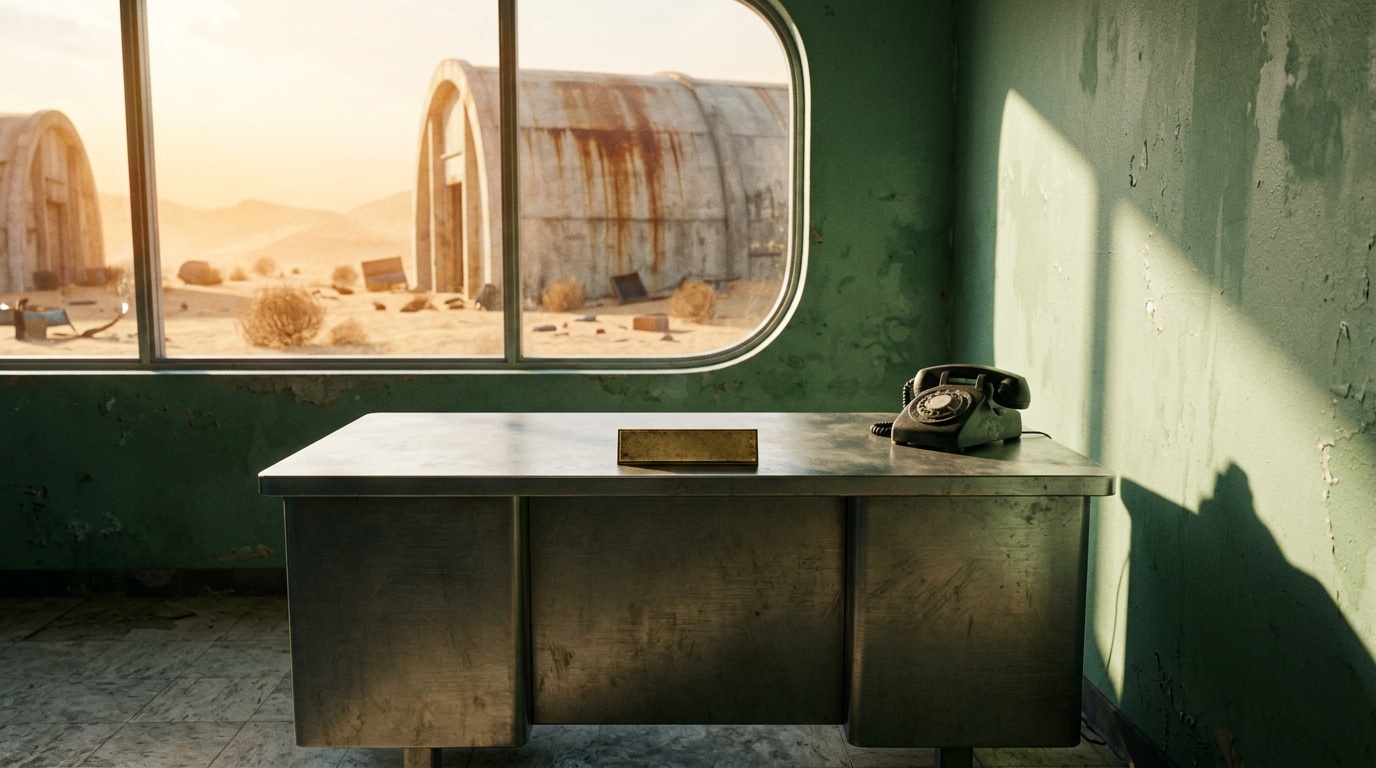
Barb's "Good Vaults" Secret Will Break Cooper
THE THEORY
Barb Howard knows the vault hierarchy is not administrative but experimental, and her refusal to explain what makes certain vaults good is not corporate discretion but the active protection of a choice she has already made about her own position within a system that treats some humans as subjects. The gap between her knowledge and her silence is the structural fracture in the marriage. Cooper is being pulled toward the one man who has named that structure out loud, and the business card he keeps is the first evidence that he believes it.
How This Theory Works
Barb Howard is not withholding corporate policy from her husband. She is withholding the knowledge that she has already decided, on behalf of Vault-Tec, which humans are subjects and which are survivors. That is the claim the theory is pressing toward and the one it needs to commit to.
The gap between what Barb knows and what she will say is the fault line beneath the marriage. When she tells Cooper that her position guarantees them a spot in one of the good vaults, she offers no criterion for what makes the others bad. She deflects, asking him to trust her. That deflection is not marital shorthand. It is the behavior of someone protecting information she has been authorized to protect, and whose continued authorization depends on protecting it. Her mention of a special oversight vault, one that watches the others, is not a reassurance. It is an accidental disclosure of the architecture she is hiding. She occupies the top of a hierarchy she will not describe.
Cooper's revulsion is not ideological drift. His contempt for Bud Askins, whose institutional indifference to soldier deaths he cannot disguise, and his framing of his own home as enemy territory during a Vault-Tec event are not the responses of a man losing faith in a corporation. They are the responses of a man who has already concluded that the people around him have made a specific category of moral choice and are living comfortably inside it. Charlie Whiteknife names the structure directly: when an organization holds more power than the government, the whole town burns. Cooper does not reject this. He keeps the business card.
The show has not confirmed whether Barb is a knowing architect of the experimental vault program or a true believer who has rationalized the hierarchy as necessary. But the more precise reading, grounded in her exactness about placement and her evasiveness about criteria, is that she is not rationalizing anything. She does not need to. She knows what the experimental vaults are for, she knows Cooper is not the kind of man who will accept it, and her silence is not protection of a secret. It is protection of the marriage from the moment it ends. When Cooper eventually learns what the good vaults are good at surviving, the betrayal will not be that Vault-Tec designed a system of human subjects. The betrayal will be that Barb understood the system completely and chose her place in it before she told him to trust her.
Is this theory convincing?
Key Evidence
Barb's "Good Vaults" Evasion
When Cooper asks why certain vaults are better than others, Barb refuses to explain and instead asks him to simply trust her, implying she has classified knowledge about vault tiers she is not permitted or willing to share.
Cooper's "Enemy Territory" Remark
Cooper describes walking among Vault-Tec employees at his own party as going into enemy territory, signaling that his disillusionment has already passed the point of discomfort into active hostility.
Bud Askins and the T-45 Deaths
Bud Askins casually admits that design flaws in the T-45 power armor he helped create killed people, and Cooper's blunt response reveals his contempt for the institutional indifference that framing represents.
Charlie's Cattle Rancher Analogy
Charlie Whiteknife compares Vault-Tec to cattle ranchers who hold more power than the law and warns Cooper that when such imbalances exist, the whole town burns down, directly naming the structure of power Cooper is circling.
Funeral Home Business Card Kept
Cooper does not discard the business card for Charlie's communist cell meeting place, suggesting he is genuinely considering crossing the ideological line rather than simply entertaining Charlie's argument as conversation.
Barb's Special Oversight Vault
Barb tells Cooper they will be placed in a special vault that oversees the others, a detail she offers without elaboration, implying a privileged position within a system whose full architecture she has access to but will not describe.
Other Theories for S1E06
Vault 4's Scientists Were Always Test Subjects
Vault-Tec did not recruit scientists for Vault 4 and later repurpose them as test subjects.
Barb Howard Built the Vault Hierarchy
Barb Howard was not a Vault-Tec employee who happened to secure good placement for her family.
Vault 4's Comfort Is the Cage
Vault 4 is not a community that happens to run experiments.

Charlie's Meetings Are an Anti-Vault-Tec Cell
Charlie Whiteknife's meetings are not a communist cell but the only pre-war institution organized around a specific structural claim: that Vault-Tec's investors required the apocalypse to happen.