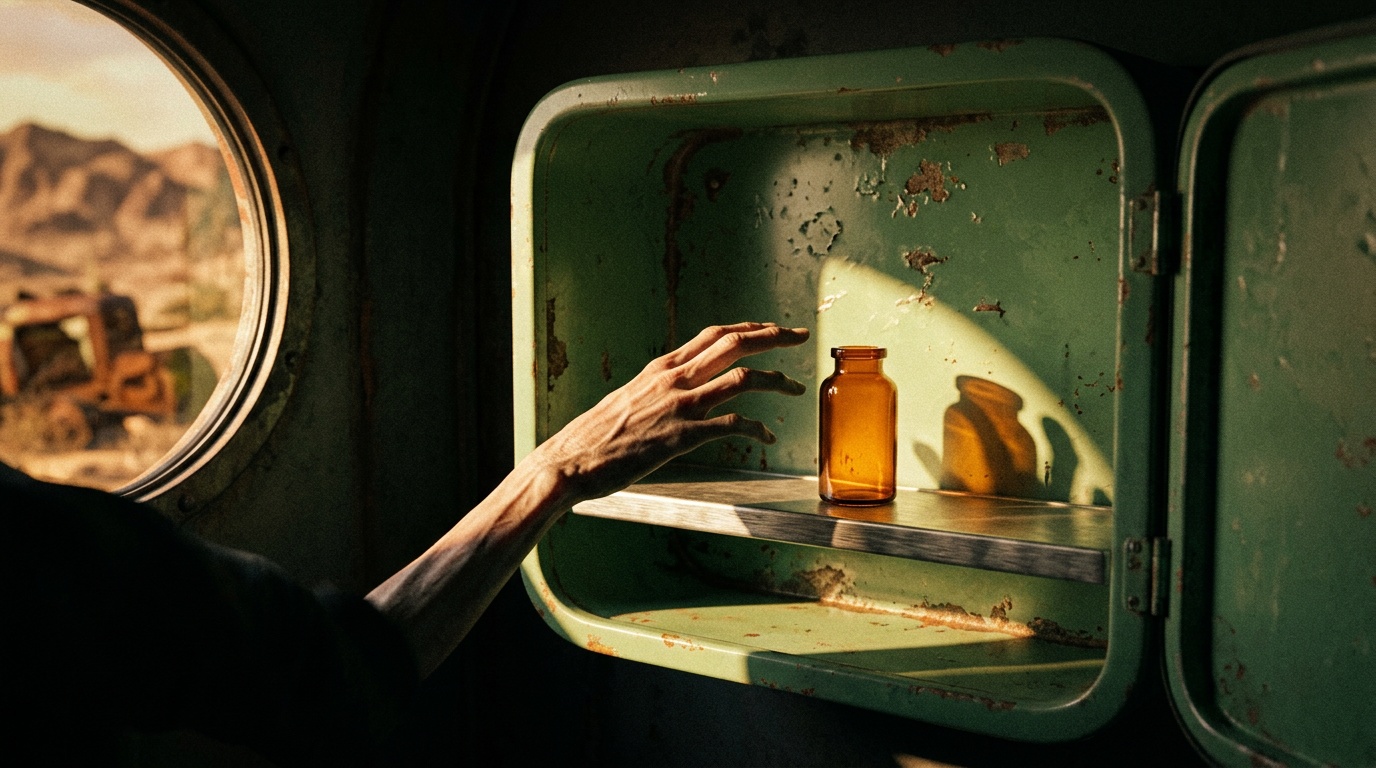
The Vials Are a Supply Chain, Not a Cure — and the Ghoul Is Managing His Own Ferality the Same Way He Managed Roger's
THE THEORY
The vials that keep ghouls human do not treat feralization as a medical condition but sustain a chemical dependency that the vials themselves create, making every human-presenting ghoul an active user managing supply rather than a survivor managing illness. Roger did not die because he was beyond saving; he died because he ran out of access and could not pay. The Ghoul's mercy-killing ritual, his supply negotiations, and his own withdrawal during the trek with Lucy are all evidence of the same drug economy — one the Ghoul cannot exit because he is still inside it.
How This Theory Works
The vials suppress feralization, but the suppression mechanism looks pharmacologically identical to addiction. The Ghoul's coughing fits and visible deterioration during his trek across the desert with Lucy track precisely with his lack of access to the vials he traded her for at the Super Duper Mart. That degradation is fast, physical, and keyed directly to supply interruption — which is withdrawal, not disease progression. When Lucy eventually revives him and leaves the building, the Ghoul does not take a measured dose. He gorges. A patient managing a chronic condition calibrates. Someone who has been in forced withdrawal and suddenly has access consumes compulsively. The show draws that line explicitly, and what it still declines to name is the implication the line creates: if the vials work by satisfying a craving the vials themselves generate, then the mechanism keeping ghouls human is structurally indistinguishable from the mechanism that destroys addicts.
The dosing arithmetic reinforces this. When the Ghoul negotiates his own supply at the Mart, he bargains in terms of two months of stock — a volume and regularity that resembles a dependency schedule, not a therapeutic regimen. Roger's situation makes the dependency framework explicit by showing what happens when supply fails: not accelerated disease, but financial collapse followed by ferality. Roger tells the Ghoul he has been showing signs for twenty-eight years. He did not deteriorate for twenty-eight years because of biology alone. He deteriorated because at some point the supply chain that had been holding the biology in check became something he could no longer afford. Roger's death is not a medical event. It is an economic one. He ran out of supply and could not pay for more, and the Ghoul, who had been managing his own supply chain with considerably more success, arrived too late and with empty pockets of his own. The Ghoul apologizes for having no vials before he begins steering Roger into reminiscence about his mother — which means the killing was already decided when the warmth started. The comfort was not offered while hoping for an alternative. It was offered because the decision was already made, and the Ghoul, who knows exactly what he is managing in himself, extended it with the precision of someone performing a ritual he has rehearsed.
That ritual is the theory's emotional core, and the dependency framework is what makes it legible. The Ghoul does not kill ghouls approaching ferality from a position of detachment or clinical mercy. He kills them from a position of exact identification. He knows what Roger is losing because he is actively losing the same thing, held at bay only by successful supply negotiation. The warmth he engineers — the food memories, the mother, the mid-sentence shot — is not tenderness imposed on a stranger. It is care extended by someone who has already rehearsed his own death in the act, who fires at the moment when the dependency has consumed everything except the part that can still remember being human, because that is the only part worth ending. Each mercy kill is also, structurally, a rehearsal. The Ghoul is not performing compassion. He is performing an act he knows he may one day require someone to perform for him, and he is doing it correctly so the template exists.
The Super Duper Mart sequence confirms the logic is transmissible. Lucy enters the episode horrified by the killing of Roger. She ends it by shooting Martha after exhausting every verbal attempt to reach her. The structure of both scenes is identical: attempt contact, attempt rescue, fail, kill. The episode places these killings in direct sequence, and the only figure who could have modeled that architecture for Lucy — consciously or not — is the Ghoul. What the show withholds is whether Lucy has now internalized his code or simply arrived at the same terminus by the same route. The Ghoul's deflection when Lucy first questions the killing of Roger is not evasion about suffering and not evasion about morality. It is evasion about premises he recognizes she does not yet have access to — specifically, the premise that the vials do not make you safe, they make you dependent, and the distance between where she is and where Roger was is a supply chain, not a species difference.
The line near Santa Monica — 'I'm you, sweetie. You just give it a little time' — is routinely read as a prediction about Lucy's corruption. The dependency framework reads it as a diagnosis of her present. The Ghoul is not forecasting what the wasteland will make her into. He is identifying that she has already crossed the threshold he crossed, that she has already performed the mercy kill, already accepted the logic of the supply chain, already become the kind of person who fires at the right moment. He recognizes the terminus because he passed it and is only still standing because he can still negotiate for vials. When he cannot, the rehearsal ends and someone who learned from him will have to do it correctly.
Is this theory convincing?
Key Evidence
Ghoul Withdrawal Coughing Fits
The Ghoul suffers visible coughing fits and physical deterioration while marching Lucy through the desert, tracking directly with his lack of access to the vials he needs.
Two-Month Supply Negotiation
The Ghoul trades Lucy to the Super Duper Mart operator specifically in exchange for a two-month supply of chems, implying a regular and calculated dosing dependency rather than occasional use.
Post-Revival Gorging on Vials
After Lucy revives him and departs, the Ghoul enters the Super Duper Mart and gorges himself on the available chems and vials, behavior that mirrors compulsive substance use rather than measured treatment.
Roger's Inability to Afford Supply
Roger tells the Ghoul he has been showing signs of going feral for twenty-eight years and that life has been rough, with the Ghoul acknowledging he has no vials to stop his friend from turning, framing access to vials as a financial and logistical dependency.
Ghoul's Deflection About Living This Way
When Lucy asks how he can go on living this way, the Ghoul appears briefly shaken but dodges the question entirely, suggesting the vial dependency is not something he has resolved emotionally or intellectually.
Other Theories for S1E04
Vault 32's Collapse Was Phase One — Vault 33 Is Phase Two
Vault 32's population discovered the nature of the experiment being run on them, destroyed themselves from within, and had been dead for roughly two years before the raiders from Vault 33 ever arrived.

Rose MacLean Let the Raiders In
Rose MacLean opened Vault 32 from the outside using her own registered Pip-Boy, directly enabling or completing the massacre that killed its population two years before the raid on Vault 33.

The Ghoul Is Not Lucy's Antagonist — He Is Her Most Accurate Narrator
Lucy is not losing her principles under wasteland pressure.

Lucy Is Already on the Ghoul Path
Lucy is not in danger of becoming the Ghoul in a metaphorical sense; she is already in the early stages of the same physiological process he underwent, and her inability to stop herself from drinking irradiated water is the first clinical sign.
The Ghoul Is Engineering Lucy's Transformation
The Ghoul is engineering Lucy's psychological transformation not as cruelty or instruction but as a compulsive attempt to re-witness his own collapse from the outside, using her as a mirror for a process he cannot otherwise examine.

The Ghoul Knows the MacLean Name
The Ghoul's visible break in composure at hearing Lucy's surname is recognition, not surprise, and it positions their pairing as a reunion between his buried pre-war history and her unknowing inheritance of it.